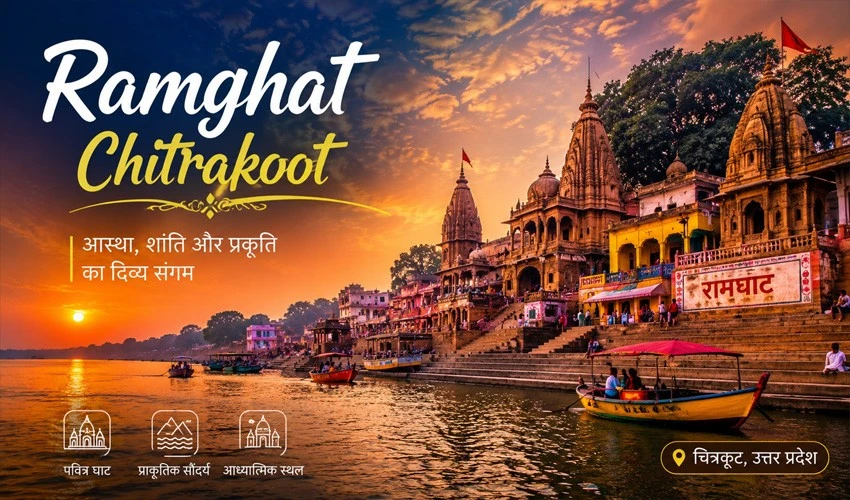
Along the banks of the Mandakini River, where the borders of Uttar Pradesh and Madhya Pradesh quietly meet, lies Ramghat, the spiritual heart of Chitrakoot. Long before it became a stop on pilgrimage itineraries, this stretch of riverbank was, according to Hindu tradition, a resting place for Lord Rama, Sita, and Lakshman during the years they spent in forest exile. That association has shaped everything about Ramghat’s identity ever since, from the stone steps worn smooth by centuries of pilgrims to the evening ritual of lamps and chants that draws visitors back year after year.
Unlike some of India’s more commercialized pilgrimage centres, Ramghat retains a certain rustic, unhurried quality. It is at once a working ghat where locals bathe and wash clothes, a boating spot for tourists, and a site of deep devotional significance where priests recite Vedic hymns as the sun sets over the Mandakini. Understanding its aarti timings, the rituals performed here, and why the site matters so much to devotees helps put the experience into proper context before you visit.
The Story Behind Ramghat
Chitrakoot occupies a central place in the Ramayana. It is described as the location where Lord Rama, accompanied by Sita and Lakshman, settled for a significant portion of their fourteen-year exile after leaving Ayodhya. Ramghat is closely tied to this period, believed to be one of the spots where the trio bathed in the Mandakini and performed their daily rituals during their stay in the forest.
The ghat’s religious identity deepened further through its connection to the poet-saint Tulsidas, the author of the Ramcharitmanas. Local tradition holds that Tulsidas had a direct encounter with Lord Rama, Sita, and Lakshman at Ramghat, and that he spent time sitting by this very riverside while composing verses of his epic retelling of the Ramayana. This layered history, part scriptural memory, part saintly legend, is part of what gives Ramghat its unusual devotional weight compared to an ordinary riverside ghat.
Over the centuries, the ghat has been renovated and expanded by various rulers and devotees, and today its stepped stone embankments, small temples, and riverside shrines reflect a mix of architectural styles built up across different eras rather than a single, uniform design.
Aarti Timings at Ramghat
The evening aarti is, without question, the signature experience at Ramghat, and most visitors plan their day around catching it. While exact timing can shift slightly with the season, the ceremony generally begins around 6:00 PM to 6:30 PM and continues for about an hour. Arriving 15 to 30 minutes early is a good idea, both to find a comfortable spot along the ghat and to soak in the atmosphere as priests set up the lamps and preparations begin.
The ritual itself has visible echoes of the more famous Ganga aarti performed at Varanasi’s ghats, though on a smaller and, many visitors feel, more intimate scale. A group of priests stands at the riverbank facing the Mandakini, holding multi-tiered brass lamps that they move in circular, rhythmic motions while Vedic hymns are chanted. The sound of temple bells, conch shells, and cymbals blends with the chanting, and as darkness falls, devotees light small clay diyas and set them afloat on the water, sending flickering points of light drifting downstream. Compared to the grandeur of the Varanasi aarti, Ramghat’s version is simpler in scale but is often described as carrying an equally strong emotional and spiritual pull, perhaps because of its closer, quieter connection to the forest and river landscape around it.
Beyond the well-known evening ceremony, some devotees also visit early in the morning, roughly between 6:00 AM and 9:00 AM, for a quieter round of rituals and river bathing before the day’s crowds arrive. This is generally a calmer time to experience the ghat, with soft morning light on the water and far fewer visitors compared to the evening rush. Unlike temples with fixed worship hours, Ramghat itself remains open throughout the day, and devotees are free to bathe in the Mandakini and offer personal prayers at their own convenience, without being tied to a specific ritual schedule outside of the main morning and evening windows.
If you’re travelling during major festivals or the Ram Navami season, keep in mind that the ghat gets considerably more crowded, and the aarti draws a much larger gathering than on an ordinary weekday evening.
Rituals and Religious Practices at Ramghat
Ramghat functions as a living centre of worship rather than a static heritage site, and several distinct rituals take place here regularly.
Holy Bathing: The most widespread practice at Ramghat is the ritual bath in the Mandakini River. Devotees believe that a dip in these waters has the power to cleanse a person of past sins, a belief that draws both pilgrims performing a deliberate spiritual practice and casual visitors who simply wish to touch the sacred river associated with Lord Rama.
Evening and Morning Aarti: As described above, the aarti is the most visible communal ritual, performed by resident priests with lamps, chanting, bells, and conches. Devotees participate by standing along the ghat, joining in the chanting, or simply observing quietly, and many choose to release small diyas onto the river as a personal offering during the ceremony.
Puja and Personal Offerings: Beyond the group aarti, individual pujas are commonly arranged at Ramghat for personal blessings, ancestral rites, and specific family ceremonies. Priests stationed at the ghat conduct these on request, and visitors looking for something beyond the standard evening ritual can inquire locally to arrange a more elaborate or customised puja.
Deep Daan (Offering of Lamps): A particularly evocative practice at Ramghat involves floating small oil lamps on the river as an act of devotion, especially striking at dusk when dozens of tiny flames drift along the dark water, reflecting the temple lights and the glow of the main aarti flame.
Boat Rituals and River Crossing: While boating on the Mandakini is partly a leisure activity for tourists, it also carries devotional overtones for many pilgrims, who see the boat ride as a way of experiencing the same river that Lord Rama is believed to have crossed regularly during his stay in Chitrakoot. Decorated boats, some lit with LED lights in the evening, line the ghat, and a shared boat ride typically costs somewhere in the range of ₹100 to ₹200 per person, though it’s worth confirming the rate upfront and being wary of touts asking for inflated prices.
Puja Samagri and Local Preparations: For visitors wanting to perform their own rituals, small stalls near the ghat sell basic puja items, marigold flowers, clay diyas, incense sticks, and other essentials, usually priced modestly enough to be accessible to most pilgrims.
Why Ramghat Holds Such Deep Religious Significance
The religious importance of Ramghat rests on several layers that reinforce one another. At the most fundamental level, it is a site tied directly to Lord Rama’s own presence, not merely a place built later to honour him, but one where tradition holds he actually bathed, rested, and performed rituals alongside Sita and Lakshman. For devotees steeped in Ram-bhakti, or devotion to Lord Rama, this proximity to the events of the Ramayana itself gives Ramghat a different character than a temple constructed purely as a memorial.
The connection to Tulsidas adds a second devotional thread. As the composer of the Ramcharitmanas, one of the most widely revered retellings of the Ramayana in North India, Tulsidas occupies an important place in popular Hindu devotion, and the belief that he encountered Lord Rama in person at this exact spot elevates Ramghat from a scriptural location to a site of living saintly legend as well.
There’s also a symbolic dimension worth noting: the aarti performed here is often understood as an offering not to the royal, enthroned Rama of Ayodhya, but to Rama in his forest-exile form, the wandering figure who chose a life in the wilderness over the comforts of the throne. This distinction matters to many pilgrims, since it frames the Ramghat rituals as a tribute to humility, sacrifice, and simplicity rather than royal grandeur, themes that resonate strongly within the broader devotional tradition surrounding the Ramayana.
Finally, Ramghat’s role as the functional starting point for a wider pilgrimage circuit reinforces its centrality. Nearby sites such as Kamadgiri Hill, where Rama, Sita, and Lakshman are believed to have resided during part of their exile, the Bharat Milap Temple commemorating Bharat’s meeting with his exiled brother, Sphatik Shila with its associated footprint impressions, Janaki Kund, and the Gupt Godavari caves are all typically visited in conjunction with Ramghat, making it the natural anchor point for a Chitrakoot pilgrimage rather than an isolated attraction.
Practical Tips for Visiting
A few practical notes can help make your visit smoother. Dress modestly, as is expected at any active place of worship, and be prepared to remove your footwear at temple premises near the ghat; carrying a small bag to hold your shoes during longer walks or a parikrama is a sensible habit. The stone steps leading down to the water can be slippery, particularly during the monsoon months, so sturdy footwear and a bit of caution go a long way, especially if you’re visiting with elderly family members or young children.
If you plan to take a boat ride, agree on the price beforehand, since some operators are known to quote higher rates to tourists than to locals. Evenings just before the 6:00 PM aarti tend to be the busiest time at the ghat, so if you prefer a quieter, more contemplative visit, an early morning trip between 6:00 AM and 9:00 AM is worth considering instead. Photography is generally welcome along the open ghat area, though it’s best to be mindful and respectful during the aarti itself, and to check locally before photographing inside any temple sanctum.
Final Thoughts
Ramghat is more than a scenic riverside stop on a Chitrakoot itinerary; it is a place where scripture, saintly legend, and everyday devotion continue to intersect. Whether you come for the quiet of a morning bath in the Mandakini, the communal energy of the evening aarti with its lamps and chanting, or simply to sit by the water and take in a landscape closely tied to the Ramayana, Ramghat offers a distinctly personal kind of pilgrimage experience, one built as much around atmosphere and memory as around ritual itself.