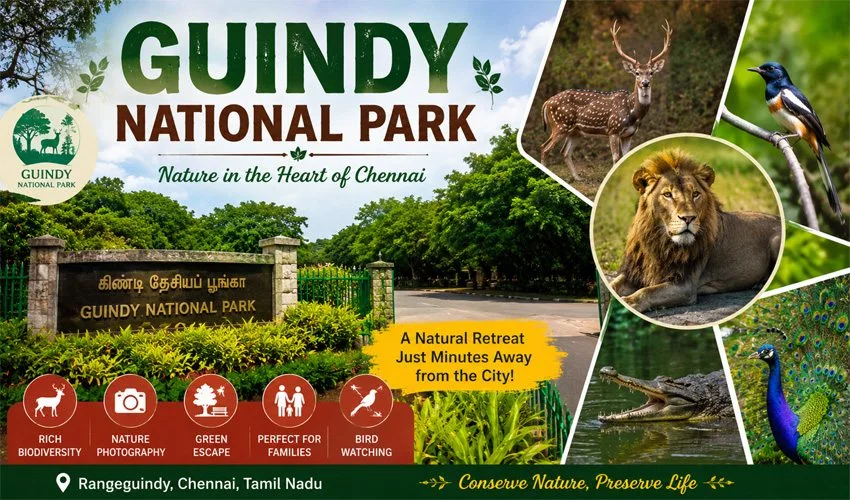
Nestled in the bustling metropolis of Chennai, Guindy National Park stands as a remarkable testament to nature’s resilience amid rapid urbanization. Covering just a small area within one of India’s largest cities, this unique protected forest is recognized as one of the country’s smallest national parks. Despite its modest size, Guindy National Park plays a significant role in biodiversity conservation, environmental education, and urban ecology.
Unlike many national parks located in remote wilderness regions, Guindy National Park offers visitors the rare opportunity to experience wildlife and natural habitats within a thriving urban landscape. The park serves as a green oasis, providing refuge to numerous species of plants, animals, birds, reptiles, and insects while offering city residents a peaceful escape from the fast-paced urban environment.
History of Guindy National Park
The origins of Guindy National Park date back to the colonial era when the area formed part of the grounds surrounding the Governor’s Estate in Chennai. Initially preserved as a private forest area, it remained relatively untouched even as the city expanded around it.
Recognizing its ecological importance, the Government of India declared the area a national park in 1978. This designation helped protect its unique ecosystems and biodiversity from the pressures of urban development. Today, Guindy National Park remains one of the few national parks situated entirely within a city, making it a rare conservation success story.
The park also serves as an important reminder of Chennai’s natural heritage. Long before the city’s growth transformed the landscape, the region was characterized by tropical dry evergreen forests, grasslands, and scrub vegetation. Guindy National Park preserves a valuable fragment of this original ecosystem.
Location and Accessibility
Guindy National Park is located in the Guindy area of Chennai, Tamil Nadu. Its strategic location makes it one of the most accessible national parks in India.
The park lies close to major landmarks such as:
- Chennai International Airport
- IIT Madras
- Anna University
- Raj Bhavan
- Guindy Railway Station
Visitors can easily reach the park using public transportation, including buses, suburban trains, metro services, taxis, and private vehicles. Its central location makes it a popular destination for tourists, students, families, and nature enthusiasts.
Size and Unique Significance
One of the most fascinating aspects of Guindy National Park is its size. Covering approximately 2.7 square kilometers, it is among the smallest national parks in India.
While larger parks such as Jim Corbett National Park, Kaziranga National Park, and Ranthambore National Park span hundreds or even thousands of square kilometers, Guindy National Park demonstrates that conservation success is not solely dependent on size.
Its importance lies in:
- Protecting urban biodiversity
- Preserving native vegetation
- Supporting environmental education
- Providing habitat for wildlife
- Serving as a research and conservation center
The park proves that even small protected areas can make significant contributions to environmental sustainability.
Rich Biodiversity Within a Small Area
Despite its compact size, Guindy National Park supports a surprising variety of flora and fauna.
Mammals
The park is home to several mammal species, including:
- Blackbuck
- Spotted deer (Chital)
- Jackals
- Small Indian civets
- Mongooses
- Indian hares
Among these, the blackbuck is particularly noteworthy. This elegant antelope species is protected within the park and serves as one of its most iconic residents.
The spotted deer population is another major attraction for visitors, who can often observe these graceful animals grazing in open areas.
Birdlife
Birdwatchers find Guindy National Park especially rewarding due to its diverse avian population.
Commonly spotted birds include:
- Indian peafowl
- Parakeets
- Kingfishers
- Cormorants
- Drongos
- Koels
- Mynas
- Egrets
- Herons
The park attracts both resident and migratory birds throughout the year, making it an excellent destination for bird photography and wildlife observation.
Reptiles and Amphibians
Several reptile species inhabit the park, including:
- Indian python
- Monitor lizards
- Garden lizards
- Various snake species
- Turtles
The presence of reptiles indicates the ecological health of the protected area and contributes to the park’s biodiversity.
Insects and Butterflies
The park supports numerous insect species that play crucial roles in pollination and ecosystem functioning.
Visitors can frequently observe:
- Butterflies
- Dragonflies
- Beetles
- Honeybees
- Moths
These smaller creatures contribute significantly to the park’s ecological balance.
Flora of Guindy National Park
Guindy National Park preserves an important section of tropical dry evergreen forest, one of the rarest forest types in India.
The vegetation includes:
- Native trees
- Shrubs
- Grasslands
- Climbers
- Medicinal plants
Prominent tree species found in the park include:
- Neem
- Banyan
- Tamarind
- Acacia
- Pongamia
These plants provide shelter, food, and breeding grounds for countless wildlife species while helping maintain ecological stability within the urban environment.
Children’s Park: A Family Attraction
One of the most popular attractions associated with Guindy National Park is the Children’s Park.
Designed to educate and entertain young visitors, the facility houses various animals and birds in a controlled environment. It provides children with an opportunity to learn about wildlife conservation while observing animals up close.
The Children’s Park features:
- Deer enclosures
- Aviaries
- Reptile exhibits
- Educational displays
- Nature awareness programs
Families visiting Chennai often include this attraction in their sightseeing itinerary.
Snake Park: Promoting Wildlife Awareness
Adjacent to Guindy National Park is the famous Snake Park, established by renowned herpetologist Romulus Whitaker.
The Snake Park plays an important role in:
- Snake conservation
- Public education
- Wildlife rescue
- Research initiatives
Visitors can observe various species of snakes, crocodiles, turtles, and lizards while learning about the ecological importance of reptiles.
The facility helps dispel myths and misconceptions surrounding snakes and encourages wildlife conservation awareness.
Environmental Importance of Guindy National Park
The ecological significance of Guindy National Park extends far beyond its boundaries.
Improving Air Quality
The dense vegetation helps absorb pollutants and improve air quality in Chennai’s urban environment.
Reducing Urban Heat
The park acts as a natural cooling zone, helping mitigate the urban heat island effect commonly experienced in large cities.
Carbon Sequestration
Trees and plants within the park absorb carbon dioxide, contributing to climate change mitigation efforts.
Supporting Biodiversity
The protected habitat allows wildlife populations to survive despite increasing urbanization.
Educational Value
Students, researchers, and environmental organizations frequently use the park for educational and scientific purposes.
Conservation Challenges
Like many urban protected areas, Guindy National Park faces several challenges.
Urban Expansion
Continuous city growth places pressure on surrounding natural habitats.
Pollution
Air, noise, and water pollution can impact wildlife health and ecosystem stability.
Human Disturbance
Increasing visitor numbers require careful management to minimize ecological disruption.
Climate Change
Changing weather patterns can affect vegetation, water availability, and wildlife behavior.
To address these challenges, authorities continue implementing conservation programs focused on habitat protection, public awareness, and scientific monitoring.
Best Time to Visit
The ideal time to visit Guindy National Park is between November and February.
During these months:
- Temperatures remain pleasant.
- Wildlife activity is more visible.
- Birdwatching opportunities increase.
- Outdoor exploration becomes more comfortable.
Although the park remains accessible throughout much of the year, summer temperatures in Chennai can be quite high.
Visitor Tips
To make the most of your visit, consider the following tips:
- Visit during early morning hours.
- Carry water and stay hydrated.
- Wear comfortable walking shoes.
- Bring binoculars for birdwatching.
- Avoid disturbing wildlife.
- Follow park rules and regulations.
- Carry a camera for nature photography.
Responsible tourism helps ensure the park remains protected for future generations.
Why Guindy National Park Matters
Guindy National Park demonstrates that meaningful conservation can occur even within densely populated urban areas. Its existence challenges the notion that wildlife protection requires vast remote landscapes. Instead, it highlights how carefully managed green spaces can preserve biodiversity while enriching urban life.
The park serves as a living laboratory for ecological research, a sanctuary for wildlife, and a source of environmental education for countless visitors. Its role in maintaining ecological balance within Chennai cannot be overstated.
As cities continue expanding across India, Guindy National Park offers a valuable model for integrating conservation into urban planning and development.
Conclusion
Guindy National Park may be one of India’s smallest national parks, but its impact is remarkably large. Situated in the heart of Chennai, this protected area preserves a unique ecosystem, supports diverse wildlife, and provides countless educational and recreational opportunities.
From blackbucks and spotted deer to colourful birds and native forests, the park showcases the richness of urban biodiversity. It stands as a symbol of successful conservation in a rapidly growing city and reminds us of the importance of protecting natural spaces regardless of their size.
Whether you are a wildlife enthusiast, student, photographer, or traveller exploring Chennai, Guindy National Park offers an unforgettable glimpse into nature thriving amidst urban life.