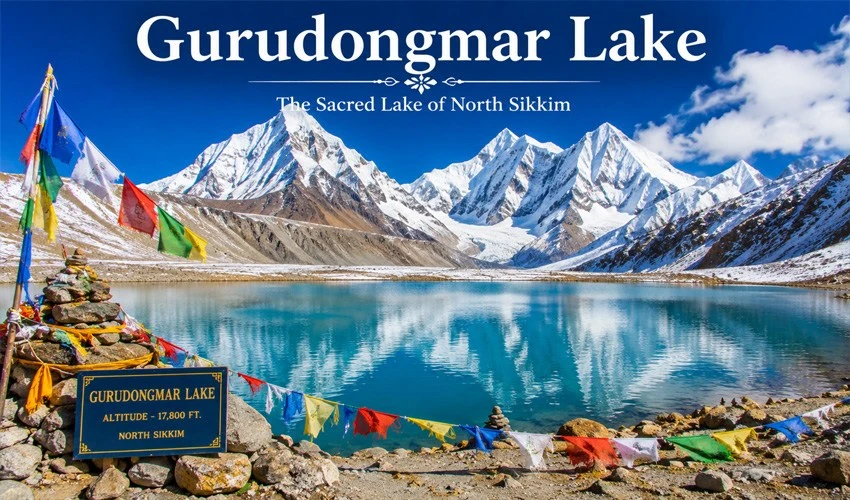
Somewhere in the far north of Sikkim, past the last village and beyond the last patch of green, the road climbs into a world made almost entirely of rock, sky, and silence. It is here, at a jaw-dropping altitude of roughly 17,100 to 17,800 feet above sea level, that Gurudongmar Lake sits like a mirror dropped into the Himalayas. Ringed by snow-capped peaks and fed by ancient glaciers, this is one of the highest lakes not just in India, but in the entire world — and for travelers willing to make the journey, it offers an experience unlike almost anywhere else on the map.
Where the Sky Meets the Water
Gurudongmar Lake lies in the Mangan district of North Sikkim, just a handful of kilometers from the Indo-China border and roughly 190 kilometers from Gangtok, the state capital. To reach it, travelers typically drive through Lachen, a small mountain town that serves as the last major stop before the high-altitude wilderness begins. From there, the route winds through Thangu and across increasingly barren, rocky terrain until the lake finally appears — a shimmering expanse of emerald-blue water framed by some of the tallest mountains on Earth.
The lake itself covers around 118 hectares, with a shoreline stretching more than five kilometers. Its waters are fed by the surrounding glaciers, and it acts as one of the sources of the Teesta River, one of the most important waterways in the eastern Himalayan region. Despite its size, the surrounding mountains and glacial terrain often make the lake appear more modest than it truly is, adding to the sense that you’ve stumbled upon something quietly enormous rather than something built to impress.
A Lake Wrapped in Legend
Few natural landmarks in India carry as much spiritual weight as Gurudongmar Lake. It takes its name from Guru Padmasambhava, also known as Guru Rinpoche, the revered figure credited with bringing Buddhism to Tibet in the 8th century. According to local legend, the guru passed through this remote region during a time when villagers were suffering from a severe lack of drinking water. Moved by their hardship, he is said to have touched the lake with his staff, blessing it and ensuring that even during the harshest winters, a portion of the water would never freeze.
That legend still shapes how the lake is treated today. Even in the depths of a Himalayan winter, when temperatures plunge far below zero and most of the lake’s surface turns to solid ice, a small patch of water is said to remain unfrozen year-round. Whether one views this as a matter of faith or simply an unusual microclimate effect caused by underground springs, it hasn’t stopped generations of pilgrims from treating the sight as proof of the lake’s sacred nature.
This spiritual significance isn’t limited to one faith. Gurudongmar Lake is considered holy by Hindus, Buddhists, and Sikhs alike, making it a rare example of a natural site that draws devotees from multiple religious traditions to the same remote shoreline. Prayer flags flutter along the edges of the lake, snapping in the thin mountain wind, adding bursts of color to an otherwise stark, monochrome landscape of rock and snow.
The View That Takes Your Breath Away — Literally
At close to 17,000 feet, the thin air here does more than create a dramatic backdrop; it also makes its presence felt in a very physical way. Oxygen levels are noticeably lower than at sea level, and many visitors experience some symptoms of altitude sickness, ranging from mild headaches and shortness of breath to more serious discomfort. This is one of the reasons visits to the lake are carefully timed and typically brief, with most tour operators recommending an early start from Lachen — often around four or five in the morning — to reach the lake by sunrise and depart again before midday, when weather conditions can shift rapidly and unpredictably.
Despite the physical challenge, almost everyone who makes the journey agrees it’s worth it. Standing at the edge of the lake, surrounded by towering peaks including views of Mount Siniolchu and Kangchenjunga in the distance, there’s a sense of scale that’s hard to describe. The mountains seem to rise directly out of the water, their snow-covered slopes reflected almost perfectly on calm days. It’s the kind of view that makes you forget, for a moment, just how hard your lungs are working to keep up.
Wildlife and Flora in an Unlikely Place
Given the extreme altitude and harsh climate, it would be easy to assume that Gurudongmar Lake is a lifeless, frozen expanse. In reality, the region supports a surprising amount of life adapted to these conditions. Blue sheep and yaks are occasionally spotted grazing on the sparse vegetation nearby, their presence a quiet reminder that even this seemingly inhospitable environment sustains its own ecosystem.
During the brief window of spring and early summer, the otherwise barren valleys leading up to the lake burst into color as rare high-altitude flowers bloom, including the delicate blue poppy, a flower so closely associated with this fragile ecosystem that spotting one feels like a small reward for the difficult journey. These seasonal blooms transform the landscape, softening the starkness of the rock and ice with unexpected patches of color.
Planning Your Visit
Because of its remote location and extreme altitude, a trip to Gurudongmar Lake requires more preparation than an average sightseeing excursion. The lake is generally accessible to visitors from April through November, depending on road and weather conditions, with the harsh winter months making the route largely impassable. Indian citizens are required to obtain a permit to travel beyond Lachen, while foreign nationals currently face restrictions that prevent them from continuing to the lake itself, making it a destination primarily experienced by domestic travelers.
There are no accommodation options near the lake itself; Lachen, roughly 65 kilometers away, serves as the nearest base for travelers, offering a range of guesthouses and small hotels suited to high-altitude travel. Most itineraries treat Gurudongmar Lake as a day trip from Lachen or as part of a broader North Sikkim tour that also includes stops like Lachung and the strikingly beautiful Yumthang Valley, often nicknamed the “Valley of Flowers” for its own seasonal blooms.
Travelers should pack warm layers regardless of the season, since temperatures at this altitude remain cold even during the relatively milder months. Given the risk of altitude sickness, it’s wise to spend a day or two acclimatizing in Lachen or Gangtok before attempting the journey, stay well hydrated, and avoid overexertion once at the lake. Anyone with pre-existing heart or respiratory conditions should consult a doctor before planning a visit, as the reduced oxygen levels can pose real risks.
Why It’s Worth the Journey
There are easier lakes to visit in India — ones with paved paths, boating facilities, and comfortable nearby cafés. Gurudongmar Lake is not one of them. Getting here demands effort: long hours on rough mountain roads, the physical strain of high altitude, and careful planning around permits and weather. But that difficulty is precisely what makes the destination so remarkable. Few places allow you to stand at nearly the same elevation as some of the world’s most famous mountain base camps, surrounded by glacier-fed water considered sacred by three major religions, all within a single-day excursion from a small Himalayan town.
For travelers who crave landscapes that feel genuinely untouched, places where nature’s scale dwarfs anything man-made, Gurudongmar Lake offers something increasingly hard to find. It’s not simply a lake to look at — it’s a place to feel small in the best possible way, to catch your breath in the thin air, and to understand, if only briefly, why generations of pilgrims have made the difficult climb to its shores. If you’re planning a trip through North Sikkim and are prepared for the altitude, this extraordinary high-altitude lake deserves a place at the very top of your list.