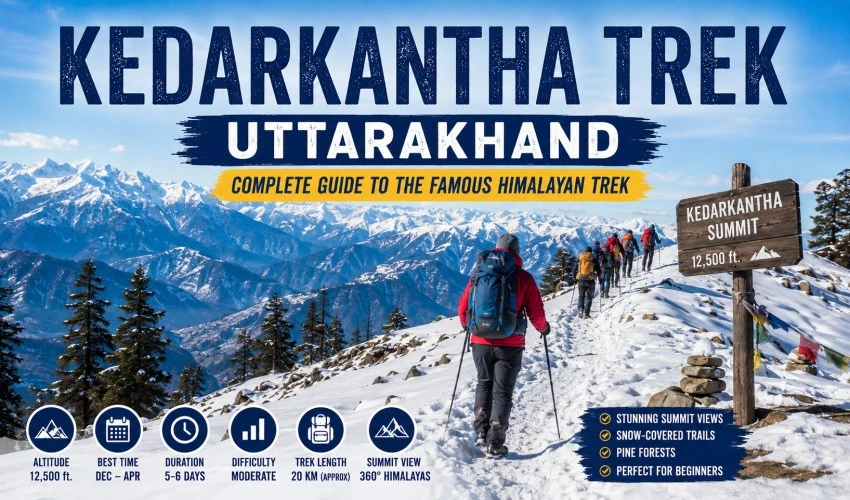
Tucked away in the Govind Wildlife Sanctuary of Uttarakhand, the Kedarkantha trek has quietly become one of the most sought-after winter treks in the Indian Himalayas. Every season, thousands of trekkers — from first-timers lacing up their boots for the very first time to seasoned mountain lovers chasing fresh snow — make their way to this modest 12,500-foot summit in the Govind National Park region. What draws them isn’t sheer altitude or technical difficulty. It’s the rare combination of accessibility, drama, and reward that Kedarkantha offers in equal measure.
This guide walks you through everything you need to know before you set off: the route, the best time to go, permits, packing essentials, and a few honest tips that can make the difference between an enjoyable trek and a miserable one.
Why Kedarkantha Is So Popular
Kedarkantha sits in a sweet spot that few Himalayan treks manage to occupy. It’s short enough to complete in five to six days, yet the summit view rivals treks that demand two weeks and serious mountaineering experience. From the top, trekkers are rewarded with an unbroken panorama of snow-capped giants — Swargarohini, Bandarpoonch, Black Peak, and the Kinnaur range are all visible on a clear day, stretching out in every direction like a frozen sea.
The trail itself moves through dense pine and oak forests, past frozen meadows locally called bugyals, and through the tiny hamlet of Juda Ka Talab, a high-altitude lake that often freezes solid in peak winter. Unlike many Himalayan routes that feel barren and exposed, Kedarkantha’s forested lower stretches give way gradually to open ridgelines, so the landscape keeps changing every single day — never monotonous, always building anticipation for the summit.
Add to this the fact that the base villages are only a half-day’s drive from Dehradun, and you have a trek that fits comfortably into a long weekend without sacrificing the sense of genuine wilderness.
Best Time to Do the Kedarkantha Trek
Kedarkantha is primarily known as a winter trek, though it’s technically doable across several months, each offering a distinctly different experience.
December to April is when the trek truly shines. This is peak snow season, and Kedarkantha earns its reputation as one of the best snow treks in India during these months. January and February typically bring the heaviest snowfall, transforming the entire trail into a white wonderland, with snow depths at the summit sometimes exceeding several feet. This is also when the trek attracts the largest crowds, so campsites can get busy.
Late April to June offers a completely different flavor — the snow retreats, meadows turn green, and rhododendrons bloom along lower sections of the trail. Days are pleasant, nights are cold but manageable, and the trekking conditions are generally easier underfoot without the risk of slipping on ice.
September to November, the post-monsoon window, brings clear skies and excellent visibility, ideal for photography, though the landscape lacks the drama of fresh snow.
Most trekkers, however, come specifically for the snow experience, and if that’s your goal, aim for late December through February.
Kedarkantha Trek Route: Day-by-Day Breakdown
The classic Kedarkantha itinerary typically spans five to six days, including a buffer day for weather or altitude adjustment. Here’s how a standard trek usually unfolds.
Day 1: Arrival at Sankri Most treks begin with a road journey from Dehradun to Sankri, a scenic drive of roughly eight to nine hours that winds through the Mussoorie hills and along the Tons River valley. Sankri, perched at around 6,400 feet, serves as the base village and last point with proper guesthouses, shops, and mobile connectivity.
Day 2: Sankri to Juda Ka Talab The actual trek begins here, gaining roughly 3 kilometers through dense pine forest before reaching Juda Ka Talab, a picturesque frozen lake at around 9,100 feet. Local legend holds that a wedding procession once vanished into this lake, giving it its evocative name. This camp offers one of the most photogenic settings on the entire route.
Day 3: Juda Ka Talab to Kedarkantha Base Camp A moderately steep climb through thinning forest leads to the base camp at approximately 11,250 feet. As trees give way to open slopes, the first real views of the surrounding peaks start to appear, building excitement for the summit push ahead.
Day 4: Summit Day — Base Camp to Kedarkantha Peak and back to Hargaon This is the heart of the trek. Trekkers typically start well before sunrise, often around 2 or 3 AM, to reach the 12,500-foot summit in time for sunrise. The final stretch is a steep, exposed ridge climb, and in winter it’s often covered in fresh snow, making the ascent both thrilling and physically demanding. The 360-degree view from the top makes every step worthwhile. After spending time at the summit, trekkers descend back to base camp and continue further down to Hargaon campsite.
Day 5: Hargaon to Sankri A relatively easy descent through forest trails brings trekkers back to Sankri, marking the end of the trekking portion of the journey.
Day 6: Sankri to Dehradun The return drive to Dehradun, often used as a buffer day in itineraries to account for weather delays.
Total trekking distance covers roughly 20 kilometers round trip, with the highest point reached at the summit.
Difficulty Level
Kedarkantha is widely classified as an easy-to-moderate trek, making it an excellent choice for beginners. That said, “easy” is relative in the mountains. The summit day involves a steep, sustained climb, often on snow or ice, and altitude sickness — while uncommon at this elevation — can still affect trekkers who ascend too quickly or don’t stay hydrated.
Basic fitness is essential. Anyone attempting this trek should be able to walk 5 to 6 kilometers comfortably and ideally should prepare with a few weeks of cardio training, such as jogging, stair climbing, or cycling, before departure. Previous trekking experience isn’t mandatory, but a reasonable fitness baseline genuinely improves the experience and reduces fatigue-related risks.
Permits and Registration
Since the trail passes through the Govind Wildlife Sanctuary and National Park, forest permits are mandatory for every trekker. These are usually arranged by trekking operators as part of the package, but independent trekkers need to secure them at the forest checkpoint in Sankri, along with a valid government-issued photo ID. Carrying multiple photocopies of your ID is a good practice, as forest officials and local checkpoints often ask for documentation.
How to Reach the Base Village
The journey to Kedarkantha begins at Dehradun, the nearest major city with an airport and railway station.
- By Air: Jolly Grant Airport in Dehradun is the closest airport, with regular flights from Delhi and other major cities.
- By Rail: Dehradun Railway Station has good connectivity from Delhi and other parts of the country.
- By Road: From Dehradun, Sankri is roughly 200 kilometers away, a drive that takes about eight to nine hours through winding mountain roads via Mussoorie, Purola, and Mori. Shared taxis and buses are available, though most trekkers prefer arranging a direct vehicle, especially in winter when road conditions can be unpredictable.
Packing Essentials for Kedarkantha
Packing smart matters more on Kedarkantha than the distance might suggest, since temperatures at higher camps can drop well below freezing, especially between December and February.
Clothing: Layering is the golden rule. Pack thermal inners, a fleece or woolen layer, and a good quality down jacket for the outer layer. Waterproof and windproof outer shells are essential for summit day. Don’t skip proper trekking pants, woolen socks, gloves, and a warm cap that covers the ears.
Footwear: Waterproof trekking shoes with good ankle support and solid grip are non-negotiable, particularly on snow-covered and icy stretches.
Gear: A daypack (if porters are carrying the main load), trekking poles for stability on snow, headlamp with extra batteries for the pre-dawn summit push, and gaiters to keep snow out of your shoes.
Other essentials: Sunglasses with UV protection (snow glare is intense), sunscreen, a personal water bottle or thermos, basic first-aid supplies, and any personal medication.
Most reputed trekking operators provide detailed packing lists and, in many cases, can arrange gear rentals in Sankri or Dehradun for items like sleeping bags and jackets.
Accommodation and Camping
On the trek itself, accommodation is entirely tented, with trekking agencies typically providing dome or alpine tents shared between two or three people, along with sleeping bags rated for sub-zero temperatures. In Sankri, guesthouses and homestays offer basic but comfortable rooms with hot water, a welcome comfort before and after the trek.
Tips for a Safe and Enjoyable Trek
A few practical pointers can significantly improve your experience on Kedarkantha. Start physical preparation at least three to four weeks in advance, focusing on stamina and leg strength. Stay well hydrated throughout the trek, since cold, dry mountain air dehydrates the body faster than people expect, even without visible sweating. Walk at your own pace rather than matching faster trekkers, since pacing yourself reduces fatigue and altitude-related discomfort.
Choose a trusted trekking operator with experienced guides, especially if this is your first Himalayan trek, since local knowledge of weather patterns and trail conditions is invaluable in winter. Finally, always carry cash, since ATMs are unreliable or entirely absent once you leave Dehradun, and Sankri has very limited banking facilities.
Final Thoughts
Kedarkantha earns its reputation as one of India’s most beloved Himalayan treks for good reason. It offers a genuine high-altitude, snow-covered summit experience without demanding technical mountaineering skills or weeks of vacation time. Whether you’re chasing your first taste of snow trekking or looking for a reliable winter escape into the mountains, Kedarkantha delivers forest trails, frozen lakes, and a summit view that stays with you long after the trek ends.
Plan your dates around the season that matches what you’re looking for, prepare your body and gear properly, and Kedarkantha will reward you with one of the most memorable mountain experiences the Indian Himalayas have to offer.