Tucked away in the Kullu district of Himachal Pradesh, Jalori Pass sits at an elevation of roughly 3,120 metres (10,236 feet), connecting the Kullu valley with the Anni-Banjar region and the remote Seraj valley beyond. It’s one of those places that rewards travellers who venture past the usual Manali-Shimla circuit — meadows carpeted in wildflowers, dense deodar forests, alpine lakes like Serolsar just a short trek away, and views that stretch across snow-dusted ridgelines on a clear day. But Jalori Pass is also a place where timing matters enormously. Get the season right and you’ll have one of the most rewarding drives and treks in the state. Get it wrong, and you could be staring at a closed road, waist-deep snow, or a landslide-hit trail. This guide breaks down exactly when to go, what the weather does throughout the year, how snowfall shapes accessibility, and what the road conditions actually look like season by season.
Where Exactly Is Jalori Pass
Jalori Pass lies between Banjar and Ani in the Kullu district, roughly 130 km from Shimla and about 65 km from Kullu town. It’s the gateway to some of Himachal’s most underrated destinations — Jibhi, Shoja, Tirthan Valley, and the Great Himalayan National Park all sit within striking distance. The pass itself is a narrow ridge with a small temple, a handful of tea stalls, and a trailhead leading up to Raghupur Fort and Serolsar Lake. Because of its altitude and its position along a relatively narrow mountain road, the pass experiences a much sharper seasonal swing than the valleys below it, which is exactly why planning around the calendar matters so much here.
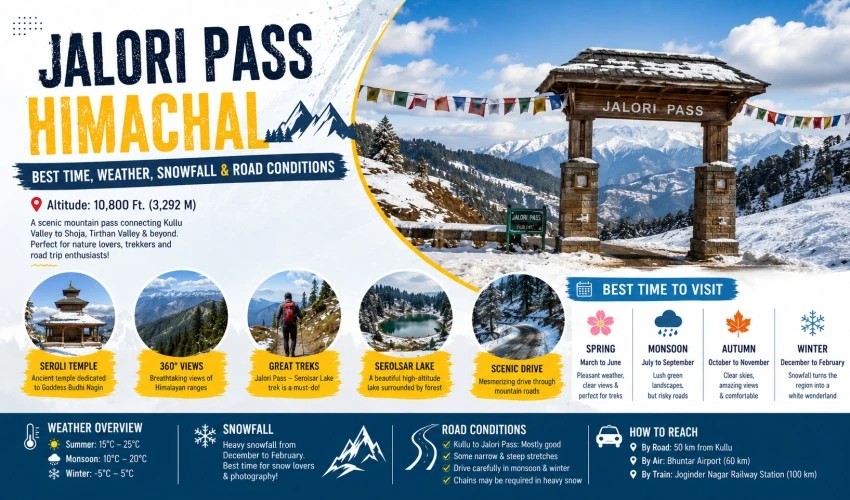
Best Time to Visit Jalori Pass
The short answer is that Jalori Pass is at its most accessible and scenic between March and June, and again from late September to November. Each of these windows offers a distinctly different experience, so it’s worth understanding what each season actually delivers rather than picking dates at random.
March to June: The Prime Window
This is when most visitors make the trip, and for good reason. By March, the heaviest snow has usually started melting from the lower stretches of the road, though patches can linger at the top well into April in a heavy snow year. April and May bring the meadows to life — rhododendrons bloom in the forests below the pass, the grass turns a vivid green, and visibility on clear days is excellent. June is arguably the sweet spot: the road is fully open, temperatures are pleasant even at altitude, and the trek to Serolsar Lake through the pine and oak forest is at its most comfortable. This period also aligns with the broader travel season for Himachal, so nearby Jibhi and Tirthan Valley are lively without being overcrowded the way Manali or Shimla can get.
July to Mid-September: Monsoon Caution
The monsoon turns Jalori Pass green and dramatic, with clouds rolling through the valley in a way that photographers love, but it’s also the riskiest period to visit. Landslides and slippery, narrow stretches of road are common, and the pass can be cut off for hours or days after heavy rain. If you do travel during this window, treat it as a trip that requires flexibility and a genuine willingness to turn back if conditions look unsafe.
Late September to November: The Quiet Second Window
Once the monsoon clears out, Jalori Pass enters another excellent phase. Skies are usually crisp and clear, the forest floor is still damp and green from the rains, and the crowds thin out considerably compared to peak summer. Early November can bring the first light snow at higher points, which is a bonus for travellers who want a taste of winter without the road being fully blocked.
December to February: For Snow Seekers Only
Winter transforms Jalori Pass into a genuinely snowbound landscape, but this comes with serious accessibility caveats covered in detail below. If your goal is specifically to see snow and you’re prepared for a much more limited, weather-dependent trip, this is the season — but it is not the season for a relaxed, guaranteed drive over the pass.
Weather at Jalori Pass Through the Year
Because of its altitude, Jalori Pass runs noticeably colder than towns like Kullu or Mandi at almost any time of year, and the weather can shift quickly even within a single day.
Spring (March–May): Daytime temperatures typically range from around 10°C to 18°C, dropping close to freezing or just below at night in March, and warming up by May. Mornings are often crisp and clear, with clouds building up by afternoon.
Summer (June–August): June days are pleasant, generally between 15°C and 22°C, making it the most comfortable stretch for trekking. From July onward, monsoon moisture rolls in, and while temperatures stay mild, humidity and cloud cover increase sharply, along with the chance of sudden rain.
Autumn (September–November): This is when the air is at its clearest. Daytime temperatures hover between 10°C and 18°C in September, cooling to single digits by November. Nights get progressively colder, and by late November you can expect near-freezing conditions after dark.
Winter (December–February): This is genuinely cold, with daytime highs often struggling to get past 5°C to 8°C on sunny days, and sub-zero temperatures common overnight. Wind chill at the pass itself makes it feel considerably colder than the thermometer suggests, especially once snow is on the ground.
A practical note regardless of season: mountain weather at this altitude can change within hours. A clear morning doesn’t guarantee a clear afternoon, so it’s worth checking a short-range forecast the evening before and morning of your trip rather than relying on a forecast checked days in advance.
Snowfall at Jalori Pass
Snowfall is really the defining factor that shapes when Jalori Pass is usable and when it isn’t.
The first snow of the season typically arrives in late November or early December, often as a light dusting that melts within a day or two if temperatures rise. By mid-to-late December, snowfall becomes more sustained, and the pass usually sees its first proper accumulation that doesn’t immediately melt.
January and February are the peak snow months. It’s common for the pass to be under one to several feet of snow during this period, with the exact depth varying significantly year to year depending on how active the winter weather systems are. In heavier snow years, drifts can pile up considerably higher along the roadside where ploughing pushes snow to the edges.
Snow typically begins melting from lower elevations by early-to-mid March, but the pass itself, being the highest point on the route, tends to hold onto snow longer than the approach roads from either Banjar or Ani. It’s not unusual for patches of old, hardened snow to remain at the very top of the pass into April, even as the surrounding slopes turn green.
For travellers specifically chasing snow, the most reliable window is late December through February, with the understanding that this is also when the road is least predictable (more on that below). If you want snow with a better chance of a passable road, the tail end of the snow season — early-to-mid March in a lighter snow year — can sometimes offer the best of both, though this varies considerably from year to year.
Road Conditions at Jalori Pass
Road conditions are really the practical crux of planning a Jalori Pass trip, and they shift dramatically with the seasons.
March to June: Roads are generally in their best condition of the year during this stretch, especially from April onward once meltwater has cleared and local authorities have had a chance to repair any winter damage. The road is narrow and winding with sharp hairpin bends in places, so it demands careful driving, but under dry conditions it’s manageable for most vehicles, including hatchbacks, though a vehicle with reasonable ground clearance is still preferable given some rough patches.
July to mid-September: This is the most unpredictable period for road conditions. Monsoon rain regularly triggers landslides and slips along the Kullu-Banjar-Jalori stretch, and the road surface can turn slick and rutted. Sections may be temporarily closed for clearing after heavy rain, and even when open, expect slower going and reduced visibility due to fog and low cloud. If you’re driving yourself, a vehicle with good tyres and confident handling on wet mountain roads is important; if you’re not experienced with monsoon mountain driving, this is a season where hiring a local driver is a genuinely good idea.
Late September to November: Roads dry out and stabilise well during this window, making it nearly as good as the spring season for driving. Occasional early snow at the very top in November can catch drivers off guard, so it’s worth checking recent conditions if you’re travelling in the back half of the month.
December to February: This is where road access becomes genuinely uncertain. Once heavy snowfall sets in, the stretch right at and near the top of the pass frequently becomes impassable for regular vehicles, and in many winters it’s closed to traffic altogether for extended periods. Local authorities do attempt snow clearance, but this depends on resources and the severity of the snowfall, and clearance can take days after a heavy spell. Even when technically open, ice on the road surface makes the drive genuinely hazardous without snow chains and winter-rated tyres. Many travellers who want to experience the pass in deep winter park lower down, near Shoja or Jibhi, and either trek up on foot or check locally on the day for the latest status before attempting to drive further.
Practical Tips for Planning Your Trip
A few things are worth keeping in mind regardless of when you go. First, mobile network connectivity around Jalori Pass is patchy at best, so it’s wise to download offline maps and confirm road status with your homestay or hotel in Jibhi, Shoja, or Banjar before setting out, since locals usually have the most current read on conditions. Second, fuel up in Banjar or Kullu, as there are no reliable fuel stations right at the pass. Third, if you’re trekking to Serolsar Lake or Raghupur Fort, start early in the day; afternoon cloud cover is common even outside monsoon season and can reduce visibility considerably on the ridge. Finally, carrying warm layers is non-negotiable even in the summer months, since temperatures at 3,120 metres can drop suddenly once the sun dips or clouds roll in, regardless of what the weather looked like in the valley that morning.
Final Thoughts
Jalori Pass rewards travellers who plan around its seasons rather than against them. The April-to-June window and the September-to-November stretch offer the most reliable combination of good weather, open roads, and spectacular scenery, while the winter months deliver a striking snow-covered landscape at the cost of significant unpredictability. Whichever season you choose, checking recent, on-the-ground updates before you set out will make the difference between a smooth, memorable trip and a frustrating one — this is a place where conditions on the ground often move faster than any forecast can keep up with.