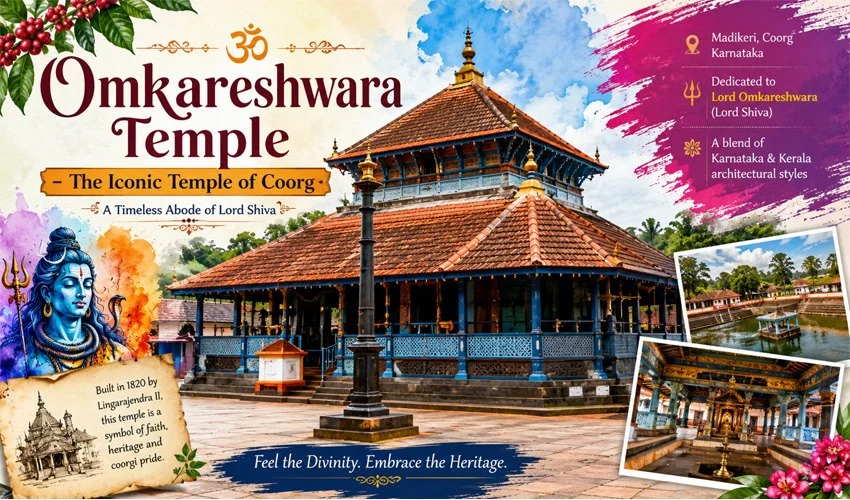
Nestled in the misty hills of Madikeri, the headquarters of Coorg (Kodagu) district in Karnataka, the Omkareshwara Temple stands as one of the most distinctive religious landmarks in South India. Unlike the typical Dravidian-style temples scattered across Karnataka and Tamil Nadu, this shrine dedicated to Lord Shiva presents an unusual blend of Islamic and Gothic architectural elements, making it a fascinating study in cultural fusion. For travelers exploring Coorg’s coffee estates, waterfalls, and misty viewpoints, a visit to Omkareshwara Temple offers a quieter, more contemplative experience steeped in history, legend, and architectural curiosity.
A Temple Born Out of Guilt and Redemption
The story behind the construction of the Omkareshwara Temple is as intriguing as its architecture. The temple was built in 1820 by Lingarajendra II, the king of Kodagu, under circumstances that reflect both royal power and personal remorse. According to popular legend, the king was responsible for the wrongful death of a Brahmin named Apparanda Bopu. Whether through direct execution or by failing to prevent an injustice, the king felt the weight of having caused the death of a Brahmin, an act considered a grave sin in traditional Hindu belief, known as Brahmahatya Dosha.
To atone for this sin and to pacify the spirit of the deceased, the king was advised by his priests and astrologers to install a Shiva Linga and construct a temple in honor of Lord Shiva. The linga itself is believed to have been brought all the way from Kashi (Varanasi), one of the holiest cities in Hinduism and a place intrinsically associated with Lord Shiva. By bringing a linga from such a sacred site, the king sought to ensure that his act of penance carried the highest spiritual weight possible. The temple was thus born not merely as an act of religious devotion but as a royal gesture of atonement, redemption, and an attempt to restore moral and cosmic balance.
This origin story gives the temple a layered identity. It is simultaneously a place of worship, a historical monument, and a symbol of the complex relationship between power, guilt, and faith that has shaped many royal constructions across Indian history.
Architectural Marvel: A Fusion Unlike Any Other
What truly sets Omkareshwara Temple apart from other Shiva temples in India is its architectural style. Most Shiva temples follow either the Dravidian style, with towering gopurams and intricately carved pillars, or the Nagara style common in North India. Omkareshwara Temple, however, breaks this mold entirely by incorporating elements reminiscent of Islamic and Gothic architecture.
The temple features a central dome that immediately draws comparisons to mosque architecture, surrounded by four smaller minaret-like turrets at each corner of the structure. These domed towers, combined with pointed arches and a layout that echoes Indo-Islamic monuments, give the temple an appearance that is more reminiscent of a mausoleum or a mosque than a conventional Hindu shrine. This is no accident. Historians believe that the king, in an effort to make the structure unique and perhaps influenced by the architectural trends of the era under Hyder Ali and Tipu Sultan’s rule in nearby Mysore, deliberately chose this hybrid style.
The temple complex is built around a square tank, which serves both a practical and symbolic purpose, providing water for rituals while also representing purification. The tank itself is a peaceful spot, often reflecting the temple’s domes and turrets in its calm waters, creating a picturesque scene that is popular among photographers and visitors alike. Surrounding the temple is a well-maintained garden area, adding to the tranquil ambiance that pervades the entire complex.
The exterior is painted in shades of white, giving the temple a serene, almost ethereal glow, particularly striking against the lush green hills of Coorg in the background. The juxtaposition of this white-domed structure against the verdant landscape of Madikeri creates a visually arresting contrast that has made the temple a notable architectural curiosity, drawing not just devotees but also architecture enthusiasts, students, and casual tourists curious about this unusual blend of styles.
The Sanctum and Deities Within
At the heart of the temple lies the sanctum sanctorum, where the main deity, a Shiva Linga, is enshrined. This linga, as mentioned earlier, was brought from Kashi and is considered the spiritual core of the temple. The presence of a linga from such a revered location adds a layer of sanctity that elevates the temple’s significance beyond its architectural novelty.
In addition to the central Shiva Linga, the temple also houses idols of other deities, including Parvati, Ganesha, and Nandi, the divine bull who serves as Shiva’s mount and is traditionally placed facing the sanctum in any Shiva temple. The presence of these accompanying deities follows traditional Hindu temple conventions, even as the overall architectural envelope departs dramatically from convention.
Regular pujas (rituals) are conducted at the temple, and it remains an active place of worship for the local community in Madikeri. Devotees visit not only to seek blessings but also to partake in the spiritual atmosphere that pervades the temple grounds, particularly during the early morning and evening hours when the rituals are performed amid the soft glow of oil lamps and the fragrance of incense.
Religious Significance and Local Belief
Beyond its architectural distinction, Omkareshwara Temple holds deep religious significance for the people of Coorg. Many locals believe that the temple’s construction, born out of an act of penance, imbues the site with a unique spiritual energy related to forgiveness, redemption, and the restoration of cosmic balance. Visitors often come not just to admire the architecture but to seek blessings for forgiveness, peace of mind, and resolution of personal guilt or troubles.
The temple has become deeply woven into the cultural fabric of Madikeri and is considered one of the town’s most important religious sites. Festivals associated with Lord Shiva, such as Maha Shivaratri, are celebrated here with particular fervor, drawing large crowds of devotees who come to participate in special prayers, processions, and rituals dedicated to the deity. During such festive periods, the temple is illuminated and decorated, creating a vibrant atmosphere that contrasts beautifully with its otherwise serene daily ambiance.
A Must-Visit Destination in Madikeri
For tourists visiting Coorg, Omkareshwara Temple is often included in itineraries alongside other prominent attractions such as Raja’s Seat, Abbey Falls, and the Madikeri Fort. Its central location within Madikeri town makes it easily accessible, and it requires relatively little time to explore thoroughly, making it a convenient addition to any Coorg sightseeing plan.
What makes the temple particularly appealing to travelers is the sheer uniqueness of its architecture. In a region known primarily for its natural beauty, coffee plantations, and misty hills, Omkareshwara Temple offers a different kind of attraction, one rooted in history, architecture, and spiritual storytelling. Photography enthusiasts particularly enjoy capturing the temple’s reflection in the surrounding water tank, especially during the golden hours of early morning or late afternoon when the light enhances the white domes and creates striking visual compositions.
Visitors are generally advised to dress modestly when visiting, as is customary for temple visits across India, and to maintain a respectful demeanor given that this remains an active place of worship. The temple is generally open throughout the day, with specific timings for rituals typically occurring during early morning and evening hours.
Practical Tips for Visitors
Those planning to visit Omkareshwara Temple should consider visiting during the cooler parts of the day, given Coorg’s tropical climate, to comfortably explore the temple grounds and surrounding garden area. The monsoon season, while making the region particularly lush and green, may also bring heavy rainfall, so checking weather conditions beforehand is advisable.
Since the temple is located in the heart of Madikeri town, it is easily reachable by local transport, and many tour operators include it as a stop in broader Coorg sightseeing packages. Visitors with an interest in history and architecture may want to spend additional time observing the structural details, comparing the temple’s blend of styles with other religious monuments they may have encountered elsewhere in India.
Conclusion
Omkareshwara Temple stands as a remarkable testament to the layered history of Coorg, a region where Hindu, Islamic, and colonial influences have intersected in unexpected ways over centuries. Built out of royal penance and adorned with architecture that defies conventional categorization, the temple offers visitors far more than a simple religious site; it offers a story of guilt, redemption, and cultural synthesis carved in stone and mortar. Whether one visits for spiritual reasons, architectural curiosity, or simply as part of a broader exploration of Madikeri’s heritage, Omkareshwara Temple remains an unmissable and iconic landmark that beautifully encapsulates the unique character of Coorg.