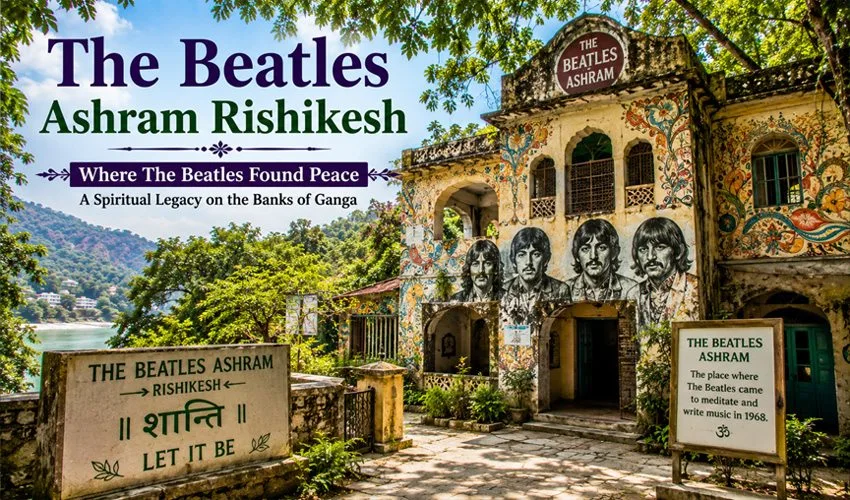
Tucked inside the forested edge of the Rajaji Tiger Reserve, on the quiet eastern bank of the Ganga, sits one of the most unusual tourist attractions in India — a crumbling ashram covered floor-to-ceiling in psychedelic murals, dedicated to four musicians who changed the course of popular music forever. Officially called Chaurasi Kutia, but known worldwide simply as the Beatles Ashram, this site draws musicians, backpackers, spiritual seekers, and curious travelers who want to stand in the exact spot where John Lennon, Paul McCartney, George Harrison, and Ringo Starr once sat cross-legged in meditation and wrote nearly four dozen songs.
If you’re planning a visit, here’s everything you need to know — from ticket prices and opening hours to what you’ll actually find once you’re inside.
A Quick History of the Ashram
Long before the Beatles ever set foot in Rishikesh, the ashram was built in the early 1960s by Maharishi Mahesh Yogi as an International Academy of Meditation, meant to train students in Transcendental Meditation (TM). The property took its nickname, Chaurasi Kutia, from the 84 small stone meditation huts (“kutis”) scattered across the grounds — “chaurasi” meaning eighty-four in Hindi.
The ashram’s fame exploded in February 1968, when the Beatles arrived to study under the Maharishi after meeting him at a lecture in Wales. What was meant to be a purely spiritual retreat turned into one of the most productive songwriting stretches of the band’s career. Over roughly two to three months, the group is believed to have written close to 48 songs, many of which later appeared on The White Album, as well as tracks scattered across other releases. The band members reportedly stayed in slightly upgraded quarters compared to other students, with access to private bathrooms, round-the-clock running water, and electric heaters — small comforts that set their kutis apart from the rest.
The Maharishi’s lease on the forest land, granted by the Uttar Pradesh government, ran for about two decades. Once it expired in the early 1980s, the property was gradually abandoned and absorbed into the surrounding protected forest zone. For over 30 years, it sat forgotten, reclaimed by vines and vegetation, until the Uttarakhand Forest Department reopened it to the public in 2015. Since then, local and international artists have transformed the peeling walls of the old meditation domes into an open-air gallery celebrating the Beatles, Indian spirituality, and 1960s counterculture — turning a derelict property into one of Rishikesh’s most photographed destinations.
Entry Fee
Ticket prices at the Beatles Ashram have crept up gradually over the past couple of years, and different sources currently quote slightly different figures, so it’s worth treating these as an approximate guide and confirming the exact price at the gate or through your hotel before you go.
As of the most recent updates, visitors can generally expect to pay somewhere in this range:
- Indian nationals: approximately ₹150–₹200 per person
- Senior citizens: discounted rates, often around ₹100
- Students: reduced entry, with a lower fee for those under 18 and a slightly higher rate for older students
- Foreign nationals: approximately ₹600–₹1,200 per person
The entry fee goes toward the upkeep of the site, which sits within a protected forest area, and helps fund ongoing conservation of the murals and structures. Carrying cash is strongly recommended, since digital payment options at the ticket counter can be unreliable, especially during peak tourist season.
Timings
The ashram typically operates daily from 10:00 AM to 4:00 PM (a few sources list opening as early as 9:00 AM, so arriving right around 10 is the safest bet). It generally stays closed for visitors after sunset, since the site sits within tiger reserve territory and lacks lighting for evening access.
A few practical notes on timing your visit:
- Arrive early. The first hour or two after opening tends to be quieter, with softer light for photography and fewer crowds around the most popular murals.
- Budget at least 1.5 to 2 hours to properly explore — the property is spread across roughly 14 acres, and rushing through means missing several of the smaller meditation huts and hidden corners.
- Avoid the midday heat in summer months, when the shadeless stretches between buildings can get uncomfortably warm.
- Check for closures. Since the ashram falls under forest department jurisdiction, timings or access can occasionally shift due to weather, maintenance, or wildlife-related restrictions — it’s worth a quick call ahead or checking with your accommodation the day before.
Getting There
The ashram is located near Swarg Ashram, a short distance from Ram Jhula, and is easily reachable on foot if you’re staying in that part of Rishikesh. For those based in Tapovan or Laxman Jhula, it’s a slightly longer walk or a quick auto-rickshaw ride.
Most travelers combine the visit with other nearby stops, since the ashram sits close to popular ghats and temples along the river. A common approach is to cross over to Ram Jhula, walk to the ashram, and spend a half-day exploring before heading back for lunch or continuing on to other Rishikesh attractions. Some visitors even pair a morning rafting session with an afternoon ashram visit, using the calm, shaded grounds to wind down after the adrenaline of the rapids.
What You’ll Actually See Inside
Once through the gate, the experience is largely self-guided — there are no scheduled tours, so you’re free to wander the property at your own pace. Here’s what typically stands out:
The meditation domes. The signature feature of the ashram — egg-shaped stone pods where students, including the Beatles, once sat in silent meditation. Many now serve as small galleries covered in vivid murals.
The Beatles Cathedral Gallery. Perhaps the most photographed section of the property, this area features large-scale portraits and artwork dedicated to the band, along with lyrics-inspired imagery and tributes to their time in India.
The main lecture hall. A larger structure where the Maharishi once addressed groups of students, now repurposed as another canvas for murals and information panels about the ashram’s history.
Residential cottages. Simple stone huts where students lived during their stay, several of which retain their original layout even amid the decay.
The panoramic river viewpoint. A standout spot near the edge of the property that offers sweeping views of the Ganga as it winds past Ram Jhula and Lakshman Jhula — one of the best places to pause for a wider shot of the landscape.
Overgrown, forested pathways. Much of the property has been reclaimed by the surrounding forest, and walking between structures often means passing through leafy, quiet stretches that make the whole visit feel more like an exploration than a typical tourist stop.
Tips for a Smooth Visit
- Wear comfortable footwear. The terrain is uneven in places, with narrow stone steps and overgrown patches between buildings.
- Bring a fully charged camera or phone. Photography is allowed throughout the property, and the murals are the main draw for most visitors.
- Carry water and sun protection, especially if visiting in the warmer months, since shade is inconsistent across the open sections of the site.
- Keep an ID handy, particularly if claiming a student or senior citizen discount.
- Don’t rush. A two-loop approach works well: one pass to get oriented and understand the layout, and a second, slower pass to properly take in the murals, structures, and viewpoints you missed the first time.
Is It Worth Visiting?
For Beatles fans, music historians, and anyone with even a passing interest in 1960s counterculture, the ashram is close to essential. But even visitors with no particular attachment to the band tend to come away impressed — the combination of faded stone architecture, forest overgrowth, striking street-art-style murals, and river views makes it one of the more atmospheric and photogenic stops in Rishikesh, regardless of musical taste.
Whether you’re retracing the footsteps of one of the most influential songwriting periods in rock history or simply looking for a peaceful, offbeat morning away from the town’s busier ghats, the Beatles Ashram offers a rare mix of history, art, and quiet natural surroundings that’s hard to find anywhere else in India.