Tucked deep within the Parvati Valley of Himachal Pradesh, Manikaran Sahib Gurudwara is one of the most extraordinary pilgrimage destinations in North India. Set against a backdrop of snow-dusted peaks, pine forests, and the fast-flowing Parvati River, this shrine draws pilgrims, backpackers, and curious travelers alike — not just for its spiritual weight, but for a natural phenomenon that has puzzled and fascinated visitors for centuries: boiling hot springs that bubble up right beside an icy Himalayan river.
Revered equally by Sikhs and Hindus, Manikaran is a rare example of interfaith harmony, where a gurudwara and ancient temples dedicated to Shiva and Rama coexist within the same sacred complex. If you’re planning a trip to Kullu, Manali, or Kasol, a visit to Manikaran Sahib is well worth adding to your itinerary. Here’s everything you need to know.
Where Is Manikaran Sahib Located?
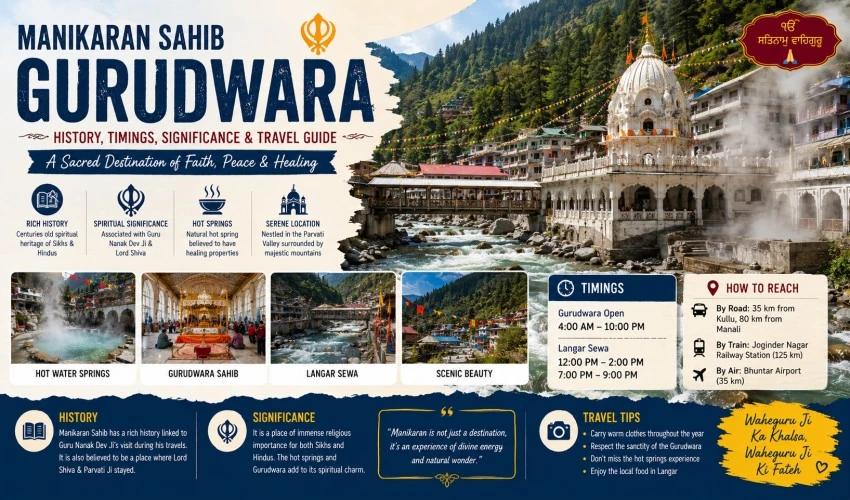
Manikaran sits in the Parvati Valley, roughly 45 km from Kullu town and about 80 km from Manali, at an elevation of nearly 1,760 meters above sea level. The village lies just beyond Kasol, the backpacker hub that has become famous in its own right, making Manikaran a natural extension of any Parvati Valley trip. The Parvati River flows right through the town, and the gurudwara itself stands on its banks, surrounded by steep mountain walls that give the whole valley a dramatic, almost otherworldly atmosphere.
The History of Manikaran Sahib
Manikaran’s story stretches back long before recorded history, blending mythology, scripture, and centuries of pilgrimage tradition into one layered narrative.
The Hindu Legend
According to Hindu mythology, Lord Shiva and Goddess Parvati once meditated in this valley for a very long period. During their stay, Parvati lost one of her precious earrings (mani) while bathing in the river. Shiva, angered by the loss, asked his serpent companion Sheshnag to retrieve it. Sheshnag hissed furiously and, in his fury, released a stream of hot water and steam from the earth, bringing the lost jewel back to the surface along with the springs that still bubble here today. This is how the town got its name — “Manikaran,” meaning “the ear of jewels.”
The Sikh Legend
For Sikhs, the story centers on Guru Nanak Dev Ji, who is believed to have visited Manikaran during his travels in the region, accompanied by his companions Bhai Mardana and Bhai Bala. As the story goes, the group arrived hungry, and Guru Nanak asked Bhai Mardana to gather food from nearby villagers, who generously offered flour and lentils. But there was no fire to cook the food. When Mardana pointed this out, Guru Nanak instructed him to lift a stone from the ground — and to everyone’s astonishment, hot water sprang forth from beneath it. Guru Nanak is said to have told his disciples that if they had faith, they could cook the roti (bread) simply by placing the dough in the hot spring. When Mardana doubted whether the bread would cook without ghee, the story continues that the roti sank and then miraculously resurfaced cooked and coated in ghee — an event still commemorated in local retellings today.
Following this episode, the langar tradition was born at this site, and the hot springs have been used to cook food for pilgrims ever since — a practice that continues in the gurudwara’s kitchens today.
Later History
The current structure of the gurudwara has been rebuilt and renovated multiple times over the centuries, partly due to natural disasters. A major earthquake in 1905 caused significant damage to several temples in the complex, including the nearby Shiva temple, which still stands slightly tilted as a result. Devastating floods in the 1990s also damaged parts of the town and the shrine, prompting further reconstruction. The gurudwara seen today, with its gleaming white-and-gold facade, reflects a more modern rebuild but continues to honor the site’s centuries-old spiritual lineage. Historical references to Manikaran also appear in older Sikh texts, including accounts associated with the Janamsakhi tradition documenting Guru Nanak’s travels.
The Hot Springs: Manikaran’s Defining Feature
No visit to Manikaran is complete without experiencing its famous hot springs, which are the heart of the site’s identity. Several springs emerge around the gurudwara and temple complex, with water temperatures hot enough to cook rice, lentils, and vegetables when submerged in cloth pouches. Locals and pilgrims alike use this natural heat source to prepare langar, and it’s common to see food being lowered into the springs in muslin bags.
The springs are believed by many to have therapeutic and healing properties, particularly for joint pain and skin conditions, owing to the mineral content of the water — the water is known to carry sulphur and trace radioactive elements typical of geothermal springs in the region. The gurudwara maintains separate bathing areas (kunds) for men and women, where pilgrims can take a dip. Note that the water is genuinely very hot, so it’s advisable to ease in gradually and follow local guidance on which pools are safe for bathing versus purely for cooking.
Religious and Cultural Significance
Manikaran’s significance operates on several levels simultaneously.
A symbol of interfaith unity. Few places in India host such an intimate coexistence of two major faith traditions. The gurudwara and the Hindu temples — dedicated to Rama, Krishna, Vishnu, and Shiva — share the same compound and even draw on the same hot springs for their rituals. Pilgrims of both faiths visit the same sacred waters, making Manikaran a living example of syncretic devotion.
A test of faith. For Sikhs, the story of the roti sinking and resurfacing cooked is often read as a parable about faith and surrender — a reminder that devotion, not doubt, is what allows miracles to unfold.
A site of pilgrimage and penance. Many Hindu pilgrims consider a dip in the Manikaran hot springs, followed by a visit to the Shiva temple, to be spiritually cleansing, comparable in importance to visiting other major Himalayan shrines in the region.
Langar as an equalizer. As with all gurudwaras, the langar at Manikaran is open to everyone regardless of religion, caste, or background. Sitting together on the floor to share a free meal cooked partly using the earth’s own heat is, for many visitors, one of the most moving parts of the experience.
Gurudwara Timings
Manikaran Sahib Gurudwara is open throughout the year and welcomes visitors daily, though exact timings for darshan, langar, and bathing can shift slightly depending on the season and local management decisions. As a general guide:
- Darshan hours: The gurudwara typically opens early in the morning, around 5:00–6:00 AM, and remains open until late evening, around 9:00–10:00 PM.
- Langar timings: Langar is usually served continuously through the day, with the busiest serving windows around breakfast, lunch, and dinner hours.
- Bathing kunds: The hot spring bathing areas generally follow the gurudwara’s operating hours but may have separate time slots for men and women, so it’s worth checking locally on arrival.
Because timings can be adjusted during major festivals or due to weather-related closures (landslides and heavy snow can occasionally affect access to the valley), it’s a good idea to confirm current hours with the gurudwara management or a local contact shortly before your visit.
Best Time to Visit
Manikaran can technically be visited year-round, but the experience varies dramatically by season:
- April to June: Pleasant weather with daytime temperatures generally comfortable, making this an ideal window for sightseeing and short treks in the surrounding valley.
- September to November: Clear skies, cooler air, and fewer crowds than peak summer, with the added bonus of autumn colors across the valley.
- December to February: Snowfall transforms the region into a striking winter landscape, and the contrast between snow-covered ground and steaming hot springs is genuinely unique — but road access can be unpredictable, so check conditions before traveling.
- July to August: Monsoon season brings heavy rain and a higher risk of landslides on the mountain roads leading into the valley, so this period is best avoided unless necessary.
How to Reach Manikaran Sahib
By Air: The nearest airport is Kullu-Manali Airport (Bhuntar), roughly 35 km away, with limited connections to Delhi and Chandigarh. From there, taxis and buses run regularly to Manikaran via Kasol.
By Rail: The nearest major railway station is in Chandigarh or Joginder Nagar, both several hours away by road. Most travelers combine train travel to Chandigarh with a road journey onward.
By Road: Manikaran is well connected by road from Kullu and Manali, both of which have regular bus services from Delhi, Chandigarh, and other major North Indian cities. From Kullu, it’s roughly a 2-hour drive through Bhuntar and Kasol; from Manali, expect around 3 hours. The final stretch of road winds through narrow mountain passes alongside the Parvati River, offering some genuinely spectacular views along the way.
Where to Stay
Manikaran itself has modest guesthouses and a dharamshala (pilgrim rest house) run by the gurudwara, offering basic but clean accommodation, often at low or donation-based rates — a common feature of Sikh pilgrimage sites. For more comfortable options, most travelers base themselves in nearby Kasol, which has a wide range of guesthouses, cafes, and hostels catering to backpackers, or in Bhuntar and Kullu town for more conventional hotel options.
Nearby Places to Explore
A trip to Manikaran pairs naturally with other highlights of the Parvati Valley:
- Kasol – A short drive away, popular for its cafes, riverside views, and backpacker culture.
- Kheerganga – A scenic trek starting near Barshaini, known for its own natural hot spring at the top and sweeping valley views.
- Tosh – A quiet village further up the valley, offering a more offbeat, laid-back alternative to Kasol.
- Parvati River rafting – Adventure operators in the region offer rafting experiences along stretches of the river.
- Kullu town and the Beas Valley – Worth combining with your trip if you’re traveling onward toward Manali.
Travel Tips
- Carry warm clothing even in summer, as evenings in the valley can turn cold quickly.
- Cover your head before entering the gurudwara, as is customary at all Sikh shrines; scarves are often available at the entrance if you don’t have one.
- Be cautious around the hot spring kunds — the water can be scalding, so follow posted guidance and staff instructions.
- Carry cash, as ATMs can be sparse or unreliable in the more remote parts of the valley.
- Respect photography restrictions inside the main prayer hall, as is standard gurudwara etiquette.
Final Thoughts
Manikaran Sahib is more than a stop on a Himachal itinerary — it’s a place where geology, mythology, and faith intersect in a way that’s hard to find anywhere else. Whether you’re drawn by the spiritual pull of Guru Nanak’s legacy, the mythological tale of Shiva and Parvati, or simply the strange thrill of watching rice cook in a natural hot spring beside a Himalayan river, Manikaran offers an experience that lingers well after you’ve left the valley.