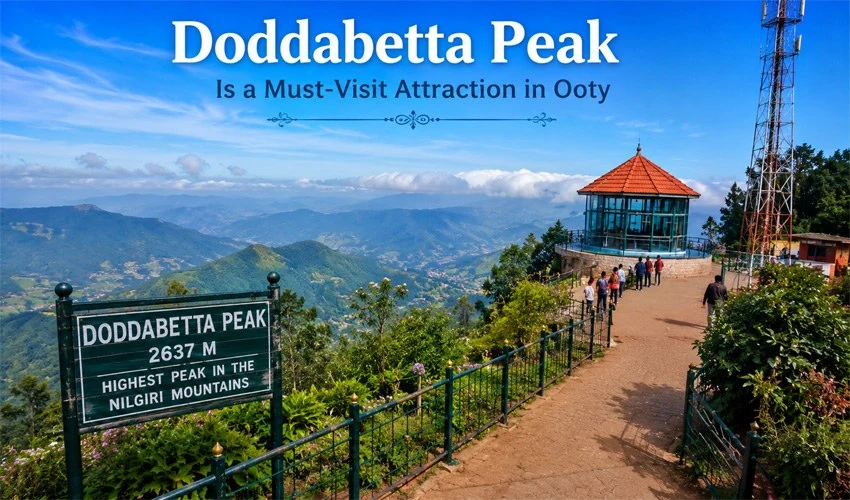
There is a certain magic that belongs exclusively to mountains. It is not the drama of a waterfall or the serenity of a lake — it is something older and more elemental: the sensation of standing at a high point above the world and understanding, for a moment, the vast and layered beauty of the earth beneath the sky. In Ooty, that magic has a name and a precise address. It is called Doddabetta Peak, and it stands at 2,637 metres above sea level — the highest point in Tamil Nadu, the highest summit in the Nilgiri Hills, and one of the most spellbinding viewpoints in all of South India.
Whether you are a first-time visitor to Ooty or someone who has returned to the Blue Mountains many times over, Doddabetta is not a destination you skip. It is the attraction that gives context to everything else — the tea gardens, the misty valleys, the colonial buildings, the winding roads. From its summit, you can see how all the pieces of the Nilgiri landscape fit together, and the view is nothing short of extraordinary.
This article explores why Doddabetta Peak deserves a central place in every Ooty itinerary, from its geological significance and rich history to its biodiversity, visitor experience, and everything you need to know before you go.
The Name and Its Meaning
The word Doddabetta comes from the Badaga language, one of the indigenous tongues of the Nilgiri tribes. It is a compound of two words: Dodda, meaning “big,” and Betta, meaning “mountain.” The name is entirely literal and entirely accurate. Doddabetta is simply the Big Mountain — and in the Nilgiris, there is no bigger.
Situated at the junction of the Western Ghats and the Eastern Ghats, Doddabetta occupies a geographical position of rare distinction. It is the point where two of India’s greatest mountain systems meet, which is one reason why the views from its summit stretch so dramatically in every direction — on a clear day, visitors can see rolling Nilgiri ridges to the west, the broader Deccan landscape to the north, and on exceptionally clear mornings, faint outlines of the plains of Kerala far below to the south.
The peak ranks fourth among the highest summits in South India, after Anamudi, Mannamalai, and Meesapulimala. But within Tamil Nadu and specifically within the Nilgiris, it stands unchallenged at the top.
A History Rooted in Indigenous Culture and Colonial Discovery
Long before Doddabetta became a tourist attraction, it was a sacred landscape for the indigenous communities of the Nilgiris — the Todas, Badagas, Kotas, and Irulas — who have inhabited these mountains for thousands of years. These tribes regarded the peak as the dwelling place of their gods and ancestors, and various rituals and festivals connected to the peak formed part of the living cultural fabric of Nilgiri life.
The British arrived in Ooty in the early 19th century, drawn by the cooler climate that offered relief from the heat of the Madras Presidency’s plains. When they explored the surrounding hills, Doddabetta captured their attention for both its altitude and its strategic vantage point. They established a meteorological observatory on the peak and, in time, built a road connecting Ooty town to the summit — a road that opened Doddabetta to civilian visitors and laid the foundation for the tourism that continues to this day.
The observatory tradition was formalized in the modern era by the Tamil Nadu Tourism Development Corporation (TTDC), which constructed the Telescope House at the summit on 18 June 1983, giving the peak one of its most distinctive and popular attractions for visitors. Today, the peak is managed by the Tamil Nadu Forest Department, which oversees conservation while supporting sustainable tourism.
The View: Why It Makes Everything Worth It
Visitors who have seen Ooty from street level and then stood at the Doddabetta summit describe it as seeing the same painting from a completely different perspective. The town below, with its lake and botanical gardens and colonial architecture, suddenly becomes a detail in a much larger composition — a composition of layered ridges, cloud shadows moving across valley floors, winding roads cutting through tea estates, and distant plains dissolving into haze.
On clear days — most common between October and February — the panorama from Doddabetta is genuinely 360 degrees. You can see the Chamundi Hills in the distance, the forests of Bandipur National Park stretching across the horizon, and the famous Ooty Lake reduced to a silver sliver far below. The forested valleys between peaks are often filled with cloud, so the effect on certain mornings is of standing above a sea of white mist with only the higher ridgelines visible — an experience that is equal parts eerie and magnificent.
The Telescope House at the summit enhances this experience significantly. Maintained by the TTDC, the glass-paned observatory houses two telescopes through which visitors can zoom in on specific landmarks — Ooty town, the Botanical Gardens, the tea plantations, and the surrounding forest canopy. The ability to observe Ooty from above through a telescope gives a curious depth to the experience, turning the panoramic view into something you can actively explore rather than simply stand before.
The Biodiversity: A Peak with an Ecosystem of Its Own
Doddabetta is not just a viewpoint. It is an ecological entity in its own right, and one of the most compelling reasons to visit is the natural world that clothes its slopes.
The lower and middle slopes are covered with shola forests — a unique form of tropical montane forest found only at higher altitudes in the Western Ghats. These dense, broad-leafed thickets, interspersed with open montane grasslands, create a landscape type found almost nowhere else on earth and recognized as one of the most biodiverse forest systems in India. Shola forests are home to endemic plant species, rare orchids, epiphytes, and a variety of mosses and ferns that give the forest floor a lush, primordial quality.
The upper slopes transition to sub-alpine shrubs, rhododendron groves, and coarse alpine grasses. Rhododendrons in particular are a visual treat when in bloom, their bright flowers standing out against the grey-green of the hill mist. The plants also have significant medicinal properties — their flowers, leaves, and bark are used in traditional remedies and herbal preparations.
Doddabetta is also excellent birding territory. The Nilgiri flycatcher, with its striking iridescent plumage, is commonly spotted here. The white-cheeked barbet, the Nilgiri wood pigeon, the Indian blackbird, and various sunbirds are regular visitors to the shola canopy. For wildlife enthusiasts, the forest corridors around the peak also occasionally produce sightings of the Nilgiri tahr, the barking deer, and the elusive Nilgiri marten.
The peak falls within the Nilgiri Biosphere Reserve, India’s first biosphere reserve and one of 18 UNESCO-recognized biosphere reserves in the country. This protected status has ensured that even as visitor numbers have grown substantially over the decades, the core ecology of Doddabetta has remained intact and functional.
Trekking to the Summit: The Rewarding Climb
While Doddabetta can be reached by road in a short drive from Ooty — the summit is approximately 9 to 10 kilometres from Ooty town along the Ooty-Kotagiri Road — the most memorable way to experience the peak is on foot. The trekking trail to Doddabetta is classified as moderate in difficulty, covering approximately 3 kilometres of ascent through forested paths, grassy slopes, and rocky sections fragrant with alpine herbs and ferns.
The trek typically takes between 2 and 3 hours depending on pace, and offers something that the road does not: the gradual, earned revelation of the landscape. Each turn in the trail opens a new angle of the valley below, and the forest through which you walk changes character as you gain altitude — thicker and damper in the shola zone, more open and windswept as you approach the summit.
Trek routes also connect Doddabetta to other key points in the Nilgiris, including Kotagiri, Coonoor, and Glenmorgan, with longer routes ranging from 4 to 8 hours. Guided treks departing from Ooty are organized by several local agencies, and the trails are generally well-marked.
For those trekking, comfortable shoes with good grip are essential, as the paths can be slippery during the monsoon and wet season. Carrying adequate water is important — shops and vendors are sparse on the trails. Layers of clothing are advisable, as summit temperatures can drop significantly even when the lower town feels warm.
Practical Information: Everything You Need to Know
- Location: Doddabetta Peak, Ooty-Kotagiri Road, Nilgiris District, Tamil Nadu. Approximately 9 km from Ooty town centre and 8 km from Ooty Bus Stand.
- Timings: The peak is open for visitors every day from 7:00 AM to 6:00 PM. The Telescope House operates within these hours. Early morning visits — arriving close to opening time — are strongly recommended for the best visibility and the experience of watching the morning mist lift from the valleys.
- Entry Fee: Adults pay Rs. 6 per person. Children below the age of 5 enter free. Camera fees apply: Rs. 10 for a still camera and Rs. 50 for a video camera. The entry is managed by the Tamil Nadu Forest Department.
- Getting There: By road, the peak is a 20 to 30-minute drive from Ooty town. TNSTC buses ply from Ooty Bus Stand to Doddabetta for Rs. 20 to Rs. 30. Private taxis and shuttle jeeps are available from Ooty town. During peak season, parking at the summit can be limited, so arriving early is advisable.
- Best Time to Visit: October to January offers the clearest skies and the most dramatic panoramic views. February through June is also pleasant. The monsoon months (July–September) bring beautiful green landscapes and a misty, atmospheric quality to the peak, though visibility from the viewpoint is reduced. April and May mark one of the peak visitor seasons.
- Time Required: A comfortable visit covering the viewpoint, Telescope House, and immediate surroundings takes 1.5 to 2 hours. Those trekking up from Ooty should budget 4 to 6 hours for the round trip.
- What to Bring: Water, light snacks, a windproof jacket (the summit is cooler than town by several degrees), sunscreen, and comfortable walking shoes. Binoculars will significantly enhance the viewpoint experience.
The Nilgiri Tea Connection: A Bonus Worth Savouring
No visit to the Doddabetta area is complete without engaging with its most famous agricultural product. The slopes below and around the peak are blanketed with Nilgiri tea estates, and the tea grown at these high altitudes — prized for its full-bodied flavour, bright colour, and distinctive muscatel notes — is among the finest in India. The Doddabetta Tea Factory near the peak offers visitors the chance to observe the tea-making process from leaf to cup, and a freshly brewed cup of Nilgiri tea on a cool summit morning is one of Ooty’s most quietly perfect pleasures. Local shops around the area also sell fresh tea, spices, homemade jams, and aromatic herbs — excellent souvenirs to bring home.
Why Doddabetta Is Irreplaceable
Ooty has no shortage of things to see and do — lakes, botanical gardens, rose gardens, heritage railways, and colonial-era architecture all compete for your time. But Doddabetta Peak occupies a different category from all of these. It is the geographic and experiential heart of the Nilgiris, the point from which everything else can be understood in proper scale and context.
It is a place where ecology, history, adventure, and sheer visual splendour converge on a single summit. Where the morning mist rolls away to reveal a world of impossible green beauty. Where the air tastes different from the air you breathe in the town below — sharper, cooler, carrying the fragrance of rhododendron and mountain grass. Where you stand at the meeting point of two ancient mountain systems and feel, briefly and completely, that you are exactly where you are supposed to be.
Doddabetta Peak is not merely a must-visit attraction in Ooty. It is the reason Ooty feels like the kind of place that stays with you long after you leave.