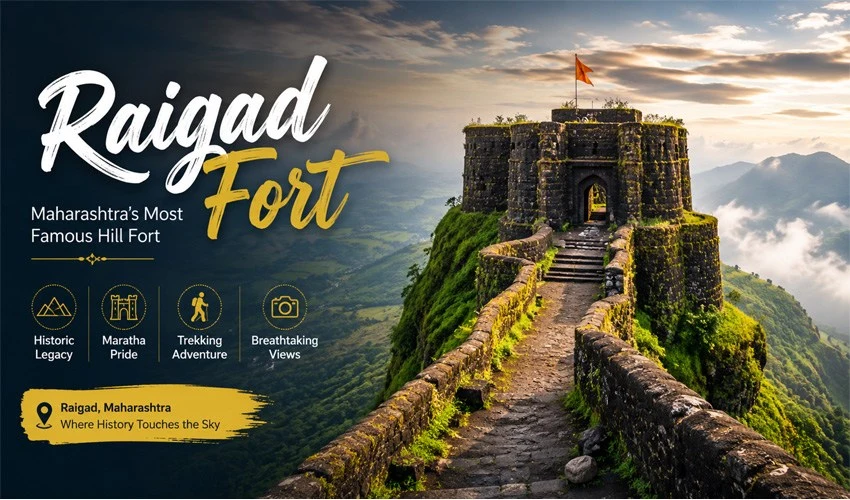
Perched nearly 2,700 feet above the Sahyadri ranges in Maharashtra’s Raigad district, Raigad Fort is far more than a collection of ruined walls and weathered stone. It is the place where the Maratha Empire was born in spirit, where Chhatrapati Shivaji Maharaj was crowned king, and where one of India’s most consequential political experiments took shape centuries before independence became a national conversation. For history lovers, trekkers, and casual travelers alike, Raigad remains one of the most rewarding hill forts in the country to visit — not just for its scenery, but for the story it tells.
A Fort Chosen for Its Defenses
Long before it became Shivaji’s capital, Raigad was known by a different name — Rairi — and belonged to a local chieftain before passing through the hands of various regional powers, including the Nizamshahi and later the Adilshahi dynasties of Bijapur. When Shivaji Maharaj captured it in 1656, he immediately recognized what made the site special: its near-impregnable location.
Raigad sits atop a solitary hill separated from the surrounding mountain ranges, meaning any approaching army would have to cross difficult terrain with no natural cover, all while being visible from the fort’s watchtowers far in advance. Steep cliffs guard nearly every side, and the few approachable routes could be defended by a handful of soldiers against a much larger force. Shivaji saw in Raigad what earlier rulers had overlooked — a fortress that could double as a fully functioning capital, safe from siege and central enough to govern an expanding kingdom.
He commissioned extensive renovations, bringing in the architect Hiroji Indulkar to redesign the fort into a proper seat of power, complete with palaces, markets, water storage systems, and administrative buildings. By 1674, Raigad was ready to host the most significant event in Maratha history.
The Coronation That Changed Maratha History
On June 6, 1674, Shivaji Maharaj was formally crowned Chhatrapati at Raigad, a coronation performed with full Vedic rites and religious legitimacy that had rarely been extended to a regional Maratha ruler before. The event was deliberately grand. Thousands of guests, including scholars, priests, and dignitaries from across the subcontinent, gathered at the fort to witness the ceremony.
This coronation mattered because it was more than symbolic. It formally established Shivaji as a sovereign ruler rather than a rebel chieftain operating outside the recognized political order, giving the fledgling Maratha state legal and religious standing among the other kingdoms of India. Raigad, from that day forward, became the political and spiritual heart of the Maratha Empire, a status it held until Shivaji’s death in 1680.
Walking Through Raigad’s Ruins Today
Visitors who make the climb — either via the roughly 1,400-step staircase carved into the hillside or the modern ropeway that cuts the ascent down to a few minutes — are rewarded with a sprawling complex of ruins that still hint at the fort’s former grandeur.
Among the most visited sites within the fort:
The Main Gate (Maha Darwaja): Positioned in a way that made it nearly invisible to approaching enemies until they were directly upon it, this gate remains one of the best-preserved defensive features at Raigad.
Bazar Peth: The remains of what was once a bustling marketplace stretch along a central pathway, with rows of shop foundations still visible on either side. In its prime, this street would have been lined with merchants selling everything a functioning capital city required.
The Royal Court (Rajsabha): This is where Shivaji’s coronation took place, and it remains the emotional centerpiece of any visit to Raigad. The raised platform where his throne once stood is still marked, and the surrounding pillars, though weathered, give a sense of the scale the durbar hall once had.
Shivaji’s Samadhi: Located just below the Rajsabha, this memorial marks the site traditionally associated with Shivaji Maharaj’s cremation. It remains one of the most visited and revered spots on the entire hill, drawing pilgrims and history enthusiasts in equal measure.
Jagdishwar Temple: A modest but significant temple dedicated to Lord Shiva, built during Shivaji’s reign and still standing near the samadhi.
Hirakani Buruj: This watchtower carries one of the fort’s most enduring legends — the story of a village woman named Hirakani who is said to have scaled down the fort’s steep cliffside at night after the gates had closed, driven by the need to return to her infant child. The tower named after her is a popular stop for visitors interested in the folklore surrounding the fort as much as its formal history.
Takmak Tok: A cliff-edge viewpoint believed to have been used historically for the execution of traitors and criminals, offering a striking, if sobering, panoramic view of the valley below.
Ganga Sagar Lake: An artificial water reservoir built to supply the fort’s residents, showcasing the sophisticated water management systems the Marathas engineered even at such elevation.
A Capital Built for Governance, Not Just Defense
What separates Raigad from many other hill forts in Maharashtra is how thoroughly it was designed to function as an actual seat of government rather than a purely military outpost. The fort included granaries capable of storing enough food to withstand prolonged sieges, multiple water cisterns and reservoirs engineered to capture and store monsoon rainfall for year-round use, and residential quarters for soldiers, administrators, and members of the royal court.
This infrastructure reflected a deliberate philosophy. Shivaji Maharaj’s approach to fort-building emphasized self-sufficiency, allowing Raigad to operate independently for extended periods even when cut off from the surrounding region. That same design logic can be seen across the network of forts the Marathas maintained throughout the Sahyadris, but Raigad represents its most complete and ambitious expression.
The Fort After Shivaji
Following Shivaji Maharaj’s death in 1680, Raigad remained under Maratha control for several more years, but its fortunes shifted considerably as the empire faced internal succession disputes and external pressure from the Mughal Empire. The fort eventually fell to Mughal forces in 1689, and control of the site changed hands multiple times over the following decades as regional powers vied for dominance in the Konkan and Deccan regions.
By the time the British East India Company took interest in the fort during the late 18th and early 19th centuries, much of Raigad’s original grandeur had already faded through decades of neglect, conflict, and the slow erosion caused by weather and time. British forces eventually captured and partially dismantled sections of the fort in 1818, and for much of the following century, Raigad existed largely as a historical curiosity rather than an active site of political importance.
Restoration and Recognition
Interest in preserving Raigad picked up significantly in the late 19th and 20th centuries, driven in large part by a renewed cultural and nationalist interest in Maratha history. Restoration efforts have continued in phases since then, with the Archaeological Survey of India and the Maharashtra state government both playing roles in stabilizing structures, clearing overgrowth, and improving visitor access.
A statue of Shivaji Maharaj was installed near the fort’s entrance, and the site has become a place of pilgrimage-like importance for many visitors, particularly around Shiv Jayanti celebrations marking Shivaji’s birth anniversary, when the fort sees a significant spike in visitors paying tribute to his legacy.
Best Time to Visit and Practical Tips
Raigad Fort is accessible throughout the year, though conditions vary considerably by season. The winter months, from October through February, offer the most comfortable trekking weather, with clear skies and cooler temperatures making the climb far more manageable. Summer months bring intense heat that can make the ascent physically demanding, particularly for those choosing to climb the steps rather than take the ropeway.
The monsoon season transforms the entire region into a lush green landscape and is a favorite time for photographers and nature enthusiasts, though the steps can become slippery and visibility from the higher points is often reduced by cloud cover and mist.
For those short on time or physically unable to manage the steep stone staircase, the Raigad Ropeway offers a quick and scenic alternative, carrying visitors to the top in a matter of minutes while offering sweeping views of the surrounding Sahyadri ranges along the way.
Why Raigad Still Matters
Raigad Fort endures not simply because of its architecture or its dramatic hilltop setting, but because of what it represents in the larger story of Indian history. It was here that a regional Maratha leader was formally recognized as a sovereign king, laying the institutional groundwork for an empire that would go on to challenge Mughal dominance across much of the subcontinent for well over a century.
Every weathered gate, crumbling wall, and quiet courtyard at Raigad carries a piece of that history. For visitors willing to make the climb, the fort offers something increasingly rare in modern travel: a direct, physical connection to a turning point in a nation’s past, set against one of the most striking natural backdrops Maharashtra has to offer.