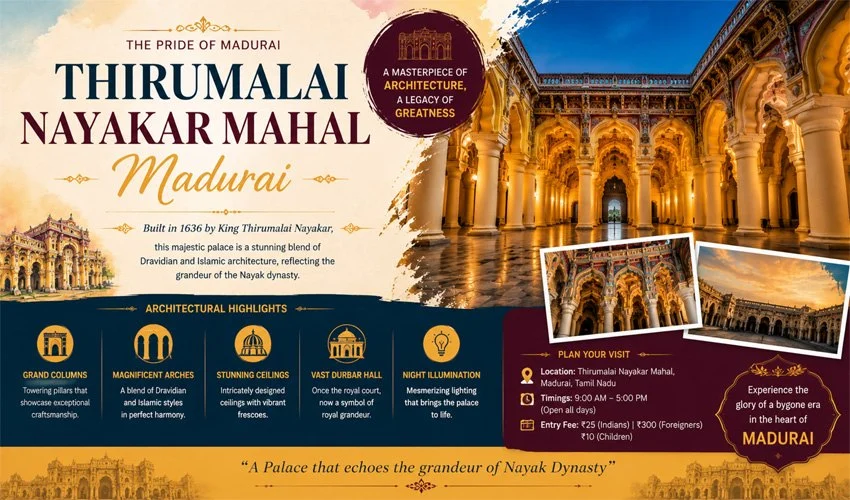
Just a short walk from the towering gopurams of the Meenakshi Amman Temple stands a very different kind of monument, one built not for gods but for kings. Thirumalai Nayakar Mahal, with its soaring pillars, echoing courtyards, and elegant fusion of architectural styles, is one of the most impressive secular buildings in South India. While Madurai is best known for its temples, this 17th-century palace offers a fascinating counterpoint: a glimpse into the courtly life, ambition, and artistic taste of the Nayak rulers who once governed the region. If you’re planning a trip to Madurai, here’s everything you need to know about this remarkable palace, its history, and how to make the most of your visit.
A Palace Built for Grandeur
Thirumalai Nayakar Mahal was constructed in 1636 AD by King Thirumalai Nayak, one of the most influential rulers of the Nayak dynasty, which governed Madurai from the mid-16th century through the mid-18th century. Thirumalai Nayak reigned from 1623 to 1659, and his rule is remembered as something of a golden period for the city. He is credited with major contributions to Madurai’s infrastructure, temple architecture, and civic development, and this palace was intended to be the crowning achievement of his reign.
The king wanted a residence that would rival anything in the region, and to achieve this, he reportedly enlisted the services of an Italian architect, giving the palace an unusual and striking blend of design influences you won’t quite see anywhere else in the region. The result was a structure that fused the Dravidian architectural traditions native to Tamil Nadu with Islamic and Rajput elements, creating what many historians consider a distinctly Indo-Saracenic masterpiece, decades before that style became more widely recognized elsewhere in India.
The palace’s construction also marked a symbolic shift, tied to the movement of the Nayak capital from Tiruchirappalli to Madurai, a decision made for both strategic and administrative reasons. Building a palace of this scale in the city was as much a statement of power as it was a functional residence.
The Palace That Time Shrank
One of the more poignant facts about Thirumalai Nayakar Mahal is that what visitors see today is only a fraction of the original structure. Historical accounts suggest the palace complex was originally about four times larger than its current footprint. The original design included two major sections: the Swargavilasa, or “Celestial Pavilion,” which served as the king’s main residence and administrative hub, and the Rangavilasa, the entertainment and theater pavilion where performances, festivals, and courtly gatherings took place.
Much of this grandeur was undone not by foreign invasion but by the king’s own descendants. According to widely repeated historical accounts, Thirumalai Nayak’s grandson dismantled large portions of the palace, stripping away wooden carvings, precious stones, and other valuable materials to construct a separate palace of his own. This left the complex diminished, with only the Swargavilasa surviving in any substantial form to the present day.
The palace saw a revival of sorts in the 19th century, when Lord Napier, who served as Governor of Madras between 1866 and 1872, undertook restoration work to preserve what remained. After India’s independence, the structure was declared a national monument and placed under the protection of the Tamil Nadu Archaeological Department, ensuring its preservation for future generations.
Inside the Architecture: What Makes It Special
Even in its reduced form, Thirumalai Nayakar Mahal remains an architectural marvel, and stepping into its central courtyard is enough to understand why it’s still considered one of Tamil Nadu’s finest palaces.
The Pillars: The palace is famous for its massive circular pillars, some reportedly reaching heights of around 48 to 82 feet depending on the section, with widths of nearly 19 feet at the base. In total, the complex houses roughly 248 pillars, an astonishing number that gives a sense of just how expansive the original structure must have been. These pillars are constructed from brick and mortar rather than stone, finished with a polished plaster called chunnam, made from a combination of shell lime and egg white, which gives the surfaces their distinctive smooth sheen even centuries later.
The Dome: The centerpiece of the Swargavilasa is its grand octagonal dome, rising an estimated 70 feet above the throne room. The dome is unsupported by any external beams or visible scaffolding, an engineering feat that continues to draw admiration from architects and historians alike. The dome sits atop a ring of curved stone ribs and circular columns, connected by a series of arches and an arcaded gallery that runs around the hall.
The Throne Room: Inside the Swargavilasa, visitors can see the space where the king’s throne once stood, along with a decorated recreation that gives a sense of the courtly ceremony that once took place here. This was the heart of the palace’s administrative life, where Thirumalai Nayak would have received guests, conducted state affairs, and hosted the ceremonial functions befitting a ruler of his stature.
The Ceiling Art and Stucco Work: Look up as you walk through the halls, and you’ll notice decorative paintings depicting Shaivite and Vaishnavite religious themes, reflecting the religious pluralism that coexisted within Nayak court culture. The stucco work on the arches and domes is similarly intricate, showcasing the kind of craftsmanship that made this palace stand apart from other regional structures of its time.
The Fusion Style: What ties all these elements together is the palace’s blending of architectural vocabularies. Dravidian temple-building traditions meet Islamic domes and arches, resulting in a structure that feels distinctly of its place while also gesturing toward broader Deccan and Mughal-era influences. It’s this fusion that art historians frequently point to when describing the palace’s significance in the broader story of Indian architecture.
The Sound and Light Show
No visit to Thirumalai Nayakar Mahal is quite complete without experiencing its evening sound and light show, held right within the palace courtyard. The show narrates the history of the palace and the story of King Thirumalai Nayak’s reign through a combination of dramatic lighting, music, and narration. Some versions of the show also draw on the Tamil epic Silappathikaram, weaving broader cultural storytelling into the presentation.
The show typically runs twice each evening, once in English and once in Tamil, with the English show usually starting in the early evening and the Tamil version following shortly after. Tickets for the show are separate from the general palace entry fee and are quite affordable, making it an easy addition to your visit. Watching the pillars and dome illuminated in shifting colors, paired with a dramatic retelling of the palace’s story, is a genuinely memorable way to end a day of sightseeing in Madurai.
How to Reach Thirumalai Nayakar Mahal
The palace is centrally located in Madurai, making it easy to reach regardless of how you’re arriving in the city.
From Madurai Junction Railway Station: The palace is only about 2 to 3 kilometers away, a quick ride by auto-rickshaw or taxi.
From Madurai Airport: The airport lies roughly 11 to 14 kilometers from the palace, and prepaid taxis or app-based cabs are readily available for the journey into the city.
From Meenakshi Amman Temple: If you’re combining your visit with Madurai’s most famous landmark, you’re in luck. The palace is barely 1 to 2 kilometers away, making it an easy joint outing on foot, by auto, or by a short cab ride.
By Local Bus: Several city bus routes connect the central Periyar Bus Stand area to the Mahal area, making this a budget-friendly option if you don’t mind a bit of walking on either end.
Timings and Entry Fee
Thirumalai Nayakar Mahal is open daily from 9:00 AM to 5:00 PM, with a short lunch break typically observed from around 1:00 PM to 1:30 PM. Entry fees are modest: Indian adults usually pay around ₹10, children pay around ₹5, and foreign visitors are charged a higher rate, generally around ₹50. There’s also a small additional camera fee if you plan to photograph inside. Since fees and timings can be revised periodically, it’s worth a quick check locally, especially around public holidays.
Best Time to Visit
Given Madurai’s warm climate, the best time to visit the palace is during the cooler months between October and March, when daytime sightseeing is far more comfortable. Within a single day, mornings between 9:00 and 11:00 AM or late afternoons from around 3:30 to 5:00 PM tend to offer the most pleasant walking conditions and better natural light for photography. Many of the palace’s sections are open-air or have limited ventilation, so visiting during the peak summer afternoons, particularly from April to June, can be uncomfortably hot.
Plan to spend roughly two to three hours here to explore the courtyards, pillared halls, and dome at a relaxed pace. If you intend to stay for the sound and light show, factor in additional time in the evening.
Nearby Attractions to Combine With Your Visit
Thirumalai Nayakar Mahal’s central location makes it easy to pair with several other Madurai highlights on the same day. The magnificent Meenakshi Amman Temple is just a short distance away and is an essential stop for any Madurai itinerary. The Gandhi Memorial Museum, which documents the life and legacy of Mahatma Gandhi through photographs and artifacts, is another nearby cultural stop. History enthusiasts might also enjoy a visit to the Vandiyur Mariamman Teppakulam, a large temple tank historically linked to the same Nayak-era building boom that produced the palace itself.
Final Thoughts
Thirumalai Nayakar Mahal stands as a powerful reminder that Madurai’s heritage extends well beyond its temples. It tells the story of a king determined to build something extraordinary, a family drama that led to its partial destruction, and a colonial-era restoration that helped preserve what remains for the world to see today. Whether you’re drawn in by the scale of its pillars, the elegance of its dome, or the drama of its evening light show, a visit to this palace offers a rich and rewarding chapter in your exploration of Tamil Nadu’s history. Set aside a few unhurried hours, bring your camera, and step into one of South India’s most fascinating royal legacies.