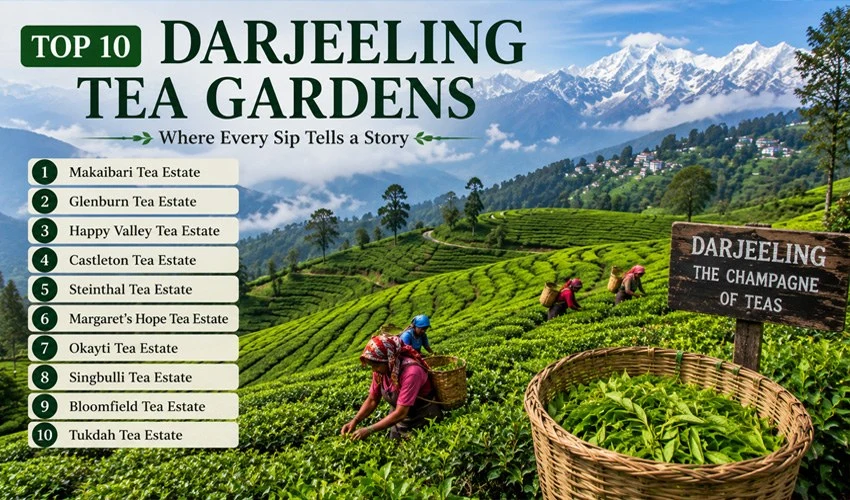
Long before Darjeeling became known for its misty hill views and the toy train that winds through the mountains, it was already famous for one thing: tea. Ever since British planters began cultivating tea bushes on these Himalayan slopes in the 1850s, Darjeeling has produced a brew so distinctive that connoisseurs around the world refer to it as the “Champagne of Teas.” Today, dozens of tea estates blanket the hillsides in neat, rolling rows of green, each one carrying its own history, flavor profile, and story to tell.
For any traveler visiting this corner of West Bengal, a walk through a working tea garden is every bit as essential as a sunrise view of Kanchenjunga. Many estates now welcome visitors with guided factory tours, tea-tasting sessions, and even overnight stays in colonial-era bungalows surrounded by endless tea bushes. Here are ten of the most remarkable tea gardens in Darjeeling that deserve a spot on your itinerary.
1. Happy Valley Tea Estate
No list of Darjeeling’s tea gardens would be complete without Happy Valley, one of the oldest and most visited estates in the region. Established in the mid-1800s and located just a short drive from the town center, Happy Valley has become something of a gateway experience for first-time visitors curious about how tea actually gets made. Because it sits so close to Darjeeling itself, it’s easily accessible even for travelers with limited time, and its guided tours walk visitors through every stage of production, from hand-plucking tender leaves to the traditional orthodox processing method used to bring out the tea’s distinctive character. A cup brewed fresh on-site, enjoyed with a view of the surrounding Himalayan slopes, is a simple pleasure that sums up why people fall in love with this town.
2. Makaibari Tea Estate
If Happy Valley represents accessibility, Makaibari represents heritage and philosophy. Established in 1859, it holds the distinction of being one of the first tea estates in the region to build its own processing factory, and it has remained under the stewardship of the same founding family for generations. What sets Makaibari apart today is its deep commitment to organic and biodynamic farming practices, treating tea cultivation as inseparable from community wellbeing and environmental sustainability. Visitors often come away struck by how the estate frames tea-making not merely as an agricultural process, but as a way of life passed down through generations. It’s also known for producing some of the most expensive and sought-after teas to come out of Darjeeling.
3. Glenburn Tea Estate
For travelers seeking a more immersive, luxurious experience, Glenburn is frequently cited as one of the finest tea estates not just in Darjeeling, but in the country. Perched amid dramatic hillside views, Glenburn has transformed part of its property into an elegant retreat where guests can stay in beautifully restored planter’s bungalows, take guided nature walks through the tea bushes, and sample teas known for their naturally fragrant, malty character. It’s the kind of place where a simple tea-tasting session turns into an afternoon of quiet indulgence, surrounded by nothing but green hillsides and mountain air. For anyone hoping to combine a tea garden visit with a proper relaxing getaway, Glenburn is hard to beat.
4. Puttabong Tea Estate
Puttabong holds a special place in the history of Darjeeling tea as the very first estate established in the region, and it remains one of the largest to this day. Spread across a dramatic elevation range and offering sweeping views of snow-capped Kanchenjunga in the distance, Puttabong was also the first estate to introduce mechanized pruning and to trade its tea commercially, effectively kickstarting the industry that would come to define this entire region. The estate cultivates a mix of Darjeeling clonal varieties and older Chinary bush stock, specially suited to the area’s unique climate and altitude. Walking through its expansive plantation rows, it’s easy to appreciate just how much of Darjeeling’s tea legacy traces back to this single estate.
5. Singtom Tea Estate and Factory
Singtom has earned a reputation as one of the most visually captivating tea gardens in the region, with rolling hills, lush greenery, and architecture that gives the estate a distinct sense of old-world charm. It’s frequently mentioned alongside Happy Valley as one of the estates most enchanting to simply walk through, even for visitors who aren’t especially interested in the technical side of tea production. The estate’s factory tours offer a comprehensive look at how raw leaves are transformed into the finished product, while the surrounding scenery alone makes it worth the visit for photographers and casual travelers alike.
6. Sourenee Tea Estate
Located a short distance before the scenic Mirik Valley along the Siliguri-Mirik-Darjeeling route, Sourenee brings a slightly more upscale flavor to the tea estate experience. The estate is home to a striking three-story luxury bungalow that blends modern comforts with old-world character, and rooms here offer some of the finest views in the area — overlooking not just the estate’s own tea gardens, but the wider Mirik Valley and even distant peaks across the Nepal border. For travelers looking to pair their tea garden visit with a comfortable stay and panoramic mountain views, Sourenee is a compelling choice.
7. Gopaldhara Tea Estate
Set deep in the heart of the Mirik Valley, Gopaldhara is often ranked among the finest tea estates in Darjeeling for the sheer quality and craftsmanship of its output. Established in the mid-20th century, the estate has built its reputation on producing meticulously handcrafted specialty teas, including delicate silver-needle varieties and other prized small-batch blends that command attention among serious tea drinkers. Sitting at one of the higher elevations among the region’s tea gardens, Gopaldhara also rewards visitors with some genuinely spectacular mountain views, making it a favorite for those who want both exceptional tea and exceptional scenery in a single stop.
8. Singbulli Tea Estate
Spread gracefully across nine rolling hills, Singbulli is another estate that has embraced organic cultivation, offering certified organic teas to a growing base of health-conscious tea drinkers. The estate produces a well-rounded portfolio that includes first flush teas plucked in early spring, richer autumn flush blends, and clonal varieties bred specifically for the region’s growing conditions. Walking through Singbulli’s undulating landscape, with its neat terraces of tea bushes climbing and dipping across the hillsides, offers a particularly picturesque introduction to how topography shapes both the visual character and the flavor of Darjeeling tea.
9. Balasun Tea Estate
Known for its sweeping panoramic views, Balasun has built its reputation on full-bodied teas carrying a distinctive muscatel character — a naturally occurring grape-like sweetness that Darjeeling teas are particularly famous for. Beyond its flavor profile, Balasun is also a treat for the eyes, especially during spring when bright, colorful blossoms decorate the estate grounds alongside the tea bushes. The estate produces a range of blends, including traditional black teas and specially cultivated Darjeeling clonal varieties, giving visitors plenty to sample during a single stop.
10. Ging Tea House and Tea Estate
Rounding out this list is Ging, an estate that has leaned into offering a well-rounded, hospitality-driven tea experience for visitors. Beyond the standard factory tour, Ging emphasizes a broader cultural immersion — combining tea production insight with warm, welcoming service that lets visitors feel genuinely connected to the local community rather than simply passing through as spectators. It’s an ideal stop for travelers who want to understand not just how Darjeeling tea is made, but the everyday life and traditions that surround its cultivation.
Planning Your Tea Garden Tour
With so many estates spread across the hills of Darjeeling, Kalimpong, and Kurseong, it helps to plan your visits around a general theme, whether that’s history, luxury, organic farming, or scenic beauty. Many of the estates on this list can be combined into a single day trip if you’re based in Darjeeling town, while others — particularly those near Mirik Valley — are better suited to a dedicated overnight excursion.
The best time to visit largely depends on what you want to experience. The first flush harvest in spring produces some of the most delicate and prized teas of the year, while the second flush in early summer yields the fuller-bodied, muscatel-rich teas Darjeeling is best known for internationally. Regardless of when you visit, most estates offer guided tours that walk you through the plucking, withering, rolling, and drying processes that transform simple green leaves into one of the world’s most celebrated teas.
A Cup Worth the Journey
Visiting a Darjeeling tea garden is about more than sampling a good cup of tea — it’s about understanding the labor, tradition, and landscape that go into every leaf. From the historic grounds of Puttabong to the luxurious retreats of Glenburn and Sourenee, each estate offers its own window into this remarkable industry that has shaped the identity of an entire region. Whether you’re a devoted tea enthusiast or simply someone who appreciates beautiful scenery and a good story, a tour through these ten gardens will give you a newfound appreciation for exactly what’s in your cup the next time you brew a pot of Darjeeling tea.

