Nestled along the shimmering coastline of southern Tamil Nadu, Tiruchendur is a town where the sound of crashing waves mingles with the resonant chime of temple bells. It is a place that simultaneously belongs to the earthly realm and the divine — a living testament to Tamil Nadu’s spiritual depth, architectural brilliance, and ancient cultural legacy. Unlike many pilgrimage towns buried inland, Tiruchendur opens its soul to the sea, making it one of the most visually and spiritually arresting destinations in all of South India.
The town draws millions of pilgrims, historians, and curious travellers every year, not merely for the grandeur of its famous temple, but for the layered story it tells — of mythological battles, dynastic patronage, colonial intrusions, and an enduring people who have kept their traditions alive across millennia. Whether you are a devoted pilgrim seeking blessings, a student of history, or a traveller in search of authentic Tamil culture, Tiruchendur has something that will remain with you long after you leave.
Location: Where Land Meets the Sacred Sea
Tiruchendur is a coastal town situated in the Thoothukudi (Tuticorin) District in the southeastern part of Tamil Nadu, India. The town sits on the shoreline overlooking the Gulf of Mannar, placing it along one of the most historically significant maritime corridors in Asia. The surrounding landscape is characterised by arid, red soil terrain dotted with dense palm trees, cashew plantations, and salt flats — a scenery that feels ancient in itself.
Geographically, Tiruchendur is well-connected to key cities in the region. The nearest major city is Thoothukudi, approximately 40 kilometres away, while Tirunelveli lies about 52 kilometres to the north. The nearest domestic airport is Tuticorin Airport, approximately 30 to 40 kilometres from the town. For international travellers, Madurai International Airport (around 165–190 kilometres) and Thiruvananthapuram International Airport (around 175 kilometres) serve as the primary entry points. The town is also accessible by rail, with its own railway station that connects to Madurai, Chennai, and other major cities across Tamil Nadu.
The town itself is managed by the Tiruchendur Municipality and serves as a taluk headquarters, with jurisdiction over 10 local bodies and 46 surrounding villages. As per the 2001 Census, the town had a population of approximately 33,970 — a figure that swells dramatically during major religious festivals, when pilgrims from across India and even from Malaysia, Singapore, Sri Lanka, and other countries converge on this small coastal settlement.
The name “Tiruchendur” is deeply meaningful. It derives from the Tamil words Thiru (meaning holy or sacred), Chendur (meaning victory or triumph), and Ur (meaning town or place), translating roughly to “the holy town of the land of victory.” This name is not incidental — it reflects the town’s mythological identity as the battlefield where the divine overcame the demonic.
History: Dynasties, Devotion, and Colonial Encounters
Ancient Origins and Mythological Roots
The history of Tiruchendur is inseparable from its mythology, and its mythology is one of the most celebrated in all of Tamil Shaivism. According to the seventeenth-century Tamil text Kanda Puranam — and echoed in the Sanskrit Kumarasambhavam and the Skanda Puranam — this coastal stretch was the site of Lord Murugan’s final and most decisive battle against the demon king Surapadman.
As the legend narrates, Surapadman, having obtained powerful boons from Lord Shiva through severe penance, became arrogant and tyrannical. He conquered the three worlds — heaven, earth, and the netherworld — subjugated the devas (celestial beings), and even imprisoned Indra, the king of the gods. In desperation, the devas sought Lord Shiva’s intervention. Shiva’s third eye opened and produced six divine sparks, which eventually gave rise to the six-faced, twelve-armed god Murugan — born specifically to vanquish Surapadman.
Murugan led his celestial army to Tiruchendur, the final battleground. After a fierce and prolonged war, Surapadman took the form of a massive mango tree that spread across the three worlds. Murugan hurled his sacred vel (spear), splitting the tree in two — one half transformed into a peacock, which became his divine vehicle, and the other into a rooster, which became the emblem on his flag. After his triumph, Murugan worshipped his father Shiva at this very site, and the divine architect Mayan built the first shrine here to commemorate this victory.
While these events are mythological, the antiquity of the site’s religious significance is very much historical. References to Tiruchendur appear in ancient Tamil Sangam literature, dating roughly from the 2nd century BCE to the 2nd century CE, placing the site within the oldest stratum of Tamil cultural consciousness.
Dynastic Patronage
Over the centuries, Tiruchendur was shaped and reshaped by the great Tamil dynasties. The Pandyas, Cheras, Cholas, and later the Vijayanagara rulers each contributed to the temple’s development, expansion, and maintenance. There are four lithic (stone) inscriptions at the temple complex that date back more than a thousand years, many of them belonging to the Pandya Dynasty, providing invaluable historical records of royal patronage and religious activity.
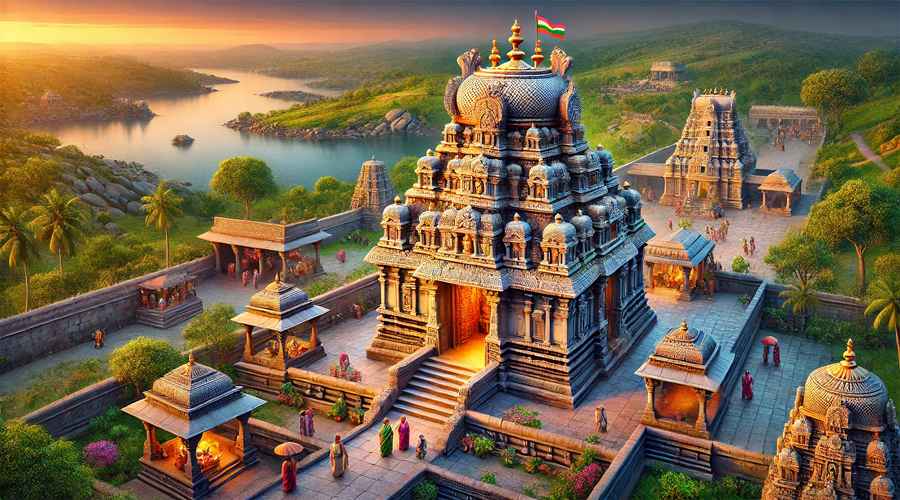
The Chera and Chola periods saw significant architectural additions to the original small sandstone structure. Over time, the modest seaside shrine grew into an expansive temple complex measuring 91 metres north to south and 65 metres east to west. The towering nine-tiered gopuram (temple tower), which rises to approximately 157 feet (48 metres), is believed to have been constructed around 300 years ago and remains one of the most striking examples of late Dravidian architecture anywhere in South India.
The Dutch Colonial Episode
One of the most remarkable — and little-known — historical episodes connected to Tiruchendur involves the Dutch East India Company. Between 1646 and 1648 CE, Dutch forces occupied the temple complex during their ongoing conflict with the Portuguese in the region. The local populace resisted and protested vehemently, and the Dutch were eventually evicted on the orders of Thirumalai Nayak, the Nayak ruler of the region.
However, as they departed, the Dutch seized two utsava murtis (processional idols) of Lord Murugan and carried them away aboard their ships. During the sea voyage, the ships reportedly encountered violent storms, and in panic, the Dutch sailors dropped the idols into the ocean. The idols were later miraculously retrieved from the sea by a local devotee named Vadamlaiyappa Pillai in 1653. This dramatic episode is depicted in a series of paintings preserved within the temple complex, making them among the most historically layered artworks in any South Indian temple.
Architecture: A Temple Unlike Any Other
The Arulmigu Subramaniya Swamy Temple at Tiruchendur stands in a class of its own in terms of architecture. While most major South Indian temples are built atop hills or set back from water, this temple hugs the flat coastline, with the rear of the temple structure facing the sea directly. The sound of waves is an ever-present accompaniment to prayer here.
The temple is constructed primarily from sandstone, which distinguishes it from the granite-heavy construction more typical of South Indian temple architecture. Its most prominent feature — the towering Mela Gopuram — faces west, another architectural anomaly, since most Tamil temples orient their primary tower to the east.
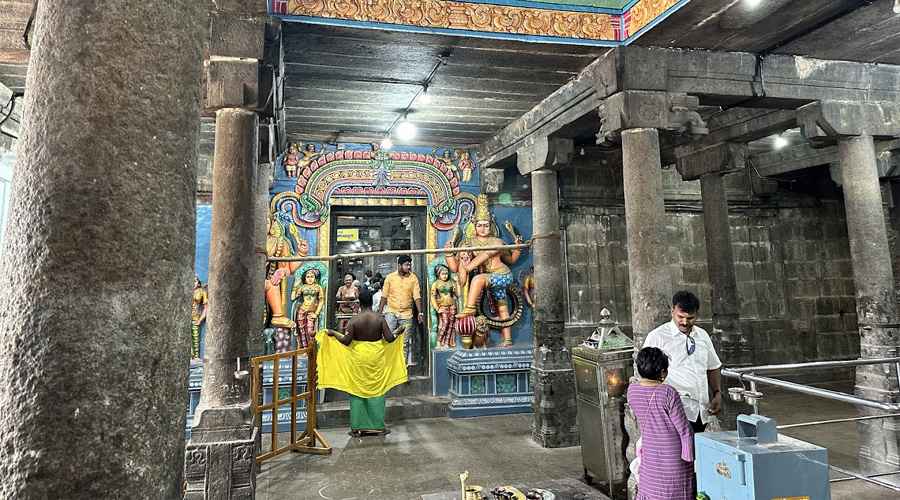
Inside, the mandapam (pillared hall) features 124 intricately carved pillars, each a detailed narrative in stone. The inner sanctum houses the main deity — Lord Murugan carved in granite, depicted in a standing, saintly-child form. A sacred freshwater spring known as Nali Kinaru (or Nazhikkinaru) sits approximately 100 metres south of the main complex; its water is considered medicinal and holy by pilgrims.
In 2016, the temple became the fourth Hindu temple in Tamil Nadu to receive an ISO certification, a recognition of its management standards, heritage preservation, and visitor facilitation — a remarkable achievement for a site of such ancient origin.
Culture: Tamil Heritage at Its Richest
Language and Literature
Tiruchendur’s cultural identity is rooted in the Tamil language, one of the world’s oldest living classical languages. The town’s spiritual and literary significance extends back to the Sangam era, and the temple has been sung about by the Tamil Shaivite saint Nayanar Appar, whose devotional verses form part of the Tevaram corpus, one of the crown jewels of Tamil devotional literature.
The medieval poet-saint Arunagirinathar composed numerous verses from the Thiruppugazh, one of the most celebrated bodies of Tamil devotional poetry, in praise of Murugan at Tiruchendur. Recitations of these hymns remain a living tradition at the temple, with devotional singing sessions held regularly, bridging the literary and spiritual life of the community.
Festivals
Tiruchendur’s festival calendar is as vibrant as its skyline. The most significant celebration is Skanda Sashti, held in October or November, which commemorates Murugan’s victory over Surapadman. The centrepiece of this festival is Surasamharam — a live, dramatic reenactment of the mythological battle, performed with tremendous energy and attended by thousands of devotees. The scenes unfold against the backdrop of the sea, creating a theatrical spectacle with deep religious resonance.
Vaikasi Visakam, which celebrates Murugan’s divine birth, and Thai Poosam, marked by elaborate Kavadi (ornate devotional offerings carried on the shoulders) processions, are other important festivals. During these occasions, devotees undertake acts of devotion and penance, including tonsuring their heads and carrying decorated frameworks as physical offerings to the deity. The temple also celebrates two major Brahmotsavams (grand consecration festivals), each lasting twelve days, during which tens of thousands of pilgrims gather from across the country and the diaspora.
Music, Dance, and Daily Rituals
Music is woven into the daily life of Tiruchendur’s temple. Six pujas (worship sessions) are conducted each day, each accompanied by nadaswaram (a classical wind instrument) and Vedic chanting, creating a soundscape that is both ancient and deeply moving. This musical tradition has been maintained without interruption for centuries and forms one of the most authentic expressions of Tamil Agamic temple culture.
Classical dance forms such as Bharatanatyam are performed during major festivals, honouring the aesthetic dimension of devotion that is central to Tamil Shaivism. These performances are not merely entertainment but a form of worship, linking the body, the arts, and the divine in a single, seamless expression.
Local Life and Economy
Beyond its spiritual identity, Tiruchendur sustains itself through a blend of tourism, fishing, and agriculture. The local fishing community has inhabited this coastline for generations, and the sight of colourful fishing boats on the Gulf of Mannar is as much a part of the town’s character as the temple tower on the horizon. Traditional crafts, local cuisine featuring seafood prepared in authentic Tamil styles, and the warm, unhurried rhythm of coastal life give Tiruchendur a texture that goes well beyond pilgrimage tourism.
Tiruchendur as One of the Six Abodes of Murugan
Tiruchendur holds a place of supreme importance within the Arupadai Veedu — the six sacred abodes of Lord Murugan. The other five are Palani, Swamimalai, Thiruthani, Pazhamudircholai, and Kutralam (Thiruparankundram). Together, these six temples define the devotional geography of Tamil Nadu for the millions who follow the Kaumaram tradition. Of the six, Tiruchendur is unique in being the only one situated directly on the seashore, adding a cosmic drama to its already powerful spiritual presence.
Conclusion
Tiruchendur is not simply a pilgrimage town. It is a place where mythology becomes landscape, where history is carved in stone and painted in colour on temple walls, and where Tamil culture continues to breathe and evolve with each wave that breaks upon its ancient shore. From the triumph of the divine as told in the Kanda Puranam, to the colonial intrigues of the Dutch era, to the UNESCO-level heritage of its living temple traditions, every layer of Tiruchendur rewards the attentive visitor.
To visit Tiruchendur is to step into the deep current of Tamil civilisation — a civilisation that has, for over two thousand years, found in this sacred stretch of coastline a meeting point between the human and the divine, between the temporal and the eternal. For those who come with open eyes and an open heart, Tiruchendur does not merely tell its story. It lets you feel it.