Tucked deep within the forested hills of West Sikkim, Khecheopalri Lake is one of those rare places that manages to be both a serious pilgrimage site and a quiet nature retreat at the same time. Far from the bustle of Gangtok and even a step removed from the more visited town of Pelling, this small emerald lake draws travelers who want something more contemplative than a typical sightseeing stop. Whether you’re drawn by its religious significance, its untouched natural setting, or simply the promise of Himalayan foothill scenery without the crowds, Khecheopalri Lake rewards the effort it takes to reach it.
Where Is Khecheopalri Lake?
Khecheopalri Lake sits at an elevation of around 1,700 meters (about 5,600 feet) near Khecheopalri village in the West Sikkim (Gyalshing) district. It’s located roughly 147 kilometers west of Gangtok, Sikkim’s capital, and about 34 kilometers northwest of Pelling, one of the more popular base towns for exploring this part of the state. The lake also lies close to Yuksom, the historic first capital of Sikkim, which sits around 26 kilometers away.
The nearest airport is Bagdogra, roughly 165 kilometers from the lake, while the nearest railway station is New Jalpaiguri, about 162 kilometers away — both located in neighboring West Bengal. Most travelers combine a flight or train journey to these hubs with a road trip into the Sikkim hills, often breaking the journey overnight in Gangtok or Pelling before continuing on to the lake.
The drive itself is part of the experience. Roads wind through terraced hillsides, pine and rhododendron forests, and small Sikkimese villages, with occasional glimpses of the Kanchenjunga range on clear days. It’s worth noting that during the monsoon months, landslides and road blockages are common in this region, so it’s wise to check current road conditions before setting out, particularly if you’re traveling between June and September.
The Legends Behind the Lake
What sets Khecheopalri apart from countless other scenic lakes in the Himalayas is the sheer depth of belief woven around it. Its original name, Kha-Chot-Palri, translates roughly to “the heaven of Padmasambhava,” a reference to Guru Padmasambhava, the revered figure who is credited with bringing Buddhism to the Himalayan region. Locally, the lake is also known as Sho Dzo Sho, meaning “Oh Lady, Sit Here.”
The lake is sacred to both Buddhists and Hindus, a rare instance of shared religious reverence that speaks to Sikkim’s layered spiritual history. Buddhists believe the lake’s waters are blessed by Padmasambhava and the goddess Tara, while Hindus associate the site with Lord Shiva, with some legends holding that the lake was formed when Shiva stepped onto the ground, or that he once meditated in a nearby cave overlooking the water.
Perhaps the most famous local legend is the story of the lake’s shape. Viewed from a lookout point on the surrounding hills, Khecheopalri is said to resemble a footprint — some say it is the footprint of Padmasambhava, others say it belongs to Shiva. In broader Sikkimese topographical folklore, the lake is also described as representing the human thorax, one of four sacred “plexuses” of the body, alongside Yuksom (the third eye), Tashiding (the head), and Pemayangtse (the heart).
The most enduring piece of local lore, though, is the belief that the lake’s surface is kept perpetually clear of leaves. According to tradition, birds swoop in and carry away any leaf that falls onto the water before it can float there, preserving the lake’s purity. Geologists offer a more measured explanation for the lake’s existence, generally dating its formation to ancient glacial activity roughly 3,500 years ago, but for most visitors, the mythology is very much part of the appeal.
Because of this sacred status, the lake has historically been off-limits for activities like fishing, boating, or swimming, and it remains a place meant primarily for quiet visits, prayer, and reflection rather than recreational use.
What to See and Do at Khecheopalri Lake
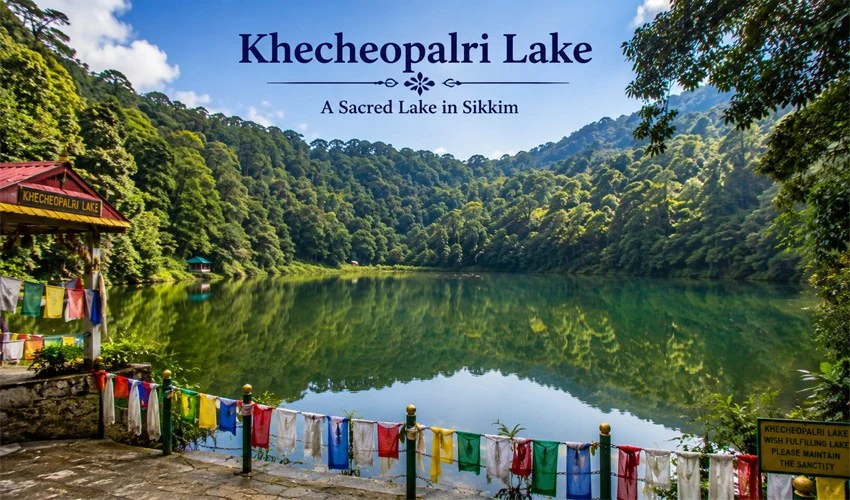
Walk the prayer-flag-lined path around the lake. A wooden walkway and forest trail circles part of the lake, strung with hundreds of colorful Buddhist prayer flags fluttering against the backdrop of dense hillside forest. It’s a peaceful, unhurried walk rather than a strenuous one, and it’s the best way to take in the lake’s stillness up close.
Visit during the Maghe Purne fair. One of the largest religious gatherings at the lake takes place over two days, typically falling in the February–March window tied to the Maghe Purne lunar calendar. Pilgrims travel from across Sikkim, Bhutan, Nepal, and other parts of India to take part, making it a striking time to witness the lake’s living cultural importance, though it also means significantly larger crowds than a typical visit.
Look out for the Chho-Tsho festival. Held in October after the local cardamom harvest, this festival is a community expression of gratitude and is a good opportunity to see local Sikkimese traditions that aren’t specifically aimed at tourists.
Explore Dupukney Cave. According to Hindu tradition, this cave sitting above the lake is where Lord Shiva is said to have meditated, and it’s a worthwhile short detour for those interested in the site’s dual religious significance.
Take in the surrounding forest and birdlife. The lake sits within a roughly 12-square-kilometer forested watershed of temperate broad-leaved trees, and the area is home to a range of Himalayan bird species. Even without a specific itinerary, simply sitting by the water and watching the interplay of mist, forest, and reflection is, for many visitors, the highlight of the trip.
Combine your visit with nearby historical sites. Since Khecheopalri lies within relatively easy reach of Pelling, it pairs naturally with a visit to the Pemayangtse Monastery, one of the oldest and most significant Buddhist monasteries in Sikkim, as well as the Rabdentse Ruins, the remains of Sikkim’s former second capital. The Kanchenjunga Falls near Pelling is another popular add-on for travelers building a fuller West Sikkim itinerary.
Getting There and Trekking Options
By road: The most common way to reach the lake is by hired taxi or shared vehicle from Pelling, a drive of about 1.5 to 2 hours covering roughly 34 kilometers. Vehicles are also easily arranged from Gangtok, Siliguri, Darjeeling, or Yuksom, though travel times from these points are naturally longer.
By trek: For those who prefer a slower, more immersive approach, a trekking route connects Pelling to Khecheopalri Lake, typically taking around 3–4 hours on foot through forested hill trails. This is a popular option for travelers who want to experience the landscape at ground level rather than from a car window, though it does require a reasonable level of fitness and is best avoided during heavy monsoon rain.
Entry and conservation fee: Access to the lake complex is generally through a ticketed entry point, with proceeds going toward the maintenance and conservation of the site — a small but meaningful contribution given the environmental pressure that increased tourism has placed on the lake’s surrounding flora and fauna in recent years.
Best Time to Visit
Khecheopalri Lake can generally be visited throughout the year with the exception of the peak monsoon months. The clearest, most comfortable conditions typically fall between October and May, when skies are more likely to be clear and mountain views more visible. Winter months bring a crisp chill and occasional mist that adds to the lake’s mystical atmosphere, while the monsoon season (roughly June to September) brings heavy rainfall, increased leech activity on forest trails, and a higher risk of landslides affecting road access — all worth factoring in if you’re planning a trek rather than a straightforward drive.
Where to Stay
Accommodation directly at Khecheopalri village is modest, consisting mainly of small lodges, trekkers’ huts, and homestay-style options rather than large hotels or resorts. Because of this, many travelers choose to visit the lake as a day trip from Pelling or Yuksom, both of which offer a wider range of hotels and guesthouses, and then return for a comfortable night’s stay. If you do want to stay closer to the lake itself, it’s worth booking ahead, particularly around the Maghe Purne fair when local lodging fills up quickly.
Final Thoughts
Khecheopalri Lake isn’t a destination you rush through. Its appeal lies less in dramatic scenery — though the setting is genuinely beautiful — and more in the atmosphere it holds: centuries of shared Buddhist and Hindu devotion, quiet forest trails strung with prayer flags, and a sense that this small stretch of water has meant something significant to the people around it for a very long time. For travelers exploring West Sikkim, pairing a visit here with Pelling’s monasteries and ruins offers a rounded picture of the region’s history and spirituality — Khecheopalri Lake is well worth carving out the time for.