Some places earn the word “great” through reputation. A few earn it through scale. Very rarely does a single structure earn it through all of these things at once — through beauty, intellectual ambition, engineering audacity, and an unbroken thread of living worship stretching across more than a thousand years. The Brihadeshwara Temple in Thanjavur is one of those rarest places. Known by many names — Peruvudaiyar Kovil, Thanjai Periya Kovil, Rajarajesvaram, the Big Temple — it is recognized the world over as a UNESCO World Heritage Site, celebrated as the supreme expression of Dravidian temple architecture, and visited each year by pilgrims, scholars, architects, and travelers who arrive from every corner of India and beyond.
If you are planning a trip to Tamil Nadu in 2026, the Brihadeshwara Temple is not simply a box to tick on a sightseeing list. It is an experience that reshapes the way you think about what ancient people were capable of imagining and building. This complete guide covers everything you need to know: history, architecture, timings, entry details, how to get there, what to see nearby, and the practical insights that make the difference between a rushed hour and a genuinely transformative visit.
The Name: What It Means and Why It Matters
The Sanskrit name Brihadeshwara translates as “the Great Lord” — brihat meaning great, and ishwara meaning lord, a title of Shiva. The temple was originally named Rajarajesvaram by its builder, meaning “The Lord of Rajaraja,” a fusion of the divine and the royal that reveals the depth of personal devotion behind its construction. Over the centuries it became known in Tamil as Peruvudaiyar Kovil (“Temple of the Great Lord”) and colloquially as Thanjai Periya Kovil — “Thanjavur Big Temple” — a name that is unpretentious, direct, and accurate in the most literal sense.
It is also referred to as Dakshina Meru, the Meru of the South — an invocation of the cosmic mountain of Hindu cosmology and a claim that this temple, in the flat river delta of the Kaveri, rises with the same sacred authority as the mythic axis of the universe.
History: A Thousand Years in Stone
The Vision of Rajaraja Chola I
The story of the Brihadeshwara Temple begins in the late tenth century CE, when a prince named Arulmozhivarman ascended the Chola throne and took the regnal name Rajaraja Chola I. By the time he commissioned the temple, Rajaraja I had already transformed the Chola Empire into the most powerful state in South Asia. His armies had subdued the Pandyas and Cheras of the peninsula, conquered Sri Lanka, and projected Chola naval power deep into Southeast Asia. His treasury was vast, his ambitions were grand, and his personal devotion to Shiva was profound.
According to epigraphical records, Rajaraja I initiated the construction of the temple in his 19th regnal year and completed it on the 275th day of his 25th year — a total construction period of just six years, concluding in 1010 CE. This was not merely a temple but a statement: a declaration to the known world that Chola civilization had reached its zenith, and that its king intended to leave a monument that time itself would struggle to erase.
The emperor named the presiding deity Peruvudaiyar and installed a massive Shiva lingam — approximately 12 feet in height — in the innermost sanctum. He populated the new temple complex with an extraordinary administrative and cultural apparatus. An inscription on the north wall of the enclosure, dated 1011 CE, records the names and roles of more than 600 people employed by the temple — priests, lamp-lighters, washermen, tailors, jewelers, potters, carpenters, dance gurus, devadasi dancers, singers, musicians, and accountants, among others. Their wages were paid in land, and the temple functioned as a living institution of cultural patronage and civic sustenance as much as a place of worship.
Centuries of Change and Continuity
The millennium following its consecration was not uneventful. The temple suffered damage from raids and wars, particularly conflicts between the Muslim Sultans who controlled Madurai and the Hindu kings of Thanjavur, but these were repaired by Hindu dynasties that regained control. Each succeeding dynasty that held Thanjavur — Nayakas, Marathas, and others — left its mark on the complex, adding shrines, mandapams, and paintings to what was already there. The significant shrines of Kartikeya, Parvati, and Nandi are from the 16th and 17th-century Nayaka era, and the Dakshinamurti shrine was built later; the temple was also well-maintained by the Marathas of Thanjavur.
The Brihadeshwara Temple was designated a UNESCO World Heritage Site in 1987. In 2004, the UNESCO site was extended to include the Gangaikondacholisvaram Temple, built by Rajaraja’s son Rajendra I in 1035, and the Airavatesvara Temple built by Rajaraja II in the 12th century — together forming the grouping known as the Great Living Chola Temples. The word “living” is deliberate: unlike so many ancient monuments that survive only as archaeological relics, the Brihadeshwara Temple has never ceased to function as an active center of Hindu worship, its daily rituals unbroken across more than a thousand years.
Architecture: Engineering That Defies Its Era
The Scale and Concept
To understand the architecture of the Brihadeshwara Temple is to understand ambition translated directly into stone. The temple complex is a rectangle covering 240.79 metres east to west and 121.92 metres north to south, classified as a Perunkoil — a big temple built on a higher platform. The entire complex is built from granite, a material not found locally in the Thanjavur region. The nearest granite sources are at least 30 miles away up the Kaveri River, and the temple is estimated to contain 40 times as much stone as the average Chola temple. Moving these blocks — some weighing multiple tons — across tens of kilometres of terrain without mechanical assistance remains one of the most remarkable logistical achievements of the ancient world.
The temple was constructed with no mortar, no steel, and no machinery — granite blocks weighing tons were hauled over 50 kilometres and lifted to heights of over 200 feet with a system of ramps and rollers, centuries before cranes existed.
The Vimana: A Tower Without Equal
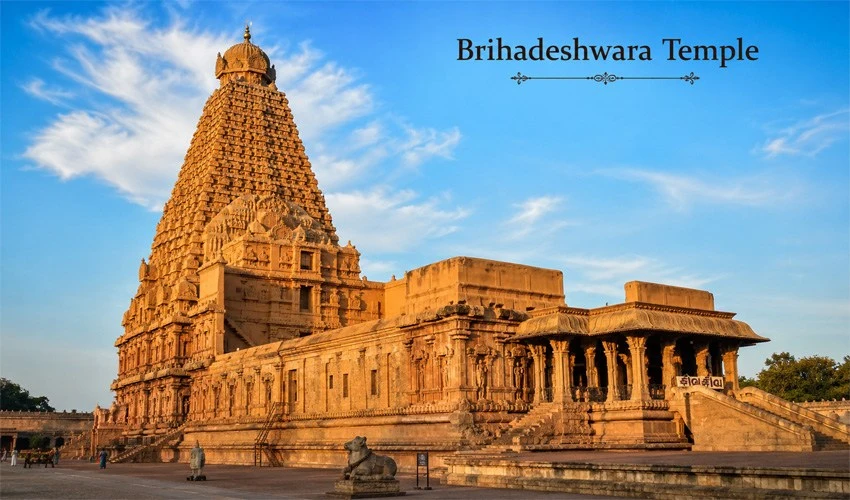
At the heart of the complex stands the vimana — the tower above the sanctum — and it is this structure that has defined the Brihadeshwara Temple in the imagination of the world. The 13-tier tower over the sanctum rises to 216 feet in height, built in Dravidian style. At its summit sits the Shikhara — a cupola carved from a single monolithic piece of granite that weighs approximately 80 tons. The prevailing theory is that a ramp approximately 2 kilometres long was constructed at a gradient gentle enough to haul the capstone to its position without cracking or splitting it. The engineering precision required to design, position, and stabilize an 80-ton monolith at a height of 216 feet — using only human and animal power — is a feat that modern engineers continue to study and marvel at.
One of the temple’s most frequently cited phenomena is astronomical in nature: due to the unique construction of its basement and the angle of the vimana, the temple’s shadow never falls on the ground at noon during any part of the year. Whether by deliberate design or fortunate consequence of precise geometry, this characteristic has contributed to the temple’s aura of the miraculous.
The Nandi and the Inner Sanctum
The inner part of the temple begins with a large Nandi mandapa that houses a 12-foot tall monolithic idol of Nandi — the sacred bull and vehicle of Lord Shiva. This Nandi was added during the Nayaka era and faces the main sanctum in the posture of eternal devotion, eyes fixed on the lingam within. It is one of the largest monolithic Nandi statues in India.
The innermost chamber, called the Karuvarai or womb chamber, houses the Shiva lingam and only priests are permitted to enter this area. Devotees receive darshan from the threshold, where the scale of the lingam and the depth of the sanctuary create an overpowering sense of sacred presence.
The outer walls of the sanctum are adorned with an extraordinary sculptural programme. The eight Ashtadikpaalakas — Guardians of the Directions — stand in their niches, each accompanied by attendant figures. Dakshinamurti, Brahma, Vishnu, Durga, and Surya are represented in various parts of the complex. The interior walls and corridor ceilings carry two distinct layers of fresco painting: the deeper Chola-era murals and the later Nayaka additions painted on top of them, a palimpsest of artistic history that conservation experts have painstakingly worked to document and preserve.
Layout and Enclosures
The temple complex uses a strictly axial and symmetrical geometry. It is surrounded by two concentric enclosure walls, the outer one featuring a large gopuram gateway. In a purposeful architectural decision that distinguishes the Brihadeshwara Temple from virtually all later South Indian temples, this entrance gopuram is designed to be shorter than the main vimana. In the centuries that followed, temple builders across Tamil Nadu gradually reversed this relationship — making their entrance towers progressively taller than their sanctum towers. At Thanjavur, the original intention — that the vimana of the deity should dominate all else — remains perfectly intact and visually uncompromised.
Temple Timings (2026)
The Brihadeshwara Temple is open to visitors every day of the year, including public holidays, and follows a split schedule with a midday closure for rituals.
- Morning Session: 6:00 AM – 12:30 PM Evening Session: 4:00 PM – 8:30 PM
- The day’s ritual cycle begins with the Thiruvanandal at 6:00 AM and closes with the Ardha Jama Pooja before the temple shuts at 8:30 PM. Six or more distinct poojas are conducted across the day at prescribed hours. On major festival days — particularly Maha Shivaratri, Arudra Darshan, and the Sadhaya Vizha (the birth anniversary of Rajaraja I, celebrated in the Tamil month of Aippasi) — timings may be extended and ritual programmes significantly elaborated. Confirming timing details with the temple office or checking official notices before visiting during major festivals is strongly advisable.
- Entry Fee: Darshan and heritage access are completely free of charge for all visitors.
- Time Required: A thorough visit covering the main sanctum darshan, the circumambulatory corridor with its frescoes and sculptures, the Nandi mandapa, and the outer enclosures requires a minimum of 2 to 3 hours. Visitors with a deeper interest in the inscriptions, art history, or architectural details may wish to budget considerably more.
Travel Guide: Getting There in 2026
- By Air: The nearest airport is Tiruchirapalli International Airport (TRZ), approximately 55 km from Thanjavur. Taxis are readily available from the airport to Thanjavur. The journey takes approximately 1.5 to 2 hours by road.
- By Rail: Thanjavur Junction is well-connected to major cities including Chennai, Madurai, and Trichy. The railway station is about 2 km from the temple. Several express trains serve the route from Chennai, with journey times of approximately 7 to 8 hours.
- By Road: Regular bus services operate from Chennai (350 km), Trichy (55 km), and Madurai (150 km). State highway connectivity is strong, and the drive from Trichy in particular is pleasant, passing through the fertile Kaveri delta landscape.
- Local Transport: Auto-rickshaws, taxis, and cycle rickshaws are available for local transportation within Thanjavur, and most city attractions are within 5 km of the temple.
Visitor Tips and Essentials
- Dress Code: There is no strictly enforced dress code, but visitors are suggested to dress traditionally and avoid modern clothing such as mini-skirts, low-waist jeans, shorts, and sleeveless tops within the temple premises. Modest, respectful attire is both appropriate and expected.
- Footwear: Shoes must be removed before entering the inner complex. Footwear counters are available near the main entrance.
- Photography: Photography of the architectural elements and courtyard is generally permitted. Photography within the inner sanctum and during active rituals is restricted — follow notices displayed at each threshold.
- Guides: Official guides licensed by the Archaeological Survey of India are available at the temple entrance and are highly recommended. The inscriptions, sculptural narratives, and fresco layers require informed interpretation to be fully appreciated.
- Best Time to Visit: The best time to visit is from October to March when the weather is pleasant. Early mornings and late afternoons are ideal to avoid crowds and heat — the temple is particularly beautiful during sunrise and sunset.
- Accessibility: The temple complex is largely on level ground and accessible to visitors with mobility considerations, though some inner corridor thresholds have raised stone steps.
What to See Nearby
Thanjavur is a city of layered cultural riches, and the temple anchors an area rich in heritage. The Thanjavur Royal Palace, built by the Nayaka rulers from around 1550 CE, houses an exceptional art gallery and the extraordinary Sarasvati Mahal Library — one of Asia’s finest collections of rare manuscripts, palm-leaf texts, and historical documents spanning multiple languages and centuries. Siva Ganga Garden, situated between the temple and Schwartz Church, is a pleasant green space for rest between sightseeing stops.
Thanjavur is also the heartland of traditional bronze casting and Tanjore painting, and several workshops in the old town offer the chance to observe these crafts being practised much as they have been for centuries. A traditional Tamil meal served on a banana leaf at one of the family-run restaurants near the old town is a fitting conclusion to a day spent in one of South India’s greatest cultural cities.
A Monument That Lives
What separates the Brihadeshwara Temple from all but a handful of monuments in the world is that it has never become merely historical. The stone has aged, the frescoes have dimmed in places, and dynasties have risen and fallen around it — but the bells still ring at dawn, the oil lamps still burn in the inner corridors, and the priests still conduct the same sequence of sacred rites that Rajaraja Chola I would have recognized a thousand years ago. It is a place where history and the present exist simultaneously, and where human ambition, at its most creative and devout, has genuinely produced something timeless.
Whether you arrive in Thanjavur as a pilgrim, a history enthusiast, an architect, or simply someone looking to understand what India has contributed to the world’s heritage, the Brihadeshwara Temple will meet you exactly where you are and show you something you will not forget.