There are temples you visit, and there are temples that visit you — staying in your memory long after the incense smoke has cleared and the journey home is done. The Brihadeeswarar Temple in Thanjavur, known simply and lovingly as the Thanjavur Big Temple, belongs firmly to the second category. Rising from the sun-baked plains of Tamil Nadu with commanding authority, its granite tower visible from kilometres away, this thousand-year-old masterpiece is not merely a place of worship. It is a declaration — of Chola ambition, engineering genius, and a civilization’s absolute confidence in the permanence of beauty.
Designated a UNESCO World Heritage Site, the Brihadeeswarar Temple is one of the most visited monuments in South India and one of the most significant temples in the Hindu world. Whether you arrive as a pilgrim seeking Lord Shiva’s blessings, a history enthusiast tracing the arc of the Chola Empire, or an architecture lover in search of the Dravidian style at its most sublime, the Big Temple will exceed your expectations in every direction.
The History Behind the Stone
The story of the Thanjavur Big Temple begins with one of ancient India’s most consequential rulers: Arulmozhivarman, who reigned as Rajaraja Chola I from 985 to 1014 CE. At the height of his power, commanding an empire that stretched across peninsular India and reached into Sri Lanka and the Maldives, Rajaraja I turned his ambition toward an act of permanent devotion. He commissioned a temple that would surpass all existing Hindu shrines in scale, artistic sophistication, and architectural daring.
Construction began around 1003 CE and was completed by 1010 CE, an astonishing pace for a structure of such complexity. The emperor himself named it Rajarajesvaram — “The Lord of Rajaraja” — and consecrated the main deity, Lord Shiva in lingam form, as Peruvudaiyar, meaning “the Great Lord.” The temple’s popular Tamil name, Thanjai Periya Kovil, simply means “Thanjavur Big Temple,” and it has remained the affectionate local name for it ever since.
The temple was not merely an act of piety. It served as a political statement of extraordinary scale — a monument that announced to the known world that the Chola Empire had arrived at the peak of its power. Detailed inscriptions on the temple’s north wall, dated 1011 CE, record the names and roles of more than 600 people employed by the temple, from priests and lamp-lighters to dancers, singers, goldsmiths, and carpenters. Their wages were paid in parcels of land, suggesting the temple operated as a vast cultural and economic institution as much as a religious one.
Over the following centuries, the temple survived invasions, raids, and the slow decay of time. Subsequent dynasties — the Nayakas in the 16th and 17th centuries and the Marathas after them — made additions and restorations. The grand Nandi pavilion at the entrance was added during the Nayaka period. The temple turned a thousand years old in September 2010, an anniversary celebrated across Tamil Nadu with cultural events, the release of a commemorative postage stamp, and a special coin from the Reserve Bank of India.
Architectural Grandeur: Engineering the Eternal
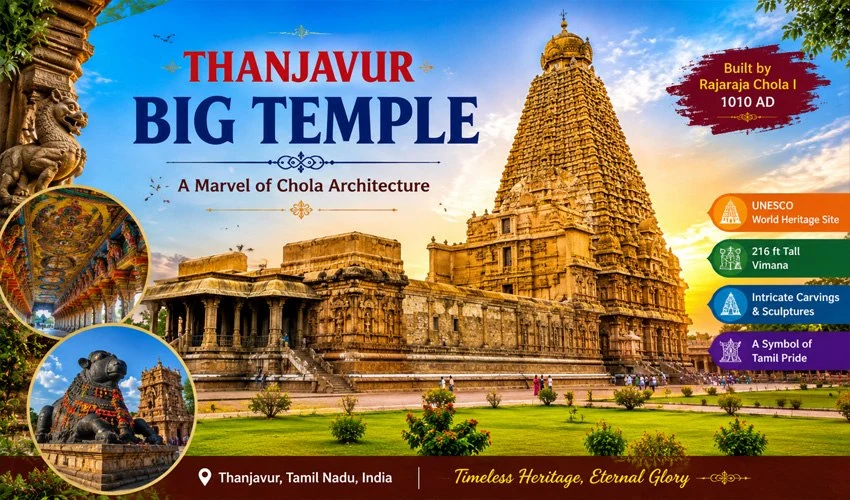
Standing inside the Brihadeeswarar Temple complex for the first time, you are confronted with the disorienting sensation that the building is impossible. The main vimana — the towering sanctum tower — rises to a staggering height of 216 feet (approximately 66 metres), making it one of the tallest temple towers in the world. Its sheer verticality against the flat Tamil Nadu sky creates a visual impact that photographs consistently fail to capture.
The entire complex is built from granite, with the nearest source of the stone lying at least 50 kilometres away along the Kaveri River. The logistics of quarrying, transporting, and precisely placing thousands of tons of granite using only 11th-century technology is staggering to contemplate. The temple is estimated to contain roughly 40 times as much stone as the average Chola temple of its era, a figure that speaks to the sheer concentration of imperial resources that Rajaraja I channeled into this single project.
The vimana is built without mortar — each stone is cut, shaped, and fitted with extraordinary precision, bonded and notched in a technique that relies entirely on stone-fitting skill rather than adhesives. The topmost element of the tower, a single monolithic stone called the Kumbam or Shikhara, weighs approximately 80 tons. How this massive capstone was placed atop the 216-foot structure remains one of ancient Indian engineering’s enduring mysteries. One theory suggests that a 6.4-kilometre earthen ramp was constructed at a gentle gradient, along which the stone was hauled — a ramp so gradual that the incline would have been almost imperceptible.
The foundation engineering is equally remarkable. The tower was built over a tank-like structure filled with sand from the rivers of the Western Ghats, creating what engineers would today call a dynamic foundation — one that absorbs and adjusts to ground movement. This is thought to be why the structure has survived earthquakes and the passage of a millennium in such excellent condition.
The main sanctum houses a massive Shiva lingam, approximately 12 feet tall, housed beneath the vimana’s extraordinary height. The outer walls of the complex are adorned with exquisite sculptures: the eight Ashtadikpaalakas, or Guardians of the Directions — Indra, Agni, Yama, Nirrti, Varuna, Vayu, Kubera, and Isana — each represented by two six-foot statues. Dakshinamurti, Parvati, Murugan, and Vishnu are also enshrined in the complex, along with hundreds of carved figures drawn from Hindu mythology across the corridor walls.
Among the temple’s most celebrated features is the monumental Nandi statue at the entrance. Carved from a single rock, the sacred bull stands 13 feet high and 16 feet wide, weighing around 20 tons. This Nandi, added during the Nayaka era, faces the main sanctum in the traditional posture of eternal devotion, gazing always toward Lord Shiva.
The interior walls and ceilings of the circumambulatory corridor contain remarkable frescoes painted in the Chola style — vibrant scenes of Shiva dancing the Nataraja, Shiva at Kailash, and scenes of royal ceremony. In certain sections, later Nayaka-era paintings were added directly over the original Chola work, a layering of artistic history that art historians have carefully studied to separate and document.
The complex as a whole is laid out on a strictly axial and symmetrical plan, surrounded by two concentric enclosure walls. The outer wall features a large gopuram — a gateway tower — that, in a deliberate architectural philosophy unique to the Brihadeeswarar Temple, is designed to be shorter than the main vimana. In most later South Indian temples, the outer gopuram eventually came to dominate the skyline; here, the sanctum tower retains its supremacy, exactly as Rajaraja I intended.
Temple Timings and Darshan Schedule
The Brihadeeswarar Temple is open to both pilgrims and tourists every day of the year, including public holidays. The temple follows a twice-daily schedule with a midday closure for rituals and rest.
Morning Session: 6:00 AM to 12:30 PM Evening Session: 4:00 PM to 8:30 PM
The temple conducts several daily rituals (poojas) according to Agamic tradition, beginning with the Thiruvanandal at 6:00 AM and concluding with the Ardha Jama Pooja late in the evening before the temple closes at 8:30 PM. On festival days and auspicious occasions, timings may be extended or modified, and it is advisable to check with the temple administration before visiting during major Hindu festivals.
Entry to the Brihadeeswarar Temple is completely free for all visitors, whether arriving for darshan or heritage exploration. On Sundays and during peak festival seasons when crowds are larger, a special fast-track darshan queue is sometimes available for a nominal fee of Rs. 5, which can significantly reduce waiting time.
A minimum of two to three hours is recommended to explore the complex with appropriate attention — the main sanctum, the Nandi pavilion, the circumambulatory corridor with its frescoes and sculptures, and the surrounding shrines each deserve unhurried observation.
Visitor Guide: Making the Most of Your Trip
- Best Time to Visit: The ideal months are October through March, when Thanjavur’s climate is pleasant and manageable. Summers (April–June) can be intensely hot, and while the monsoon months bring green beauty, movement around the open corridors and courtyards can be difficult. Early mornings and late afternoons offer the most comfortable conditions and the most atmospheric light.
- Photography: The temple complex and its architectural elements can be photographed freely. Cameras and mobile phones are generally permitted in the outer complex, though photography inside the main sanctum is restricted. Sunrise, when the vimana catches the golden morning light, and late afternoon offer the most dramatic photographic conditions.
- Dress Code: As an active place of worship, modest clothing is expected. Shoulders and legs should be covered. Footwear must be removed before entering the inner complex and can be deposited at the footwear counters near the entrance.
- Guides: Official guides licensed by the Archaeological Survey of India are available at the temple entrance and are highly recommended. A knowledgeable guide can interpret the sculpture narratives, explain the architectural innovations, and bring the inscriptions to life in ways that independent exploration cannot easily achieve.
- Getting There: Thanjavur is well-connected by rail and road. Thanjavur Junction railway station is approximately 1.5 kilometres from the temple, and the city is served by regular trains from Chennai (about 350 km), Trichy (55 km), and Madurai (150 km). The nearest airport is Tiruchirapalli International Airport, approximately 55–60 kilometres away, from which taxis are available. Within Thanjavur, auto-rickshaws are the most convenient mode of local transport.
- Nearby Attractions: The Thanjavur Royal Palace and its associated Sarasvati Mahal Library — home to a remarkable collection of ancient manuscripts and rare texts — is a short distance from the temple and well worth pairing with your visit. The Siva Ganga Garden, between the temple and Schwartz Church, is a pleasant space for a short rest. The town also has strong connections to Carnatic music and Tanjore painting, and several cultural centres offer insights into these living artistic traditions.
A Monument That Time Cannot Diminish
What strikes visitors most forcefully about the Thanjavur Big Temple is not any single element of its design but the totality of the experience — the way every detail, from the 80-ton capstone to the smallest carved figure in a corridor niche, reflects the same uncompromising standard of excellence. Rajaraja Chola I built this temple as a gift to Lord Shiva and as a statement to history, and in both purposes he succeeded beyond measure.
A thousand years after its consecration, the Big Temple remains an active center of worship where daily rituals are performed just as they have been across the centuries. It is at once a living temple and a monument to human ambition at its most constructive. Visiting it is not simply a cultural or spiritual obligation — it is an encounter with one of the finest things the human mind and hand have ever made.
Plan your visit carefully, arrive early, and give yourself the gift of unhurried time within its walls. The Thanjavur Big Temple will reward every moment you give it.