Agrasen Ki Baoli sits right in the middle of Connaught Place. One of Delhi’s busiest commercial corridors. And somehow, almost nobody walking past knows it’s there.
I’ve been writing about Indian travel for 10 years. I’ve done the Rajasthan circuit more times than I can count, crawled through cave temples in Ellora, gotten genuinely lost in Varanasi’s ghats. But Agrasen Ki Baoli stopped me cold in a way that still stays with me. It is one of the Most Haunted Places in Delhi that gives you a thrilling experience.
What Makes Agrasen Ki Baoli Famous?
Two things: the architecture and the atmosphere.
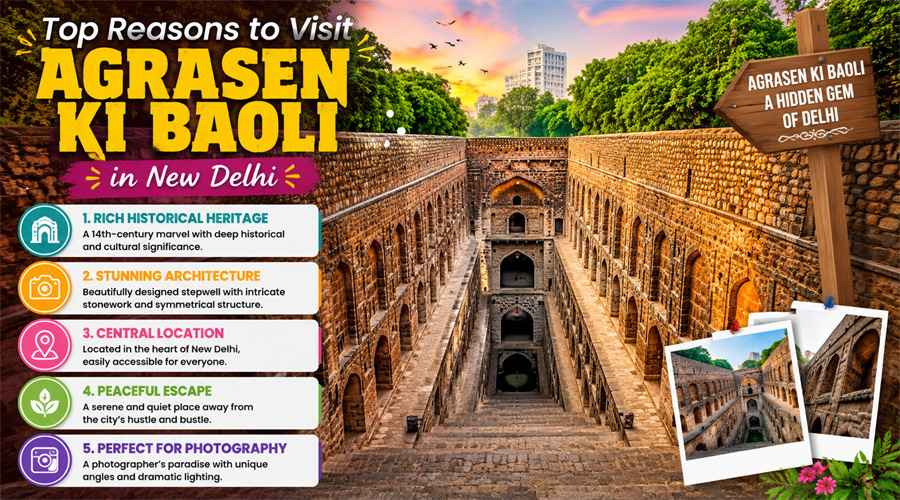
The stepwell drops 15 metres underground through 103 steps, flanked by 3 levels of arched galleries. It’s one of the most geometrically satisfying structures I’ve ever stood inside. That symmetry, those repeating arches, the way the walls converge as you go deeper.
Then there’s the other thing. The haunted reputation. Locals, paranormal enthusiasts, Bollywood filmmakers (PK was shot partly here) all talk about it. That story, I’ll get to.
My Journey to Agrasen Ki Baoli
I got there on a Tuesday morning, around 9:30 AM. Rickshaw from Connaught Place, 10 minutes, 60 rupees. Walked through a narrow lane off Hailey Road and then suddenly, there it was.
No grand entrance. No ticket counter. No crowd yet. Just a quiet stone mouth opening into the earth.
The Archaeological Survey of India maintains the site and entry is completely free. I had maybe 20 minutes of near-solitude before the first tour group arrived. If you want that, go early.
The Eerie Atmosphere Inside the Stepwell
I’ll be honest: I expected a nice photo location. What I didn’t expect was how genuinely unsettling the place feels.
It’s the acoustics, partly. Sound travels strangely down those walls. My own footsteps echoed back half a beat late. A pigeon flapping near the top sounded like it was right behind me.
But mostly it’s the stillness. Outside, Delhi roars. Inside Agrasen Ki Baoli, that noise cuts off almost completely by the time you reach the third level. There’s a specific kind of quiet that doesn’t feel empty. It feels occupied.
The water level is dry now. The base of the well shows cracked stone and dead moss. That dryness makes it feel more skeletal somehow, like seeing a body without blood.
History and Architecture
Nobody knows who built Agrasen Ki Baoli originally. The popular attribution goes to the legendary king Agrasen of the Agrawal community, supposedly from the Mahabharat era. Historians are skeptical. The current structure probably dates to the 14th century, during the Tughlaq or early Lodhi period.
What’s certain is the construction quality. The stepwell runs 60 metres long and 15 metres wide. Those 103 steps aren’t decorative. They were functional infrastructure, pulling water from the water table through 3 descending levels during Delhi’s dry months.
The arches are Indo-Islamic in style. Each row of niches on the side walls would have held oil lamps. Imagine walking down at night with that illumination flickering off the stone. Practical, yes. But also genuinely dramatic.
The Archaeological Survey of India declared it a protected monument in 1991. Restoration work is ongoing but restrained. They’ve kept it from crumbling without Disneyfying it. Good call.
Haunted Stories and Urban Legends
The most repeated story: the water in the baoli once turned black. Anyone who drank it felt compelled to jump to their death. Suicides, supposedly, were common here.
I can’t verify any of that historically. What I can say is that the place lends itself to dark stories. The geometry does something to your depth perception. Standing at the top and looking down, the bottom looks closer than it is. Your brain keeps recalibrating.
There’s also a story about figures seen in the arched alcoves at dusk. Shadows that don’t match any visible person. Multiple accounts from different people who didn’t know each other’s stories.
I was there in daylight. Nothing supernatural happened. But I’ll tell you this: when I climbed back out and the Delhi noise hit me again, I felt an actual physical relief. Like I’d been holding my breath without knowing it.
Photography Guide
This place is a photographer’s problem in the best way. Too many compelling angles.
Top-down shot: Stand at the first level, shoot straight down the staircase. The converging lines and repeating arches compress into something almost abstract. Best in morning light when sun hits the west wall.
Arch portrait: Sit inside one of the alcoves. The frame naturally becomes your frame. Works for portraits, works for lone landscape shots.
Water-level shot: Walk down to the dry base and shoot back up. The sky becomes a small rectangle. Delhi disappears. You could be anywhere, any century.
Golden hour is the answer but also the problem. Everyone knows golden hour is magic here. The place gets crowded between 4:30 and 6:30 PM. If you want empty frames, early morning wins. 8 to 9:30 AM.
Avoid midday. Harsh shadows and peak tourist traffic. The arches are deep and the light goes flat.
Best Time to Visit
October to March. Full stop.
Delhi summers are brutal. Standing in a stone chamber with limited airflow in May is not the meditative experience you’re looking for. The monsoon (July to September) makes the steps slippery and the humidity is punishing.
Winter mornings are the sweet spot. Mild temperature, soft light, fewer tourists. I went in late November and the conditions were close to perfect.
Timing within the day: 8 AM to 10 AM, or 3:30 PM to 6 PM. The site is open from 9 AM to 5:30 PM, so the morning window is tight. Get there when the gates open.
How to Reach Agrasen Ki Baoli
The stepwell is on Hailey Road, between KG Marg and Barakhamba Road, about 400 metres from Connaught Place.
Metro: Barakhamba Road station (Blue Line) puts you a 7-minute walk away. Best option.
Auto/cab: From Connaught Place, 60 to 80 rupees. Tell the driver “Hailey Road baoli” and they’ll know it.
Parking: Possible but annoying. The surrounding lanes are narrow. Metro is genuinely the better call here.
No entry fee. Open all 7 days. Timings: 9 AM to 5:30 PM.
Nearby Places to Explore
Jantar Mantar is 1.2 km away. Maharaja Jai Singh II built it in 1724 as an astronomical observatory. The instruments are massive and still functional. Worth an hour easily.
Connaught Place is right there. If you want coffee before or after, every major chain is within a 10-minute walk.
Lodhi Garden is 4 km south. Medieval tombs set in 90 acres of park. The contrast with Agrasen Ki Baoli’s tight, vertical geometry is interesting. Lodhi spreads outward. The baoli goes down.
Humayun’s Tomb is 6 km away. If you’re building a historical loop of the day, this is the logical next stop.
Frequently Asked Questions
Is Agrasen Ki Baoli actually haunted?
Nobody can say definitively. The atmosphere is undeniably strange. Paranormal? I’m a skeptic but I also can’t fully explain what that silence felt like.
Is photography allowed?
Yes, freely. Tripods are technically allowed but practically difficult on the narrow steps. Drones need ASI permission and that process is genuinely cumbersome.
How long do you need?
45 minutes to an hour for a thorough visit. Photography enthusiasts easily spend 2 hours.
Is it accessible for elderly or mobility-limited visitors?
The 103 steps are steep and uneven in places. The upper level is accessible. The full descent is challenging without good mobility.
Can you visit at night?
No. The site closes at 5:30 PM. Night visits aren’t permitted.
Conclusion
Agrasen Ki Baoli is one of those Delhi places that makes you recalibrate the city in your head. You’re standing in a medieval stepwell in the middle of a business district, and the 21st century just… doesn’t make it inside.
I’ve recommended this spot to every Delhi traveler I’ve talked to since my visit. Most of them come back saying they weren’t prepared for how it would feel.
That’s the thing about Agrasen Ki Baoli. The photos don’t do it. The Wikipedia entry doesn’t do it. You need to walk down those steps and let the city go quiet above you.
Then you’ll understand why people keep coming back.