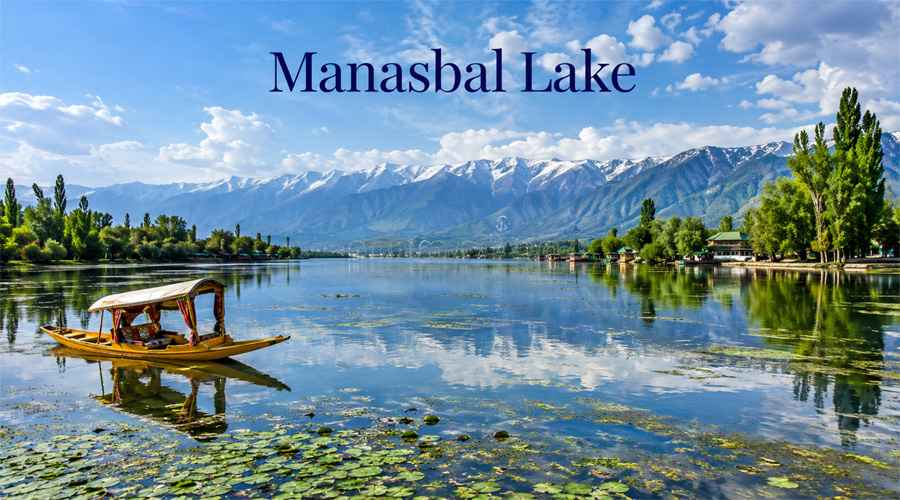
Nestled quietly in the Ganderbal district of Jammu & Kashmir, about 30 kilometres north of Srinagar, Manasbal Lake sits like a forgotten jewel in the lap of the Himalayas. Unlike the globally celebrated Dal Lake or the ethereally beautiful Wular Lake, Manasbal has managed to preserve a certain quietude — a stillness that feels almost sacred. It is not just Kashmir’s deepest freshwater lake; it is, by most accounts, the deepest freshwater lake in the entire Indian subcontinent, plunging to depths of approximately 13 to 14 metres. That singular distinction makes it not merely a tourist spot, but a geographical landmark of remarkable importance.
A Lake Born from the Mountains
Manasbal Lake spans an area of roughly 2.7 square kilometres, cradled between low-lying hills and agricultural plains. The lake is fed by natural springs and seasonal streams that descend from the surrounding ridges, keeping its waters perennially cool and surprisingly clear. The depth of the lake, so unusual for a valley waterbody, has historically contributed to a microenvironment that supports diverse aquatic life and a unique ecological balance not commonly found in the shallower lakes of the region.
The name “Manasbal” is believed to have Sanskrit origins, with some scholars connecting it to “Manasa,” a sacred concept denoting the mind or a divine lake in Hindu mythology. Whether or not this etymology holds precise historical accuracy, the spiritual undertone it carries seems fitting — there is an unmistakable meditative quality to standing at the lake’s edge at dawn, watching mist curl across the water while the Zabarwan Range looms silently in the distance.
The Lotus Phenomenon
One of the most visually striking features of Manasbal Lake is its extraordinary bloom of lotus flowers. Every summer, typically from July to September, the surface of the lake transforms into a vast canvas of pink and white. The lotus blooms here are among the densest in all of Kashmir, arguably surpassing even those of Dal Lake in sheer concentration and visual impact.
This annual spectacle draws photographers, naturalists, and travellers who are fortunate enough to know about it. Local fishermen navigate their wooden boats through corridors of floating lotus pads, creating images that seem to belong more to a painting than to reality. The lotus is not merely ornamental here — its roots, seeds, and stems are harvested by local communities, forming part of the traditional Kashmiri diet and trade economy that has existed for centuries.
A Birdwatcher’s Paradise
Manasbal Lake is a designated wetland of ecological significance, and for good reason. The lake and its surrounding marshlands serve as a critical stopover point on the Central Asian Flyway, one of the world’s major migratory bird routes. During the winter months and the transitional seasons, the lake hosts thousands of migratory birds including bar-headed geese, pochards, teals, mallards, and the majestic osprey.
The resident birdlife is equally impressive. Kingfishers, purple herons, little egrets, and various species of cormorants can be spotted throughout the year. For serious birdwatchers, a quiet morning at Manasbal — before tourist activity picks up — can yield sightings that rival those at far more celebrated birding destinations in the subcontinent. The lake’s depth and the relative absence of heavy motorised boat traffic mean that fish populations remain healthy, in turn sustaining the predatory birds that depend on them.
Mughal Gardens and Historical Significance
The shores of Manasbal Lake are not simply scenic — they carry layers of history embedded in their soil. The eastern bank of the lake is home to Jaroka, a Mughal-era garden that, though now in a state of partial restoration, once stood as one of the most refined pleasure retreats of the imperial court. Emperor Jahangir is said to have been particularly fond of Manasbal, referring to it in his memoirs with notable admiration. He reportedly called it the finest of all the lakes in Kashmir, a high compliment from a ruler who had access to the entire subcontinent’s beauty.
The Mughal connection gives Manasbal a historical depth that matches its physical one. The terraced gardens, now tended by the state’s Horticulture Department, still retain traces of their original design — stone pathways, water channels, and old chinar trees whose roots reach deep into the Mughal past. Visiting these gardens while overlooking the lake offers one of those rare experiences where landscape and history merge seamlessly.
The Villages Around the Lake
The communities that live around Manasbal are predominantly dependent on the lake for their livelihood. Fishing is the primary occupation, with species such as common carp, snow trout, and catfish pulled from the deep waters daily. The fishermen use traditional methods passed down through generations — long nets cast from wooden boats at specific hours, timed with an intimate knowledge of the lake’s rhythms that no modern instrument could replicate.
These villages also cultivate the surrounding agricultural land intensively, growing paddy, maize, and vegetables. The relationship between the local population and the lake is deeply symbiotic. However, in recent decades, this relationship has come under strain. Agricultural runoff, encroachment of built structures along the banks, and the gradual introduction of invasive aquatic plants have begun to alter the lake’s ecological character. Conservation organisations and the state government have flagged Manasbal as a priority wetland requiring intervention before the pressures of development cause irreversible damage.
Getting There and the Best Time to Visit
Manasbal Lake is accessible from Srinagar in approximately 45 minutes by road via the Srinagar–Sopore highway. The nearest major town is Safapora, from where the lake is only a short distance away. The roads are generally in reasonable condition, and both private taxis and shared cabs make the journey routinely.
The best time to visit Manasbal is between June and September, when the lotus blooms are at their peak and the weather in Kashmir is most hospitable to travel. July and August offer the most dramatic floral displays, while September carries a beautiful autumnal quality — the surrounding trees begin to turn, the crowds thin, and the lake takes on a more reflective, quieter mood. Winter visits, while cold, reward those who come with spectacular migratory bird activity and the rare experience of seeing the lake partially iced at its edges during the harshest weeks.
Why Manasbal Deserves More Attention
In the popular imagination, Kashmir’s lakes mean Dal and Nagin — their shikaras, houseboats, and floating markets forming the defining image of the valley for millions of visitors. Manasbal offers something profoundly different. It offers silence, depth — both literal and metaphorical — and an intimacy with nature that the more commercialised lakes can no longer provide.
There are no houseboats here, no crowded shikara rides, no floating markets bustling with noise. What Manasbal offers instead is the chance to sit undisturbed at the water’s edge, to watch a kingfisher dive and resurface, to see the morning light fracture across a thousand lotus blooms, and to feel, perhaps for the first time on a trip to Kashmir, that you have found something not yet manufactured for tourism.
The lake is a reminder that Kashmir’s natural wealth runs deeper than its famous postcard imagery. At 13 metres beneath the surface, Manasbal holds something that the more visited lakes have long since lost — an unbroken, unperformed wildness that rewards those willing to look beyond the obvious.
Conservation and the Road Ahead
Preserving Manasbal is not merely an environmental imperative — it is a cultural one. The lake is woven into the agricultural economy, the culinary traditions, the historical memory, and the ecological identity of this part of Kashmir. Without sustained conservation efforts, including managed water quality monitoring, regulated agricultural practices in the catchment zone, and controlled tourism development, Manasbal risks following the trajectory of Dal Lake — a body of water whose ecological crisis has become a cautionary tale repeated across the world.
The good news is that awareness is growing. Local environmental groups, researchers from Kashmir University, and government bodies have begun treating Manasbal with the seriousness it deserves. With the right policies and community involvement, there is every reason to believe that this remarkable lake — the deepest in Kashmir, the deepest in all of India — can be protected not just for the next generation of travellers, but for the ecosystems and communities that depend on it today.
Manasbal Lake does not announce itself. It does not shimmer with houseboats or echo with tourist noise. It simply waits, deep and still, for those who come looking.