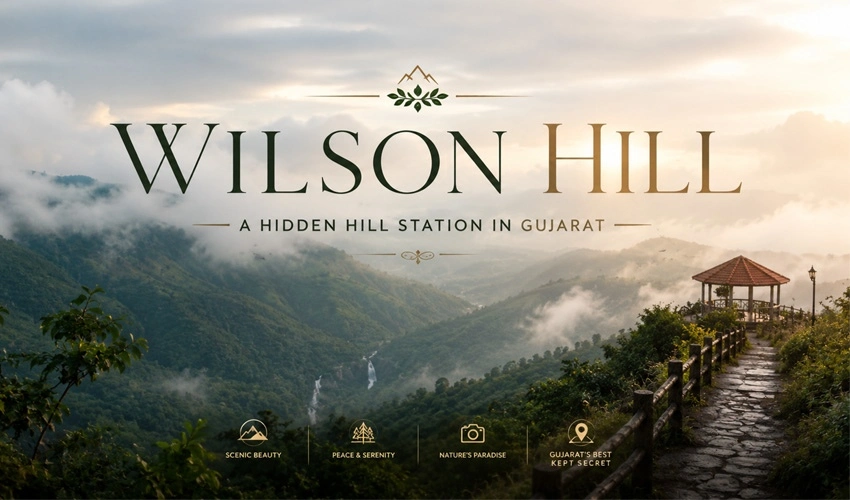
When people think of Gujarat, images of the Rann of Kutch’s white salt desert, the lion trails of Gir, or the temple towns of Somnath and Dwarka usually come to mind first. Rolling hills and misty viewpoints rarely make the list — which is exactly why Wilson Hill comes as such a pleasant surprise. Tucked away near Dharampur in the Valsad district, Wilson Hill is one of the very few hill stations Gujarat has to offer, and quite possibly its best-kept secret. Surrounded by dense forest, close to the Pangarbari Wildlife Sanctuary, and set at a modest elevation of around 750 meters, it offers cool air, green slopes, and — remarkably for a hill station — distant views of the Arabian Sea.
This guide takes a closer look at what makes Wilson Hill worth the detour: its history, what to see and do, when to visit, and how to plan a trip there.
Where Is Wilson Hill and How Did It Get Its Name?
Wilson Hill sits in the Sahyadri range, part of the larger Western Ghats system, near Dharampur taluka in Valsad district. It’s roughly 60 kilometers from Valsad city, around 80 kilometers from Navsari, and about 130 kilometers from Surat — making it the closest hill station to Surat, and a realistic weekend escape for travelers from both Gujarat and neighboring Maharashtra.
The name itself carries an interesting bit of colonial-era history. Wilson Hill was named in memory of Leslie Wilson, who served as the Governor of Bombay from 1923 to 1928. According to local accounts, Wilson and Vijayadevji, the Maharana of Dharampur at the time, had plans to develop the area into a proper hill station together. For reasons lost somewhat to history, that ambitious development never fully materialized — but a monument commemorating the two men still stands at the peak today, a quiet reminder of a plan that was never completely finished, yet still gave the hill its name and its start as a destination.
Interestingly, some accounts note that a private company only took over serious tourism development of the area in the early 2000s, which explains why Wilson Hill still feels refreshingly undeveloped compared to more commercialized hill stations elsewhere in India.
What Makes Wilson Hill Special
Most hill stations in India offer either mountain views or, if you’re lucky, a river or lake somewhere in the landscape. Wilson Hill offers something rarer: on a clear day, it’s possible to catch a glimpse of the Arabian Sea from its heights, even though the location itself is very much a forested inland hill. This combination of dense greenery, misty slopes, and a distant shimmer of the sea is part of what makes the spot so distinctive — and part of why some describe it as one of the few hill stations anywhere with this kind of dual scenery.
Wilson Hill’s setting near the Pangarbari Wildlife Sanctuary also means the surrounding forest is thick and biodiverse, home to a variety of birds and smaller wildlife. Add to that the presence of tribal villages in the region, and Wilson Hill offers not just scenic beauty but a genuine slice of rural Gujarati and tribal culture — something you won’t easily find at more mainstream hill destinations.
Because it remains relatively unknown outside the region, Wilson Hill also comes without the crowds, traffic jams, and commercialized shopping strips that tend to accompany popular hill stations. It’s a place where you can genuinely slow down.
Top Places to See in Wilson Hill
Wilson Hill isn’t a single viewpoint but a cluster of scenic spots spread across the hilltop area, often referred to locally as having around half a dozen distinct points worth visiting.
Marble Chhatri (Marble Pavilion). The most iconic structure at Wilson Hill, this elegant marble pavilion sits right at the peak and is widely regarded as the hill’s signature landmark. It was built as a tribute — according to local history, a dedication from King Vijay Devji to Lord Wilson — and today serves as a peaceful spot to sit, enjoy the breeze, and take in sweeping views of the surrounding forest. It’s also, unsurprisingly, one of the most photographed corners of the entire hill station.
Ozone Valley. Known for its clean, fresh air and tranquil setting, Ozone Valley is ideal for slow nature walks. Visitors often come here to observe local flora and fauna in a quieter, less-trafficked corner of the hill.
Local temple and trekking trail. A temple surrounded by lush greenery offers both a spiritual pause and the starting point for a scenic trekking trail, making it a popular stop for visitors who want to combine a bit of devotion with some light hiking.
Shankar Waterfalls. Located just a few kilometers from the main hill station, this waterfall is a favorite nearby excursion, especially appealing during and after the monsoon when water flow is at its strongest and the surrounding greenery is at its most vivid.
Barumal Shiva Temple. Situated between Wilson Hill and Dharampur, this temple adds a cultural and spiritual dimension to a Wilson Hill itinerary, and is easily combined with a visit to the main hill station.
Local museum. A small museum in the area sheds light on the region’s history and natural richness, offering useful context for travelers keen to understand more about the area beyond its scenic value.
Things to Do at Wilson Hill
Wilson Hill’s appeal lies largely in its outdoor, nature-driven activities:
- Trekking and nature walks: The forested trails around the hill range from beginner-friendly paths to more demanding hikes, winding through dense vegetation and occasionally leading to smaller hidden waterfalls.
- Birdwatching and wildlife spotting: Thanks to its proximity to Pangarbari Wildlife Sanctuary, the area supports a healthy variety of bird species and small wildlife, making it appealing for casual nature enthusiasts and dedicated birdwatchers alike.
- Photography: Between the Marble Chhatri, misty valley views, and the rare sight of the sea from a forested hilltop, Wilson Hill offers plenty of frame-worthy moments.
- Rappelling and rock climbing: For visitors seeking more adventure, some operators in the area offer guided rappelling and rock-climbing experiences on the region’s rugged cliffs, typically under the supervision of trained instructors.
- Picnicking: With its open, scenic spots and cool climate, Wilson Hill is a popular picnic destination for families and groups looking for a relaxed day out surrounded by nature.
- Meditation and quiet relaxation: The overall calm of the area — minimal crowds, birdsong, and gentle breezes — makes it a natural fit for travelers simply looking to unwind.
Best Time to Visit Wilson Hill
Wilson Hill’s charm shifts noticeably with the seasons, and different sources highlight different sweet spots depending on what kind of experience you’re after.
Summer (March to May): Somewhat unusually for a hill station, Wilson Hill is particularly popular in the summer months, since its elevation gives it a cooler, less humid climate compared to the surrounding lowland plains of Gujarat. This is also mango season locally, adding a small seasonal bonus for visitors.
Monsoon (July to September): This is when Wilson Hill turns into its most dramatic, lush self. The forests turn a deep green, the Shankar Waterfalls swell with fresh water, and the misty atmosphere gives the whole hill an almost magical quality. The trade-off is that trails can get slippery, so sturdy footwear and caution are essential.
Winter (October to February): For travelers who prefer crisp, cool air and clear skies over monsoon drama, winter offers comfortable temperatures ideal for trekking, photography, and outdoor picnics without the risk of rain interrupting plans.
In short, there isn’t a single “wrong” time to visit Wilson Hill — it largely comes down to whether you’re chasing cool summer relief, monsoon-soaked scenery, or crisp winter clarity.
How to Reach Wilson Hill
Wilson Hill doesn’t have a railway station or airport of its own, so getting there is entirely road-based — which, if anything, adds to its off-the-beaten-path appeal.
- By Air: Surat Airport is the nearest airport, roughly 125–130 kilometers away, from where taxis can complete the journey.
- By Rail: Valsad Railway Station is the closest, at approximately 27 to 60 kilometers depending on the exact route taken, and is well connected to major cities across Gujarat and beyond. From Valsad, taxis and buses run regularly toward Wilson Hill.
- By Road: Wilson Hill lies on Gujarat State Highway 181 and is well connected to both Surat and Valsad by bus and taxi. The drive itself, winding through forested hill roads, is often described as part of the experience rather than just a means of getting there.
Final Thoughts
Wilson Hill isn’t trying to be Gujarat’s answer to Ooty or Munnar, and that’s precisely its appeal. It’s a modest, forested hill station with a fascinating colonial-era backstory, a handful of genuinely scenic viewpoints, and a rare vantage point where mountain mist and distant sea views coexist. Whether you’re drawn in by the marble elegance of the Chhatri, the adventure of a monsoon trek to Shankar Waterfalls, or simply the promise of a quiet, uncrowded escape from Gujarat’s plains, Wilson Hill delivers an experience that feels refreshingly personal — a hidden hill station that rewards those willing to seek it out.