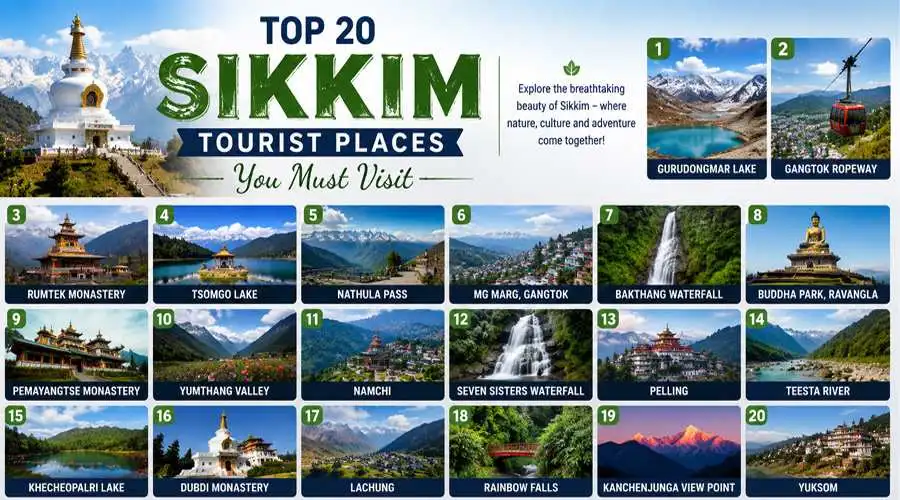
There are few places in India that match Sikkim for sheer, unrelenting beauty. Tucked between Nepal, Bhutan, Tibet, and West Bengal, this tiny Himalayan state packs more visual drama, cultural richness, and ecological diversity into its borders than most destinations ten times its size. Snow-capped peaks, ancient Buddhist monasteries, cascading rivers, high-altitude lakes, and rhododendron forests that blaze red and pink in spring — Sikkim is, quite simply, one of the most rewarding travel destinations in all of Asia.
In 2026, with improved road connectivity, restored trekking routes, and growing ecotourism infrastructure, there has never been a better time to explore this northeastern jewel. Here are the top 20 Sikkim tourist places you must visit this year.
1. Gangtok
The capital city of Sikkim is the natural starting point for any visit. Perched at an elevation of around 1,650 metres, Gangtok offers sweeping views of Kanchenjunga on clear days, a buzzing pedestrian Mall Road, vibrant local markets, and an impressive cluster of monasteries and museums. The Enchey Monastery, the Namgyal Institute of Tibetology, and the Flower Exhibition Centre are essential stops. Gangtok also serves as the logistical hub for excursions across East, North, and West Sikkim.
2. Tsomgo Lake (Changu Lake)
About 40 kilometres from Gangtok at an altitude of 3,753 metres, Tsomgo Lake is one of the most visited high-altitude glacial lakes in India. Surrounded by steep, snow-dusted mountains, the lake shimmers in shades of turquoise and grey depending on the season and light. It remains frozen in winter and blooms with wildflowers in summer. Yak rides along the lakeside and a small Shiva temple nearby add to the experience. A Protected Area Permit is required for Indian tourists; foreign nationals need an additional permit.
3. Nathula Pass
Just 15 kilometres beyond Tsomgo Lake lies Nathula Pass, one of the few open border crossings between India and China, sitting at a breathtaking altitude of 4,310 metres. The pass is part of the ancient Silk Road and carries enormous strategic and historical significance. The views of snow-covered terrain on both sides of the border are dramatic, and watching Indian Army soldiers patrol the high-altitude frontier adds a sobering sense of scale. Permits are required and the pass is typically closed on Mondays and Tuesdays.
4. Rumtek Monastery
Located 24 kilometres from Gangtok, Rumtek is one of the most important Tibetan Buddhist monasteries outside Tibet. It is the seat of the Karma Kagyu school of Tibetan Buddhism and houses a remarkable collection of religious artefacts, golden stupas, and ancient thangka paintings. The monastery complex is large, serene, and architecturally stunning against its forested hillside backdrop. The annual Cham dance festival held here attracts monks and visitors from across the Buddhist world.
5. Pelling
In West Sikkim, Pelling is the destination of choice for those seeking unobstructed views of Kanchenjunga — the world’s third-highest peak. On clear mornings, the mountain fills the horizon in a way that feels almost surreal. Pelling is also the gateway to the Pemayangtse Monastery, one of the oldest and most revered in Sikkim, and to the Rabdentse ruins, the former capital of the Kingdom of Sikkim. The recently built Skywalk and glass bridge near Pelling have become popular new additions.
6. Gurudongmar Lake
At 5,183 metres above sea level, Gurudongmar Lake in North Sikkim is one of the highest lakes in the world and among the most spiritually significant in the region. Named after Guru Padmasambhava, who is believed to have blessed its waters, a portion of the lake reportedly never freezes even in the depths of winter. The journey to Gurudongmar passes through stark, high-altitude landscapes of extraordinary beauty. Prior permits and physical acclimatisation are essential for this trip.
7. Lachen and Lachung
These two charming mountain villages in North Sikkim serve as base camps for some of the state’s most spectacular high-altitude excursions. Lachen is the gateway to Gurudongmar Lake and Chopta Valley, while Lachung opens the route to Yumthang Valley and Zero Point. Both villages retain a quiet, traditional character with wooden houses, small monasteries, and warm Lepcha and Bhutia hospitality that makes staying overnight deeply memorable.
8. Yumthang Valley
Often called the Valley of Flowers of Sikkim, Yumthang Valley at 3,564 metres comes alive between March and May when primulas, rhododendrons, poppies, and irises carpet the entire landscape in colour. Even outside the flowering season, the valley’s wide river meadows framed by snow-streaked peaks create a sense of calm grandeur that is hard to find anywhere else. Hot springs near the entrance to the valley are an added attraction.
9. Zero Point (Yumesamdong)
Beyond Yumthang, the road continues to Zero Point at 4,820 metres — the last motorable destination in North Sikkim before the Chinese border. Here, vegetation gives way entirely to snow and rock. There are no settlements, no shops, and no noise — only the wind, the white mountains, and a profound sense of having reached the edge of the inhabited world. For many travellers, Zero Point is the single most memorable stop in all of Sikkim.
10. Ravangla
Situated at around 2,150 metres in South Sikkim, Ravangla is a peaceful hill town known for its magnificent views of the Kanchenjunga range and the enormous Buddha Park that sits above the town. The 130-feet tall statue of the Buddha Amitabha, inaugurated in 2013, is a commanding presence visible from miles around. The Tathagata Tsal park surrounding it is beautifully landscaped and makes for a contemplative visit.
11. Namchi
South Sikkim’s largest town, Namchi, is home to two landmark religious monuments: the Char Dham complex, which houses replicas of India’s four most sacred Hindu pilgrimage sites, and the Samdruptse Hill, crowned by a towering 108-feet statue of Guru Padmasambhava — one of the tallest statues of the Guru in the world. Namchi is also surrounded by cardamom plantations and offers fine views of the surrounding valleys.
12. Yuksom
Yuksom holds a very special place in Sikkimese history — it was the first capital of the Kingdom of Sikkim, where the first Chogyal (king) was crowned in 1642. Today it is a small, forested village in West Sikkim and the starting point of the famous Goechala trek, which offers close views of Kanchenjunga’s southern face. The Norbugang Coronation Throne and the ancient Dubdi Monastery above the village are must-visits for history lovers.
13. Temi Tea Garden
Sikkim’s only tea estate, Temi Tea Garden near Ravangla, is a gentle, rolling expanse of manicured tea bushes set against a backdrop of mountain peaks. The estate produces award-winning organic teas and the walk through its terraced slopes is both scenic and aromatic. The tea garden bungalow, one of Sikkim’s most charming heritage stays, makes Temi a tempting overnight destination for those who prefer a slower pace.
14. Zuluk (Dzuluk)
One of Sikkim’s best-kept secrets, Zuluk is a remote village in East Sikkim located along the old Silk Route at an altitude of around 3,000 metres. The road to Zuluk passes through 32 breathtaking hairpin bends visible from Thambi View Point — one of the most dramatic road views in the entire Himalayan region. Sunrise over Kanchenjunga from Lungthung viewpoint near Zuluk is a memory that stays forever.
15. Pemayangtse Monastery
One of the most important monasteries in Sikkim, Pemayangtse near Pelling dates to the 17th century and belongs to the Nyingma school of Tibetan Buddhism. Its name translates to “Perfect Sublime Lotus.” The monastery houses a remarkable seven-tiered wooden sculpture called Zangdog Palri — a handcrafted model of Guru Rinpoche’s heavenly abode — that took one monk ten years to complete. It is considered a masterpiece of sacred Buddhist art.
16. Khecheopalri Lake
Sacred to both Buddhists and Hindus, Khecheopalri Lake in West Sikkim is known as the Wishing Lake. Local belief holds that the lake is so holy that even a fallen leaf does not remain on its surface for long — birds reportedly remove them immediately. The forest surrounding the lake is dense, spiritual, and alive with birdsong. The walk from the parking area to the lakeside through prayer-flag-lined paths sets the mood perfectly.
17. Singtam and the Teesta River Valley
Singtam, at the junction of the Teesta and Rangpo rivers, is not a typical tourist town — but the Teesta River valley it anchors is spectacular. Rafting on the Teesta between Singtam and Makha is among the best white-water experiences in northeast India, with rapids ranging from Grade III to Grade V depending on the season. The valley’s lush green gorges and riverside camps make it a paradise for adventure travellers.
18. Fambong Lho Wildlife Sanctuary
For birdwatchers and wildlife enthusiasts, Fambong Lho Wildlife Sanctuary near Gangtok is a rewarding and relatively accessible destination. The sanctuary is home to red pandas, leopards, Himalayan black bears, and over 150 species of birds including the blood pheasant, Sikkim’s state bird. The forest trails here are well-maintained and the sanctuary sees far fewer visitors than the major tourist circuits, making encounters with wildlife more likely.
19. Mangan and Singba Rhododendron Sanctuary
Mangan, the headquarters of North Sikkim district, is surrounded by some of the most beautiful landscapes in the state. Nearby, the Singba Rhododendron Sanctuary near Yumthang is a protected area harbouring over 40 species of rhododendron — including several found nowhere else on earth. Between April and May, the sanctuary is a riot of red, pink, white, and purple blossoms that draw photographers and botanists from across the world.
20. Goechala Trek
No list of Sikkim’s top destinations is complete without acknowledging its greatest trek. The Goechala Trek is a 90-kilometre round journey through pristine Himalayan wilderness, starting from Yuksom and culminating at the Goechala Pass at 4,940 metres — one of the closest viewpoints of Kanchenjunga accessible without technical mountaineering skills. The trail passes through rhododendron forests, alpine meadows, glacial moraines, and high-altitude lakes including the beautiful Samiti Lake. It is widely regarded as one of the finest treks in the entire Indian Himalaya.
Planning Your Sikkim Trip in 2026
The best time to visit Sikkim depends on what you are looking for. Spring (March to May) brings rhododendron blooms and moderate temperatures. Summer (June to August) sees monsoon rains that make roads challenging but waterfalls spectacular. Autumn (September to November) offers the clearest skies and the best mountain views. Winter (December to February) is ideal for snow experiences but several high-altitude roads may be closed.
All visitors to Sikkim require an Inner Line Permit, obtainable on arrival at entry points or online. Additional permits are needed for North Sikkim, Nathula Pass, and border areas. With responsible travel and genuine curiosity, Sikkim in 2026 will reward you in ways that are difficult to put into words — and impossible to forget.