I came to Bhubaneswar for the temples. Specifically for Lingaraj Temple, which kept showing up every time I read anything about Odisha. Ancient. 180 feet tall. Built in the 11th century. One of the oldest active shrines in the country.
The photos don’t prepare you for the real thing.
Standing at the gates at 6am, watching the first pale light hit that sandstone tower, I understood why this city is called the Temple City of India. Lingaraj Temple is the reason Bhubaneswar has its name. Bhubaneswar, or Ekamra Kshetra as it was once called, took its identity from this single structure. That’s how significant it is.
Here’s everything from my 2-day visit.
About Lingaraj Temple
Lingaraj Temple Bhubaneswar sits in the old part of the city, about 5 km from the railway station. It’s the largest temple in Bhubaneswar, sprawling across 250,000 square feet, and the 180-foot vimana (tower) over the main sanctum dominates the skyline for kilometres around.
The temple is dedicated to Harihara, a combined form of Lord Vishnu and Lord Shiva. That syncretism is the unusual part. Most Shiva temples are purely Shaivite. Lingaraj carries both traditions, believed to reflect the rising influence of the Jagannath cult around the time of its construction.
The presiding deity is a Swayambhu Shivalinga, meaning self-manifested, 8 feet in diameter and 8 inches tall, partially submerged in water inside the garbhagriha (sanctum sanctorum).
The temple was built by King Yayati Keshari of the Somavanshi dynasty in the 11th century CE. Some historians push the origins back to the 6th century. Either way, this is a structure that has been in active worship for at least 1,000 years. That fact hits differently once you’re inside.
Lingaraj Temple is among the most famous temples in Odisha and one of the most important pilgrimage sites in India.
My first impression of Lingaraj Temple
The approach is through a narrow lane in Old Town. Flower sellers on both sides. Incense smoke cutting through the morning air. A few priests moving with purpose, everyone else moving slowly in the way pilgrims do.
Security is proper. Metal detectors at the entrance, bag checks, and clear signs about what you can’t bring in. Mobile phones go into a storage counter outside, no exceptions.
The atmosphere is devotional without being aggressive about it. Nobody’s pushing you to buy flowers or offering unsolicited puja services, at least not in a way that felt overwhelming. One or 2 touts existed, but a firm “no” settled things.
Then you walk in and see the tower properly for the first time.
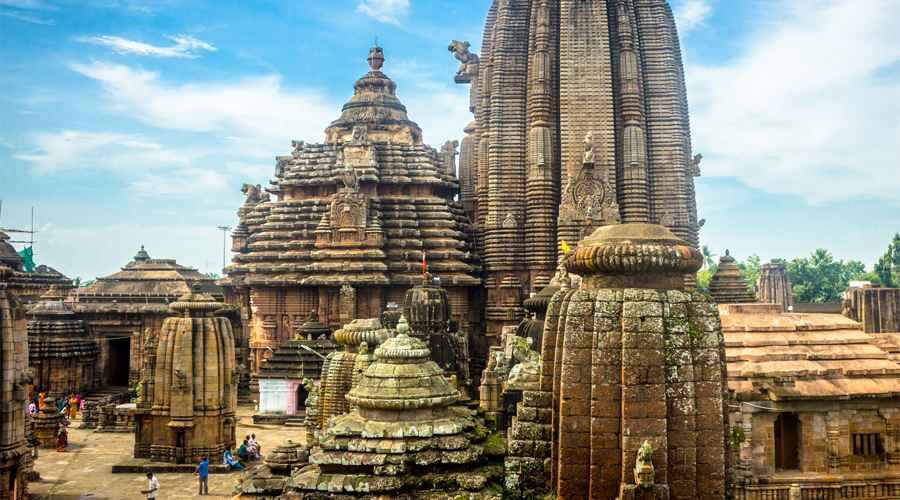
I’ve visited maybe 60 temples across India. The Lingaraj temple Bhubaneswar tower stopped me. Physically stopped me. The sheer vertical mass of it, the fine carving on every surface, the way it presses upward like it’s mid-launch. I stood there for probably 3 minutes before anyone had to nudge me forward.
Architectural beauty of Lingaraj Temple
Main temple structure
The temple complex has 4 main halls aligned on a single axis. The Garbhagriha (sanctum), the Jagamohana (assembly hall), the Natamandira (dance hall), and the Bhoga Mandapa (offering hall). Walking through them in sequence is like reading a sentence that builds to something.
Ancient Kalinga architecture
The Lingaraj Temple is among the finest examples of Kalinga architecture, a style specific to Odisha. The vimana is curvilinear, tapering as it rises, and the entire surface is carved. No blank stone anywhere. The temple sits on a high platform, which amplifies that sense of vertical thrust.
The Kalinga style here is post-Gupta in origin. Compared to the Mukteshwar Temple nearby, which is older and more contained, Lingaraj feels like what happens when a tradition matures fully. Everything the earlier temples were attempting, this one accomplishes.
Carvings and stone sculptures
The sandstone walls carry carvings of deities, dancers, musicians, and mythological scenes. Some sections have erotic carvings in the tradition of temples like Konark, though at Lingaraj they’re less prominent and less likely to be the thing you notice first.
The detail is extraordinary close up. Chains carved from single stones. Figures with individual finger joints. I spent 20 minutes on one panel before realising I was holding up foot traffic.
Temple complex layout
Inside the compound wall, 150 smaller shrines are scattered across the courtyard. Dedicated to Parvati, Ganesha, Kartikeya, and various other deities. You can spend hours just moving through this inner complex. Most visitors focus on the main sanctum and miss them.
Darshan experience – what I observed
Entry process
Only Hindus are allowed inside Lingaraj Temple. A declaration system at the gate. You state your faith, and entry is granted. A raised viewing platform has been built just outside the complex for non-Hindu visitors to see the tower.
Shoes go into a cloak room. The floor of the inner complex is stone, which feels searingly hot by 9am if you haven’t worn socks. Wear socks.
Queue management
I visited on a Wednesday morning in December. No festival period. The queue for the main sanctum was about 40 minutes. Manageable.
The temple gets roughly 6,000 visitors on an average day. During Mahashivaratri, that number climbs to 200,000. If you’re going during a festival period, double or triple your time estimates for everything.
Temple rituals
The puja schedule runs throughout the day. The morning Mangala Aarti is particularly worth attending. Drums, conch shells, the smell of burning camphor. All of it layering into something that gets into your chest.
The priests here come from 3 communities: Badu Nijog, Brahman Nijog, and Pujapanda Nijog. This multi-community priesthood is specific to Lingaraj and unusual even among major temples.
Crowd situation during my visit
December weekday: manageable. The Old Town area outside was busy but navigable. Inside the main complex, the crowd was thick near the sanctum and sparse near the smaller shrines.
Avoid Sundays. Avoid festival dates unless experiencing the festival is specifically what you want (in which case, Mahashivaratri is genuinely worth the crowd).
Timings, entry rules, and visitor information
Lingaraj Temple timings: 6:00 AM to 12:30 PM and 3:30 PM to 9:00 PM daily.
The afternoon closure (12:30 PM to 3:30 PM) is strict. Arrive by 11:30 AM if you want a full morning session without rushing.
Photography: Strictly prohibited inside the temple. Mobile phones and cameras must be deposited at the cloak room before entry. Don’t try to sneak them in. The security is thorough.
Dress code: Modest clothing required. Women should cover their heads inside the sanctum. Men should avoid shorts. A cotton dupatta bought from a stall near the entrance costs ₹50 and solves the head covering question.
Entry fee: Free.
Mobile phone restriction: Absolute. No exceptions. The deposit counter outside charges nothing and is generally well-run.
Best time to visit Lingaraj Temple
| Season | Weather | Travel experience |
|---|---|---|
| Summer (March-May) | 35-42°C, very hot | Manageable early morning only, stone floors painful by mid-morning |
| Monsoon (June-September) | Humid, frequent rain | Cooler temperatures, wet stone paths, fewer crowds |
| Winter (October-February) | 15-28°C, pleasant | Best time, comfortable all day, clearest skies for photos |
During Mahashivaratri: The temple is dressed in flowers, lanterns, and diyas. A majestic Mahadipa (large illuminated earthen lamp) is lit atop the tower. Spiritually powerful, logistically demanding. Plan weeks in advance for accommodation.
During Ashokastami (Rath Yatra of Lingaraj): The deity’s idol is taken on a chariot procession to Rameswar Temple. The 4-day festival includes a purifying bath at Bindu Sarovar. One of the more unusual festival processions in Odisha temple culture.
Chandan Yatra: A 21-day celebration where idols are taken on decorated boats (Chapa) across Bindu Sarovar Lake. The water ritual is specific to this temple and worth seeing if the dates align.
I’d say October to early March for general visits. Early December was perfect.
How to reach Lingaraj Temple
By air
Biju Patnaik International Airport (BBI) is 4 km from the temple. Prepaid taxis available outside arrivals. Fare to Old Town is approximately ₹200-300. Auto-rickshaws do it for ₹100-150 if you’re comfortable negotiating.
By train
Bhubaneswar Railway Station is 5 km from Lingaraj Temple. The station connects directly to Kolkata, Delhi, Chennai, Mumbai, and most major cities. Auto-rickshaw from the station to the temple costs ₹60-80.
By road
City buses connect Old Town to most parts of Bhubaneswar. The Old Town stop is walking distance from the temple. Auto-rickshaws and app-based cabs (Ola, Uber) work fine and are the most convenient option.
I took an auto-rickshaw from my hotel near the railway station. ₹70, 15 minutes.
Things every visitor should know before visiting
Carry minimal luggage. The cloak room takes bags and shoes, but the less you’re managing outside, the better. Leave the big backpack at the hotel.
Respect temple customs. Remove footwear before entering. Maintain silence in the main sanctum area. Don’t point your feet toward the deity. These aren’t suggestions.
Plan for crowds. Even on quieter days, the sanctum queue runs 30-45 minutes. Budget time accordingly. Don’t arrive 30 minutes before the afternoon closing and expect a relaxed experience.
Follow photography restrictions. The no-camera rule is firm. Photographing the exterior from outside the complex is permitted. The raised platform for non-Hindu visitors is a good photography spot.
Stay hydrated. Water is scarce inside the complex. Carry a bottle. Bhubaneswar in summer is particularly unforgiving.
Nearby attractions I explored
Bindu Sagar Lake (300 metres from Lingaraj Temple): A sacred water body 1,300 feet long and 700 feet wide, believed to contain water from all sacred rivers. The lake is the focal point of Chandan Yatra each year. Pleasant for a morning walk. I went there immediately after the temple.
Mukteshwar Temple (1 km): Called the “Gem of Odisha Architecture.” Smaller than Lingaraj, built around 950 AD, and arguably more refined in its carving detail. The Torana (arched gateway) at the entrance is one of the most photographed things in Bhubaneswar. Half a day here is well spent.
Rajarani Temple (2 km): No active worship. A purely archaeological site. Famous for its red sandstone, its unusual name (no specific deity, named after the stones used), and its sculptural grandeur. The Rajarani Music Festival happens here in January.
Khandagiri and Udayagiri Caves (6-8 km): Ancient Jain rock-cut caves carved into twin hillsides. Udayagiri has the more elaborate carvings. Doable in 2 hours. Good evening activity.
Odisha State Museum (4 km): Palm leaf manuscripts, tribal artefacts, ancient sculptures. Solid 2 hours if you care about context for what you’re seeing.
Food and local experiences around the temple
The area around Lingaraj Temple in Old Town has plenty of small eateries and street stalls.
Traditional Odia food: The local staple is rice with dal, a simple vegetable sabzi, and often a fish preparation. Machha Jhola (fish curry) is the dish specific to Odisha, built on a thin mustard-and-tomato base. I had it at a tiny restaurant near Bindu Sagar. ₹120 for a full plate.
Odia sweets: These are serious business. Rasagola originated in Odisha (a fact Bengalis and Odias dispute vigorously, and I’m staying out of it). Chhena Poda, a baked cottage cheese dessert with caramelised edges, is specific to Odisha and better than it sounds. Chhena Gaja and Rasabali also worth trying.
Near the temple market, stalls sell Khaja (flaky, syrup-soaked pastry), which is the traditional prasad sweet of Bhubaneswar temples.
Street food: Dahibara Aloo Dum is the Bhubaneswar street classic. Lentil fritters in yoghurt with a spiced potato curry ladled over. Morning street food, widely available near Old Town. ₹30-50 per plate.
Approximate costs: Breakfast ₹50-80, lunch ₹100-150, dinner ₹150-250. Old Town eating is cheap. The upscale restaurants near the newer parts of Bhubaneswar cost 3 to 4 times more for comparable food.
Travel budget for visiting Lingaraj Temple
Budget traveller (per day):
- Transport (auto-rickshaws): ₹150-200
- Food (local eateries): ₹300-400
- Accommodation (budget guesthouse): ₹600-900
- Sightseeing: ₹100-150 (most temples are free or ₹5-20)
- Total: ₹1,150-1,650/day
Mid-range traveller (per day):
- Transport (Ola/Uber): ₹300-400
- Food (restaurants): ₹600-800
- Accommodation (3-star hotel): ₹2,000-3,000
- Sightseeing: ₹300-500
- Total: ₹3,200-4,700/day
Family traveller (family of 4, per day):
- Transport: ₹600-800
- Food: ₹1,200-1,600
- Accommodation (2 rooms): ₹3,000-5,000
- Sightseeing: ₹500-800
- Total: ₹5,300-8,200/day
Temple entry is free. Most nearby historical sites charge ₹5-25 per person.
Photo spots around Lingaraj Temple
Photography inside the temple is not permitted. All the following are exterior or nearby spots.
The raised viewing platform outside the complex is built specifically for non-Hindu visitors and provides a clean sightline to the tower. Hindus exiting the complex can also stop here for exterior shots. Best light is 6-7am or 4-5pm.
The approach lane in Old Town makes for good street photography. Flower sellers, pilgrims, the occasional bull walking past a garland stall. Morning light is golden here.
Bindu Sagar Lake at sunrise with the tower visible in the background. The lake is 300 metres north of Lingaraj Temple. On still mornings, the reflection is clean.
Mukteshwar Temple’s Torana is one of the most photographed single structures in Bhubaneswar. The arched gateway, carved from a single sandstone block, photographs beautifully at any time of day.
Rajarani Temple grounds at golden hour. The temple sits in a garden, and the red sandstone glows in late afternoon light.
Frequently asked questions
Is Lingaraj Temple worth visiting?
Yes, without qualification. As a piece of architecture alone, Lingaraj Temple Bhubaneswar ranks among the finest things you can see in India. As a living place of worship with 1,000 years of continuous ritual, it’s something else entirely.
Can non-Hindus enter Lingaraj Temple?
No. Entry is restricted to Hindus. A raised viewing platform outside the complex lets non-Hindu visitors see the tower and exterior. This is a firm policy and has been for decades.
What is Lingaraj Temple famous for?
The temple is famous for its Kalinga architecture, the Swayambhu Shivalinga inside, its Mahashivaratri celebrations (which draw up to 200,000 pilgrims), and its historical status as one of the oldest active temples in India.
How much time is needed for the visit?
Budget 2 to 3 hours for the temple itself on a quiet day. Add 30-45 minutes for queue time. A full morning starting at 6am covering the temple and Bindu Sagar takes about 4 hours comfortably.
What is the best time for darshan?
6:00 AM to 8:00 AM on weekday mornings outside festival periods. Shortest queues, best light, cooler temperature.
My honest review of Lingaraj Temple
| Category | Rating |
|---|---|
| Architecture | ★★★★★ |
| Spiritual experience | ★★★★★ |
| Accessibility | ★★★★☆ |
| Cleanliness | ★★★☆☆ |
| Crowd management | ★★★☆☆ |
The architecture is genuinely world-class. Few temples in India combine scale and carving quality at this level. The spiritual atmosphere inside, during active puja with incense and drums and 1,000 years of accumulated devotion in the stone, is hard to describe without sounding like a brochure. It’s real.
Accessibility is decent. The auto network in Old Town is functional, the cloak room system is reasonably well-run, and the security arrangements work.
Cleanliness drops in the inner complex near the subsidiary shrines, especially on busy days. Manageable but honest.
Crowd management needs work during peak hours. The queue for the main sanctum has no shade. In summer, that’s a serious issue.
Who should visit: Anyone interested in Indian temple architecture, Shaivite pilgrims, history enthusiasts, and anyone in Odisha with even a spare afternoon.
Who might skip it: Non-Hindus who can’t enter (though the exterior is still worth seeing), and visitors with severe crowd intolerance during festival season.
Lingaraj Temple Bhubaneswar is the reason to come to this city. Come early, leave your phone at the counter, and give it the time it deserves.