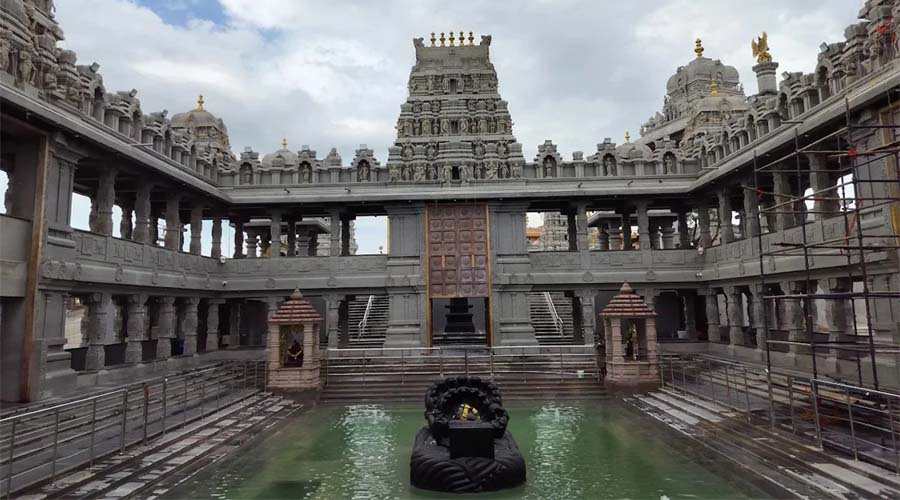
Nestled in the small yet spiritually resonant town of Avinashi in the Tiruppur district of Tamil Nadu, the Arulmigu Avinashi Lingeshwarar Temple stands as one of South India’s most revered and historically significant Shaivite shrines. Known by many names — Thiruppukkozhiyur, Avinasiappar Temple, and Karunaiyaaththaal Temple — this ancient temple is not merely a place of worship. It is a living testament to Tamil devotion, mythological wonder, Dravidian craftsmanship, and the enduring power of Lord Shiva. For centuries, pilgrims and devotees from across the country have made their way to this sacred complex to seek blessings, witness its architectural grandeur, and immerse themselves in its deeply layered spiritual heritage.
Origins and Historical Legacy
The origins of the Arulmigu Avinashi Lingeshwarar Temple stretch back well beyond recorded history. Scholars and temple historians place its existence as far back as the Pallava dynasty, spanning the 3rd to 9th centuries CE, while inscriptions found on its walls provide concrete documentation from the Chola period, specifically from the reign of Kulothunga Chozha I in 1152 AD. The temple’s antiquity is further validated by its status as a Paadal Petra Shiva Sthalam — one of the 275 sacred Shiva temples glorified in the Tevaram, the canonical collection of Tamil Saiva devotional hymns composed between the 7th and 9th centuries by the revered Nayanar saints.
The temple is identified as the 259th Thevaram Paadal Petra Shiva Sthalam and holds the distinguished position of being the first Shiva Sthalam in the Kongu Nadu region — a geographic and cultural heartland of Tamil Nadu that includes the areas around Coimbatore and Tiruppur. Inscriptions etched across the temple’s walls speak of patronage from several successive dynasties: the Cholas, Kongu Cholas, Pandyas, Hoysalas, Vijayanagaras, and Nayaks. The masonry structure that stands today largely reflects the renovations undertaken during the Nayak period in the 16th century, though the spiritual essence within has remained unchanged for millennia. Under these rulers, the deity was revered by names such as Avinashialudaiyar and Avinashi Aludaiya Nayanar, while the goddess was celebrated as Kamakottathu Perungkarunai Nayagi.
The Name That Tells a Story
The word “Avinashi” derives from Sanskrit and means “indestructible” or “that which cannot be destroyed.” This name is not arbitrary — it carries the weight of two powerful legends that define the temple’s spiritual identity.
The first legend speaks of the Devas, the celestial beings of the Hindu pantheon, who once fled from the relentless attacks of the Asuras and sought refuge at this very spot. Lord Shiva, in his infinite compassion, granted them sanctuary and protection, reinforcing the belief that this sacred ground and all who come to it remain under the divine shield of the indestructible god.
The ancient name of the town — Thiruppukkozhiyur — also carries significance. It translates roughly to “a place of refuge,” pointing directly to this protective and sanctuary-like quality ascribed to the site across different eras and traditions.
The Miracle of Sundarar: A Legend That Lives On
Of all the stories woven into the fabric of this temple, none is more celebrated or deeply embedded in the local consciousness than the Miracle of Saint Sundarar. This legend, immortalized in the Tevaram verses, is also the story that most directly explains both the name “Avinashi” and the town’s older designation, “Pukkozhiyur.”
According to the legend, two young boys of about eight years of age were bathing in the temple tank when a crocodile lurking beneath the water suddenly snatched one of them and dragged him under. The distraught mother of the swallowed child approached the Tamil Saiva saint Sundarar, who was passing through on his way to Tiruvanchikulam. Her grief was compounded by the fact that she had been preparing for her son’s Upanayanam — the sacred thread ceremony — and the tragedy had struck at this joyful threshold. Moved by her anguish, Sundarar composed devotional hymns in praise of Lord Shiva in this temple. By divine grace, the boy emerged miraculously alive from the crocodile’s mouth — an event so extraordinary that the place came to be called Pukkoliyur (meaning “the place where one came out of a mouth”).
This miraculous event is commemorated annually during the festival of Mudalai Vaai Pillai Utsavam, celebrated on Panguni Uththiram with great religious fervor. A dedicated shrine to Sundarar stands on the banks of the temple tank, and the base of the temple’s flagpost bears a relief depicting this very legend — ensuring that no visitor leaves without being reminded of Shiva’s grace. Beyond Sundarar, legends also hold that Brahma worshipped Shiva here for a hundred years, and that Airavata, the sacred white elephant of Indra, performed penance at this spot for twelve years — giving rise to the sacred Airavata Theertham (the holy water body associated with the temple).
Architectural Splendour: A Dravidian Masterpiece
The Arulmigu Avinashi Lingeshwarar Temple is a stunning showcase of classical Dravidian architecture, with each structural element reflecting centuries of artistic and spiritual intention. Spread across a five-acre complex, the temple is oriented eastward and greets visitors with a commanding seven-tiered Rajagopuram (main gateway tower) adorned with sculpted figures of deities, celestial beings, and mythological scenes rendered in vivid detail.
One of the most remarkable structural features is the Deepa Sthambham — a towering 70-foot monolithic stone lamp pillar, believed to be among the tallest of its kind in Tamil Nadu. The base of this pillar is intricately carved with scenes depicting the Sthala Purana, including the Sundarar-crocodile miracle.
The outer prakaram (corridor) houses the Rishabam (Nandi bull), Balipeedam (offering altar), and Dwajasthambam (flag post), along with shrines for Dakshinamurthy, Lingothbavar, Brahma, and Shiva Durgai. The inner prakaram is home to shrines for the 63 Nayanmars (Arupathi Moovar), a Sahasra Lingam (a collection of 1,000 Lingams), and shrines to Kala Bhairavar, Chandikeswarar, Gaja Lakshmi, and more. Flanking the entrance to the main sanctum are two imposing, nearly life-sized stone idols of Veerabhadra and Urdhwatandavamurthy, each standing between six and seven feet tall, imbuing the gateway with a sense of divine authority.
The main sanctum (Garbhagriha) enshrines Lord Shiva in the form of a self-manifested black granite Lingam — an object of immense reverence. The goddess Sri Karunambigai (also called Perungkarunai Nayagi, meaning “the great compassionate lady”) is uniquely enshrined to the right of the main deity’s sanctum — a configuration considered unusual and spiritually significant among Shaivite temples.
Spiritual Equivalence to Kashi
A particularly striking aspect of this temple’s reputation is its widely accepted comparison to Varanasi (Kashi) — the holiest city for Shaivites across India. Devotees and religious scholars alike refer to the Avinashi Lingeshwarar Temple as the “Dakshina Kashi” or the “Kasi of Kongu Nadu”, suggesting that a pilgrimage here carries spiritual merit equivalent to worshipping at the sacred banks of the Ganga in Varanasi. This equivalence has been passed down through generations and continues to draw pilgrims who may not be able to undertake the journey northward.
The Paathiri tree serves as the Sthala Vriksha (sacred tree) of the temple, further anchoring the complex within Tamil Saiva temple tradition where each divine site is associated with a specific tree believed to embody celestial energy.
Festivals: Celebrations That Unite the Community
The temple calendar is rich with festivals that turn the sacred complex into a vibrant hub of culture, music, and devotion. The most prominent among them is the Brahmotsavam, a grand festival celebrated during the Tamil month of Maagam (February–March), marked by elaborate rituals, processions, and community celebrations. The Chithirai Brahmotsavam in the Tamil month of Chithirai (April–May) is another major event that draws thousands of devotees from across Tamil Nadu.
The Ther Thiruvizha (Car Festival) is particularly spectacular, with the decorated temple chariot — considered on par in grandeur with the famous chariot of Tiruvarur — being drawn through the streets in a procession that unites the entire town in devotion. Other significant festivals include Maha Shivaratri, Panguni Uththiram, Navaratri, Skanda Sashti, Kartikai Deepam, Arudra Darisanam, and Vaikasi Visakam, each bringing its own flavor of traditional ritual and communal celebration.
Visiting the Temple: Practical Information
The temple is located in Avinashi, Tiruppur District, Tamil Nadu — Pincode 641654, situated approximately 40 kilometers from Coimbatore and around 10 kilometers from Tiruppur city, making it conveniently accessible by road from both urban centers. Daily rituals are performed in six sessions from 5:00 AM to 8:30 PM, ensuring that devotees can visit at multiple times of day. The best time to visit is during the cooler months between October and March, when the weather is pleasant and several major festivals coincide with this period.
Conclusion: An Eternal Sacred Flame
The Arulmigu Avinashi Lingeshwarar Temple is far more than an architectural monument or a religious destination — it is a living reservoir of Tamil faith, history, and cultural memory. From its mythological origins and Sundarar’s miraculous hymns to its towering gopuram and the quiet reverence of its inner sanctum, every element of this temple speaks of a civilization that found meaning, beauty, and the divine in stone, song, and devotion. Whether you are a pilgrim seeking spiritual blessings, a history enthusiast tracing the footprints of ancient dynasties, or a traveler drawn to the poetry of sacred spaces, the Avinashi Lingeshwarar Temple offers an experience that is as indestructible as its name suggests — timeless, transcendent, and unforgettable.