There is a particular kind of darkness that only ancient lands carry — one that seeps from the ground, rises through crumbling stone, and settles like cold air around your shoulders. India, with its ten-thousand-year-old civilisational memory, is a land saturated with that darkness. Behind every ruin, every abandoned palace, every fog-draped forest road, there is a story. Some are historical. Some are mythological. And some are simply unexplained.
The following ten locations are not chosen for spectacle alone. Each one carries a documented legacy of fear — drawn from local testimony, recorded paranormal investigations, historical tragedy, and in at least one case, an official government warning. These are the places where India’s past refuses to stay buried.
1. Bhangarh Fort — Rajasthan’s City of the Damned
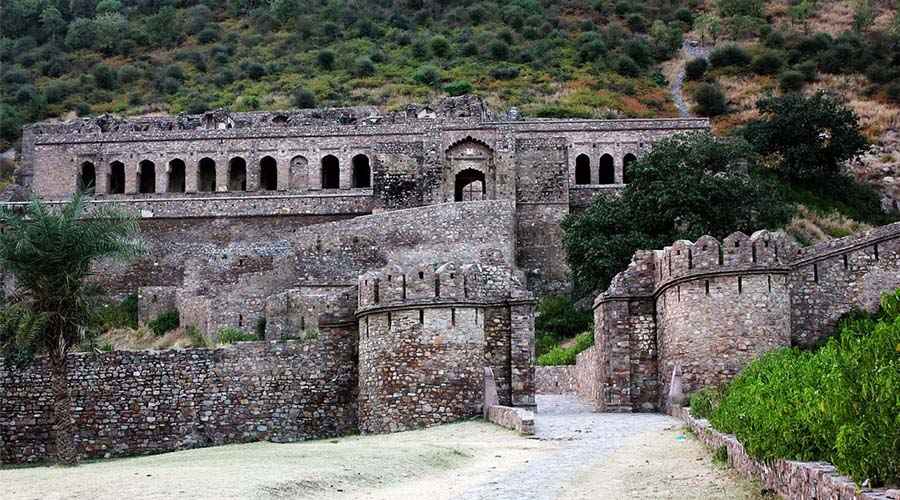
In the amber-hued hills of Alwar district, the ruined city of Bhangarh Fort has stood abandoned for nearly four centuries — and no one has been able to live there since. Founded in 1573 AD by Bhagwant Das, a trusted general of Emperor Akbar, Bhangarh once thrived as a fortified town with temples, bazaars, and a royal court. Within a hundred years, every soul had vanished.
Two curses are held responsible. The first involves the ascetic Guru Balu Nath, who granted permission for the city’s construction only on the condition that no building’s shadow fall upon his meditation ground. A greedy ruler broke the agreement. The hermit’s wrath, locals say, consumed the city whole. The second legend is darker still — a sorcerer named Singhia, obsessed with the beauty of Princess Ratnavati, enchanted her perfume oil. She discovered the plot and smashed the bottle against a rock. The boulder, now possessed by dark energy, crushed Singhia — but not before he cursed every living soul in the kingdom to die without rebirth.
The Archaeological Survey of India (ASI) has formally prohibited entry after sunset, making Bhangarh the only monument in India to carry an official supernatural warning. Visitors report sudden temperature drops, invisible presences, and an almost physical weight of dread near the palace ruins. Even stray animals refuse to enter after dark.
2. Kuldhara — The Village That Cursed Itself
Roughly 18 kilometres from Jaisalmer, the ghost village of Kuldhara sits exactly as it was left — overnight, in 1825. Nearly 1,500 Paliwal Brahmins, a prosperous and educated community, abandoned their homes in a single night to escape the cruelty of Salim Singh, the Diwan of Jaisalmer, who had demanded the village headman’s daughter as tribute.
Before they disappeared into the desert forever, the Paliwals placed a curse on the land — that no one would ever settle there again. The curse has held. Several families who attempted to move in over the following decades reported inexplicable illness, madness, and misfortune before fleeing. Paranormal teams who have camped overnight describe shadows moving through empty doorways and the sound of women weeping carried on the desert wind. The ASI has since fenced the village as a protected site, but it remains one of India’s most desolate and quietly terrifying places.
3. Shaniwar Wada — Where a Prince’s Screams Never Faded
The grand Shaniwar Wada fortification in Pune was once the nerve centre of the Maratha Empire’s Peshwa dynasty. Today it is a skeletal monument to betrayal. In 1773, the sixteen-year-old heir Narayan Rao was murdered within its walls — slaughtered by hired killers acting on the orders of his own uncle, Raghunath Rao. The boy allegedly ran through the halls screaming for his uncle to save him before being cut down near the Delhi Gate.
Every full moon night, residents of the surrounding neighbourhood claim to hear those screams rise again — young, desperate, and utterly inconsolable — echoing from inside the burnt-out structure. A catastrophic fire in 1828 destroyed most of the palace interiors, yet the legends grew only stronger in the ruins. Night security personnel have reportedly requested transfers after experiencing what they describe as cold hands on their shoulders in empty corridors.
4. Dow Hill — The Forest That Watches Back
The quiet hill station of Kurseong in West Bengal holds a secret beneath its tea garden charm. Dow Hill is home to the Victoria Boys’ High School, a colonial institution with a long winter closure during which, according to decades of consistent accounts, a headless child walks the corridors in silence.
More alarming is the stretch of forest road below the school, locally called the “Death Road.” Woodcutters working the forest have reported the same experience across generations — a boy without a head, standing among the sal trees, who turns and walks away before dissolving into the shadows. Paranormal researchers who visited the area recorded anomalous electromagnetic readings and what they described as a persistent feeling of being followed. The sound of childlike footsteps in the empty school hallways during vacation months has been reported by caretakers with such regularity that it has ceased to be news in Kurseong.
5. Dumas Beach — Where the Sea Whispers Names
Not all haunted places are abandoned. Dumas Beach near Surat, Gujarat is an active, visited shoreline — and yet after dark, it transforms into something locals refuse to approach. The beach served as a Hindu cremation ground for centuries, and the belief that restless souls remain tied to the ash-black sand is as strong today as it has ever been.
What makes Dumas unusual is the nature of the reported phenomena — not visual apparitions but auditory ones. People walking the beach at night claim to hear their names called from the water, murmured conversations with no source, and sudden, inexplicable laughter near the shoreline. Several individuals have reportedly walked into the sea in response to what they described as an irresistible voice and were pulled back just in time. Dogs brought to the beach after sunset bark uncontrollably at empty stretches of sand before refusing to move further.
6. Agrasen ki Baoli — Delhi’s Hypnotic Stepwell
Buried between the glass towers of Connaught Place lies an ancient stepwell that predates the city around it by centuries. Agrasen ki Baoli, restored in the 14th century but believed to originate in the Mahabharata era, descends eleven levels underground through tightening arches of pale stone.
The deeper you descend, the stranger visitors say they feel. Multiple unconnected accounts describe a growing urge to sit at the bottom and not return — a psychological pull that some describe as hypnotic and others as simply terrifying. The water that once filled the well was said to appear black regardless of the light above, and local lore holds that it drove onlookers toward self-destruction. Authorities now restrict access to the lower levels.
7. Ramoji Film City — Haunted Behind the Camera
The largest film studio complex in the world, Ramoji Film City in Hyderabad, was constructed over land that served as a battlefield during the Nizam era — a ground soaked in the blood of soldiers never properly laid to rest. The studio’s crew members have reported lights swinging in locked rooms, makeup being disturbed in sealed dressing areas, and food items hurled off tables by unseen hands.
Women in particular report being pushed, scratched, or followed in the older sections of the complex. The management has conducted religious rituals on the premises on multiple recorded occasions. That one of India’s most commercially active and modern locations carries such a deeply embedded supernatural reputation makes Ramoji Film City all the more fascinating.
8. Tunnel No. 33 (Barog Tunnel) — Shimla’s Darkest Passage
On the Kalka-Shimla mountain railway, a UNESCO World Heritage route, Tunnel No. 33 carries a tragedy inside its 1,144-metre length. Colonel Barog, the British engineer assigned to build the tunnel in the early 1900s, made a catastrophic miscalculation and dug from both ends in a way that meant the two bores would never meet. Fined and publicly shamed by the colonial government, he walked into the incomplete tunnel one morning and shot himself.
His burial site sits just outside the tunnel entrance. Train passengers, railway staff, and trekkers passing through the tunnel at night have for over a century reported seeing the pale figure of a man in uniform standing silently near the mouth of the passage. The tunnel’s sheer darkness — even at midday — combined with its history makes every crossing feel like a transaction with the past.
9. Fernhill Hotel — The Haunted Palace of the Nilgiris
Nestled in the forested hills of Ooty in Tamil Nadu, the colonial-era Fernhill Hotel was originally built as a summer residence for the Mysore royal family during the British Raj. Its wide verandas, towering ceilings, and ageing wooden interiors give it the feeling of a place that has not fully accepted the passage of time.
Staff working the night shift have reported the apparition of a regal figure walking the older wing’s corridors, persistent cold spots in rooms that have no ventilation gap, and one suite that has been permanently closed following repeated, unexplained disturbances that no maintenance work or ritual ceremony could resolve. Guests have checked out mid-stay without explanation. The hotel’s management has never officially confirmed these accounts — which, somehow, makes them more believable.
10. GP Block — Meerut’s House of Unending Sorrow
In a quiet residential neighbourhood in Meerut, Uttar Pradesh, one particular bungalow in the GP Block area has remained functionally uninhabitable for decades. Tied to a history of sudden death and at least one suicide within its walls, the house has cycled through tenants at a rate that no logical explanation satisfies.
Neighbours describe hearing furniture dragged across floors in the empty property at night, lights appearing in windows of rooms with no electricity connected, and animals refusing to pass in front of the main gate. Those who have stayed inside report recurring nightmares of the same figure and waking to find objects rearranged. Local real estate agents have long stopped attempting to market the property. Some doors, it seems, are better left closed.
The Country That Remembers Everything
India does not forget. Its soil holds too much — too many battles, too many fires, too many prayers and curses spoken into the dark. These ten places are proof not only of a culture that takes its supernatural seriously, but of a landscape that seems, in places, to hold onto the past with something resembling intent.
Visit them if you dare. But do so with the understanding that in India, the line between history and haunting has always been thin — and in some places, it disappears entirely.