Perched dramatically on the edge of the Bay of Bengal in Tamil Nadu, the Thiruchendur Murugan Temple is not merely a place of worship — it is a living testament to faith, legend, and architectural brilliance that has endured for thousands of years. One of the six sacred abodes of Lord Murugan, known as the Arupadai Veedu, this coastal shrine draws millions of devotees every year who come seeking blessings, healing, and a connection with the divine. Whether you are a devout pilgrim, a history enthusiast, or a curious traveler, Thiruchendur offers an experience unlike any other. Here are ten amazing facts about this iconic temple that reveal just how extraordinary this sacred site truly is.
Fact 1: It Is One of the Six Sacred Abodes of Lord Murugan
Thiruchendur holds an exalted place in Hindu tradition as one of the Arupadai Veedu — the six battle camps of Lord Murugan, the son of Lord Shiva and Goddess Parvati. The six shrines are Tiruttani, Swamimalai, Palani, Pazhamudircholai, Thiruchendur, and Kumara Koil at Vayalur. Each of these temples is associated with a specific episode from the life of Murugan as described in Tamil Shaivite literature. Thiruchendur, in particular, is linked to Murugan’s triumph over the demon king Soorapadman, making it one of the most spiritually significant of the six. For Tamil Shaivites, completing a pilgrimage to all six abodes is considered one of the most meritorious acts a devotee can undertake.
Fact 2: The Temple Sits Right on the Shore of the Bay of Bengal
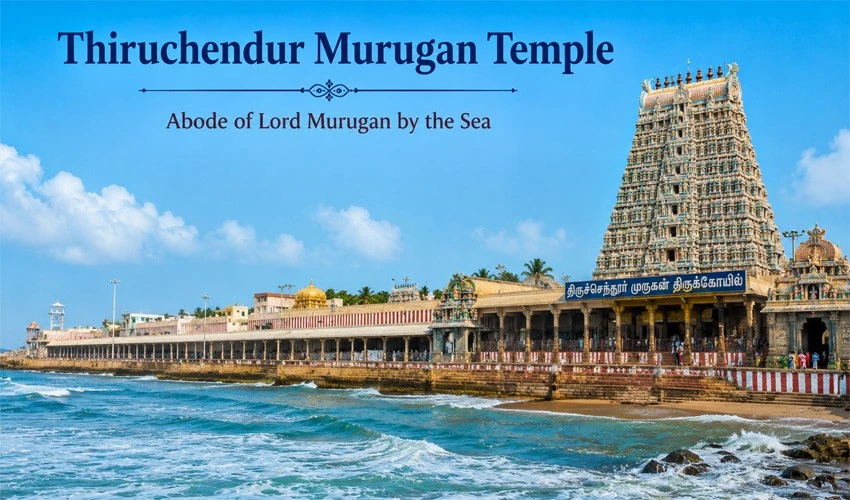
Unlike most temples located in the hills or inland plains, Thiruchendur Murugan Temple stands directly on the seashore, with the mighty waves of the Bay of Bengal crashing just meters from its sacred walls. This unique coastal setting gives the temple an atmosphere of raw, elemental power. Pilgrims who arrive at dawn witness an extraordinary sight: the sun rising over the ocean while the temple towers glow in the early light, with the sound of temple bells mingling with the roar of the sea. The sea itself is considered sacred here, and devotees take a holy dip in the ocean before entering the temple — a practice believed to cleanse both body and soul. The view from the temple’s upper levels, with the ocean stretching endlessly to the horizon, is considered one of the most spiritually stirring sights in all of Tamil Nadu.
Fact 3: The Presiding Deity Is Lord Senthilandavar
The principal deity of Thiruchendur is Lord Murugan in his form as Senthilandavar, also lovingly called Senthil Andavar — meaning “the Lord of Thiruchendur.” Unlike some Murugan temples where the deity holds a vel (divine spear) in a warrior’s stance, Senthilandavar is depicted in a more serene, graceful posture, radiating compassion and blessing. The deity is adorned with exquisite jewellery, silks, and floral garlands, and the daily rituals of abhishekam (ritual bathing), alankaram (ornamentation), and deepa aradhana (lamp offering) are performed with extraordinary devotion. Devotees believe that Senthilandavar grants wishes with special swiftness, and the temple is known as a place where heartfelt prayers are answered.
Fact 4: It Is Among the 276 Paadal Petra Sthalams
Thiruchendur is one of the 276 Paadal Petra Sthalams — the sacred Shiva temples glorified in the Thevaram hymns composed by the three most revered Nayanmars (Shaivite saints): Thirugnana Sambandar, Thirunavukkarasar (Appar), and Sundaramurthy Nayanar. These hymns, compiled in the Tevaram (part of the Tirumurai), form the foundational scripture of Tamil Shaivism. While the temple is primarily a Murugan shrine, its inclusion among the Paadal Petra Sthalams reflects its ancient veneration and the deep interweaving of Shaivite traditions at this site. This distinction gives Thiruchendur a dual sanctity that is rare among Tamil Nadu’s temples and enhances its spiritual prestige enormously.
Fact 5: The Temple Has a History Spanning Over 2,000 Years
Historical inscriptions, Tamil Sangam-era literature, and epigraphic evidence suggest that Thiruchendur has been a site of worship for well over two millennia. References to the temple can be found in ancient Sangam poems and in the works of the Nayanmars, placing its documented history firmly in the early centuries of the Common Era at the very latest. The temple’s history is also intertwined with the Pandya and later Nayak rulers of Tamil Nadu, who contributed generously to its construction, expansion, and renovation over the centuries. The towering gopurams (gateway towers), the sprawling mandapams (pillared halls), and the intricate carvings that adorn the temple today are the cumulative gift of hundreds of years of royal patronage and devotional craftsmanship.
Fact 6: The Mythology of Soorasamharam Is Central to the Temple
Perhaps the most dramatic mythological association of Thiruchendur is its link to the Soorasamharam — the slaying of the mighty demon Soorapadman by Lord Murugan. According to Shaiva Puranas, Soorapadman had obtained powerful boons and used them to wreak havoc across the three worlds, tormenting the gods and disrupting the cosmic order. The devas appealed to Lord Shiva, who sent his son Murugan armed with the divine vel (spear) crafted by Goddess Parvati. The great battle culminated on the shores of Thiruchendur, where Murugan defeated Soorapadman, splitting him with the vel. As a mark of mercy and transformation, Murugan converted the two halves of Soorapadman into a peacock (his vehicle) and a rooster (which adorns his flag). This story is dramatically re-enacted every year during the festival of Skanda Sashti, drawing hundreds of thousands of pilgrims to the temple.
Fact 7: Skanda Sashti Is the Most Grand Festival Here
Of all the festivals celebrated at Thiruchendur, Skanda Sashti stands supreme in grandeur and devotion. Observed on the sixth day after the new moon in the Tamil month of Aippasi (October–November), this six-day festival commemorates Murugan’s victory over Soorapadman. The festivities include elaborate processions, the recitation of the Kanda Sashti Kavasam (a powerful devotional hymn), spectacular chariot festivals, and the climactic re-enactment of the Soorasamharam on the beach. During this festival, the entire town of Thiruchendur transforms into a sea of saffron and devotion, with devotees traveling from across India and the Tamil diaspora worldwide. Many devotees undertake a six-day fast (known as Sashti Viradham) leading up to the celebration, believing it brings divine protection and the fulfillment of wishes.
Fact 8: The Temple Architecture Is a Masterpiece of Dravidian Style
The Thiruchendur Murugan Temple is a magnificent example of Dravidian temple architecture, the distinctive style that evolved in South India over millennia. The temple’s rajagopuram (main tower) soars over 130 feet into the sky, adorned with hundreds of colorfully painted stucco figures of gods, goddesses, celestial beings, and scenes from mythology. The temple complex encompasses multiple mandapams, sacred tanks, and inner sanctuaries, all intricately carved and richly ornamented. The famous Navaratna Mandapam (Hall of Nine Gems) and the Aayiram Kaal Mandapam (Hall of a Thousand Pillars) are architectural highlights that leave visitors in awe. The use of granite, the precision of the sculptures, and the harmonious proportions of the structures reflect the genius of the ancient Dravidian master builders who constructed them.
Fact 9: The Temple Has a Unique Underground Shrine
One of the most fascinating and lesser-known features of Thiruchendur is its underground sanctum — a rare architectural feature that sets it apart from most other temples in South India. The underground shrine, known as the Patala Vinayagar shrine, is dedicated to Lord Ganesha and is located beneath the main temple complex. Devotees descend into this dimly lit, atmospheric space carved out of rock to offer prayers to Vinayagar before proceeding to the main deity. The cool stone interiors, the flicker of oil lamps, and the profound sense of antiquity make this underground sanctum one of the most memorable spiritual experiences the temple offers. It is a reminder that temples like Thiruchendur are not just buildings but multi-layered spiritual universes with hidden depths waiting to be discovered.
Fact 10: The Temple Survived the 2004 Indian Ocean Tsunami
In one of the most remarkable chapters of Thiruchendur’s modern history, the temple survived the devastating Indian Ocean Tsunami of December 26, 2004, with minimal structural damage — a fact that deeply reinforced the faith of millions of devotees. The tsunami, which killed over 230,000 people across fourteen countries and caused catastrophic destruction along the Tamil Nadu coastline, struck the shores of Thiruchendur with tremendous force. Yet the temple, standing directly on the beach, sustained surprisingly little damage. Many devotees interpreted this as a miraculous act of divine protection — a sign that Lord Murugan himself shielded his sacred home. The incident only deepened the reverence with which the temple is held and is frequently cited by pilgrims as evidence of the deity’s supreme power and grace.
How to Reach Thiruchendur
Thiruchendur is located in the Thoothukudi (Tuticorin) district of Tamil Nadu, approximately 60 kilometers from Tirunelveli and about 40 kilometers from Thoothukudi city. The nearest airport is Thoothukudi International Airport, and Thiruchendur has its own railway station with direct connections to major cities including Chennai, Madurai, and Tirunelveli. Regular bus services connect Thiruchendur to cities across Tamil Nadu, making it easily accessible for pilgrims from all parts of the state and beyond.
Final Thoughts
The Thiruchendur Murugan Temple is far more than a religious landmark — it is a living, breathing expression of Tamil culture, mythology, art, and devotion that has shaped the spiritual identity of a people for thousands of years. From its dramatic oceanside setting and its ancient mythological roots to its breathtaking architecture and its miraculous survival of natural disaster, every aspect of this temple tells a story of faith and resilience. Whether you come as a pilgrim seeking Murugan’s blessings or as a traveler in search of wonder, Thiruchendur will leave an indelible mark on your heart. The roar of the ocean, the fragrance of incense, the golden glow of the gopuram at sunrise — once experienced, it is never forgotten.
Vel Muruga Haro Hara!