There are places in India where faith and geography fuse into something that transcends ordinary description — where mythology is not confined to scripture but is written into the landscape, the water, and the stone. Rameshwaram is one of those places. Sitting at the southern tip of the Indian subcontinent on Pamban Island, where the Bay of Bengal and the Indian Ocean meet in glittering confluence, the Sri Arulmigu Ramanathaswamy Temple is not merely a pilgrimage destination. It is the place where Lord Rama prayed, where Sita shaped a lingam from sea sand, where Hanuman journeyed to the Himalayas and returned, and where the divine merged permanently into stone and water.
For millions of Hindu devotees across India and the world, a visit to Rameshwaram is not just a journey — it is a completion. This comprehensive 2026 guide covers everything you need to know: the temple’s Jyotirlinga status, its Ramayana origins, its extraordinary architecture, darshan timings, the sacred 22 theertham ritual, how to get there, what to expect, and the remarkable places that surround it.
The Sacred Identity: Jyotirlinga and Char Dham
To understand why Rameshwaram Temple commands the reverence it does, you must first understand its dual distinction — a combination found nowhere else in Indian religious geography.
The Ramanathaswamy Temple is one of the twelve Jyotirlingas of Lord Shiva. According to Hindu theology, the Jyotirlingas are not merely statues or symbols but actual manifestations of Lord Shiva as a pillar of infinite light — swayambhu, self-manifested — each radiating divine energy at specific sacred points across the subcontinent. Visiting all twelve is considered among the most meritorious acts a devotee can undertake in a lifetime, believed to grant moksha, the liberation from the cycle of rebirth. Rameshwaram holds the eleventh position in the traditional order of the twelve Jyotirlingas.
But Rameshwaram carries a second, equally powerful distinction: it is the southernmost of the four Char Dham pilgrimage sites — the four cardinal points of Hindu sacred geography. The Char Dham, comprising Badrinath in the north, Dwarka in the west, Puri in the east, and Rameshwaram in the south, together represent the full spiritual geography of India. Completing the Char Dham Yatra is regarded as one of the highest pilgrimages a Hindu can undertake. There is also a long-standing tradition that a pilgrimage to Kashi (Varanasi) remains spiritually incomplete without a visit to Rameshwaram — the two sacred cities representing the divine pairing of Shiva worship between North and South India.
No other Jyotirlinga simultaneously carries Char Dham status, making Rameshwaram a point of absolute confluence in the Hindu spiritual universe.
The Ramayana Connection: How the Jyotirlinga Came to Be
The story of Rameshwaram Temple is inseparable from the story of the Ramayana, and this mythological depth is what gives the site its unparalleled emotional resonance for devotees.
After Lord Rama defeated Ravana — the demon king of Lanka — and rescued Goddess Sita, he began his return journey across the sea. Ravana, though a villain in the narrative, was also a learned Brahmin and a great devotee of Shiva. His killing, therefore, constituted the sin of Brahma-hatya — the most grievous transgression in Hindu ethics. To atone for this sin and to seek Lord Shiva’s blessings before returning to Ayodhya, Rama halted at what is now Rameshwaram and wished to consecrate a Shiva lingam.
He sent Lord Hanuman to Kailash to bring a sacred lingam from the Himalayas. As the auspicious moment for the consecration approached and Hanuman had not yet returned, Sita fashioned a lingam from sea sand with her own hands. Rama consecrated this Ramalingam — the sand lingam made by Sita — at the appointed hour. When Hanuman eventually returned with the Vishwalingam from Kailash, he was disheartened to find the ritual already complete. To honour Hanuman’s devotion and effort, Lord Rama decreed that the Vishwalingam must always be worshipped first during rituals, before the Ramalingam. This tradition continues unbroken to this day: both lingams reside in the inner sanctum, and priests follow Rama’s instruction at every pooja, offering obeisance to Vishwalingam first.
Lord Shiva, moved by Rama’s devotion, manifested as a Jyotirlinga at this spot and agreed to remain at Rameshwaram permanently to bless all of humanity. Since the deity was established by Lord Rama himself, he came to be known as Ramanathaswamy — the Lord of Rama — and the place took the name Rameshwaram, meaning “the Lord Shiva of Rama.”
The Architecture: A Temple That Holds World Records
The Ramanathaswamy Temple is a staggering achievement of Dravidian architecture that holds records unique in the world of sacred architecture.
The most celebrated feature is its corridors, which are the longest of any Hindu temple on earth. The outer corridor stretches approximately 1,220 metres and is flanked by 1,212 intricately carved granite pillars, each standing around 30 feet tall. Walking through these corridors creates a visual experience unlike anything else — the pillars recede into the distance in perfect alignment, creating a tunnel-like optical illusion as they appear to converge at a single vanishing point. The granite used for this construction was transported to the island from distant quarries, an engineering feat that staggers modern comprehension. The corridor does not merely impress through size — every pillar is carved with individual motifs and figures, making the 1,220-metre walk a continuous engagement with sculpted art.
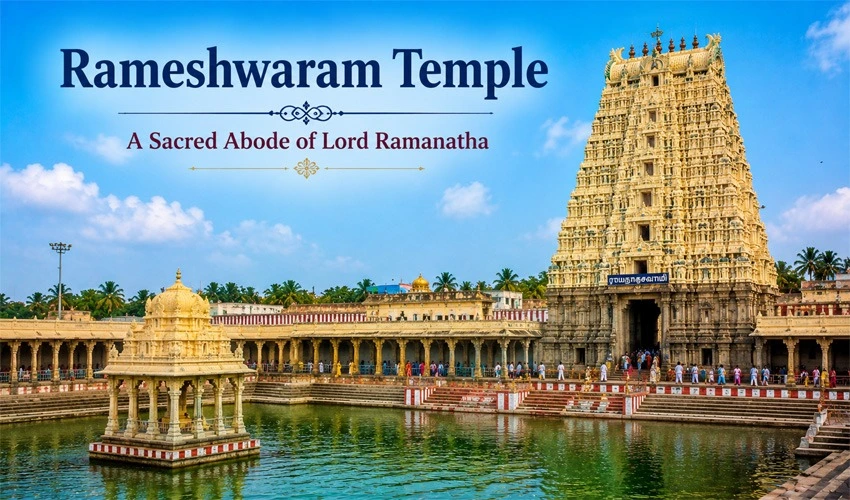
The East Gopuram, known as Rajagopuram, rises to approximately 53 metres with nine ornate tiers, a commanding presence visible from the sea. There are majestic gopurams at both the east and west ends of the temple, with gate towers adorning the north and south. The entire temple complex is surrounded by walls approximately 865 feet to 657 feet in dimension, enclosing an area of around 15 acres.
The innermost sanctum contains the two sacred lingams — the Ramalingam (consecrated by Rama) and the Vishwalingam (brought by Hanuman from Kailash). The Ramalingam is made from spatika (crystal/sand) and remains the primary object of worship. Beyond the sanctum, the inner walls carry sculpted images of deities, celestial beings, and scenes from Hindu mythology, the entire visual programme reflecting the temple’s centrality in both Shaivite and Vaishnavite traditions — because Rama, a form of Vishnu, worshipped Shiva here, the temple uniquely unifies both great streams of Hindu devotion.
The temple also houses an extraordinary collection of sacred wells: 22 theerthams (holy water bodies) inside the complex itself, out of a total of 64 theerthams across the wider Rameshwaram area. Each well is believed to have distinct spiritual properties, the waters drawn from sacred sources connected to different divine events in the Ramayana narrative.
The 22 Theertham Ritual: The Heart of the Rameshwaram Pilgrimage
For most pilgrims, the defining experience at Rameshwaram is not the darshan but the Teertha Snanam — the ritual bath in the 22 sacred wells inside the temple complex. This is not optional; it is considered essential to the spiritual logic of a Rameshwaram pilgrimage, a process of purification that prepares the devotee for the darshan of the Jyotirlinga.
Pilgrims are led by temple staff through the 22 wells in sequence. At each well, a priest pours water from the well over the devotee using a special vessel, and a brief prayer is offered. The water from each theertham is believed to possess distinct healing and purifying properties — and devotees note that the water from each well tastes subtly different, a phenomenon that has attracted both faithful wonder and scientific curiosity for generations. The entire ritual takes approximately 1.5 to 2 hours.
Before entering the temple for the theertham ritual, pilgrims are expected to bathe in Agni Theertham — the sacred sea beach located just outside the temple’s eastern entrance. According to legend, Lord Rama bathed here to purify himself of the sin of killing Ravana. The sunrise at Agni Theertham, with devotees standing waist-deep in glowing sea water as the first light rises over the Bay of Bengal, is among the most spiritually charged and visually magnificent sights in all of India.
Carry at least two complete changes of clothes when performing the theertham ritual — you will be thoroughly soaked at each well, and the corridor floors and the walk back to your accommodation will require dry clothing immediately after.
Darshan Timings (2026)
The Ramanathaswamy Temple is open to devotees every day of the year, including public holidays, following a daily schedule with an afternoon break.
Morning Session: 5:00 AM – 1:00 PM Evening Session: 3:00 PM – 9:00 PM
The day begins with the Spadigal Lingam Pooja (the crystal lingam ceremony) in the early hours. Multiple poojas are conducted across the day at scheduled intervals, and the temple closes briefly in the afternoon for ritual maintenance before reopening for the evening session. Special and Quick Darshan timings are typically between 4:00 PM and 7:00 PM.
Entry Fee: General darshan is completely free for all visitors. There is no entry charge to enter the temple complex or receive darshan of the Jyotirlinga. However, paid options are available:
- Special/Quick Darshan (VIP): Approximately Rs. 200 per person, which reduces waiting time to 15–30 minutes (versus 1–3 hours in the general queue). Online booking is available through the official HRCE portal at rameswaramramanathar.hrce.tn.gov.in
- 22 Theertham Bath: A nominal fee applies for the bathing ritual, which includes priest assistance throughout.
Tip for 2026: Arrive at the Agni Theertham by 4:30 AM on weekdays for the shortest queues. Weekends, full moon days (Pournami), Pradosham, and festivals — particularly Maha Shivaratri and the Ramalinga Prathishtai festival — see very large crowds and significantly longer wait times.
Photography Rules: Photography is strictly prohibited inside the sanctum, inner corridors, and during rituals. Mobile phones must be switched to silent or left in the paid locker facilities available near the entrance.
Dress Code and Temple Etiquette
Rameshwaram enforces a strict dress code at its entrance, and visitors not complying will not be permitted inside.
- Men: Dhoti or veshti is strongly preferred and most respectful. Shirts with trousers or pyjamas are acceptable. Jeans, shorts, and sleeveless clothing are not permitted.
- Women: Saree or salwar kameez (churidar) is required. Jeans, leggings, skirts, and shorts are not allowed. Dupatta or similar head covering is appropriate.
Footwear must be removed before the temple entrance. Paid footwear counters are available outside. As you will be wet after the theertham ritual, carry dry footwear in a bag as well.
Travel Guide: Getting to Rameshwaram in 2026
- By Train (Recommended): Rameshwaram Railway Station (station code: RMM) is just 1 km from the temple and is connected to Chennai, Madurai, Trichy, and Coimbatore. The train journey across the new Pamban Bridge — India’s first vertical lift railway sea bridge, inaugurated in April 2025 — is an experience in its own right, offering panoramic views of the turquoise sea on both sides. Book train tickets well in advance, especially during the October–March peak season.
- By Road: Rameshwaram is connected by NH-87 from Madurai (approximately 174 km). The drive across the Pamban Road Bridge is breathtaking. State transport buses run frequently from Chennai (560 km), Madurai (174 km), and Trichy (220 km). Private taxis and cabs are available from all major Tamil Nadu cities.
- By Air: The nearest airport is Madurai International Airport (IXM), approximately 174 km from Rameshwaram. The journey by road or taxi takes 3.5 to 4 hours. Flights connect Madurai to Chennai, Bangalore, Hyderabad, and Mumbai. Note: A new airport in Ramanathapuram district has been announced with government funding, with development expected over the coming years, which will dramatically improve air accessibility.
What to See Beyond the Temple
Rameshwaram island is generously blessed with sacred and historically significant sites beyond the main temple.
- Agni Theertham: The sea beach just outside the temple’s east entrance where pilgrims take their ritual dip before entering. The sunrise here is transcendent.
- Dhanushkodi: Located 20 km from the temple at the far tip of the island, this ghost town was once a thriving settlement destroyed by a catastrophic cyclone in 1964. The ruins of a railway station, church, and post office stand as hauntingly beautiful remnants. At the tip — Arichal Munai — the Bay of Bengal and the Indian Ocean visibly meet, and on clear days, Sri Lanka is visible just 18 miles away.
- Ram Setu (Adam’s Bridge): The chain of limestone shoals connecting Rameshwaram to Sri Lanka, believed in the Ramayana tradition to be the bridge built by Rama’s army of vanaras. The floating stones associated with this site — pumice-like formations that reportedly rest on water due to their porous volcanic structure — are sold as sacred souvenirs across Rameshwaram.
- Gandhamadhana Parvatham: A hillock offering panoramic views of the town, where Lord Rama’s footprint is enshrined. Legend holds that Rama climbed this peak while searching for Sita.
- APJ Abdul Kalam Memorial: A heartfelt tribute to India’s beloved former president and Missile Man, who was born in Rameshwaram. The memorial, inaugurated in 2017, showcases his life, scientific contributions, and vision for India in an Indo-Mughal architectural setting.
- Pamban Bridge: India’s first sea bridge, connecting Rameshwaram Island to the mainland across the Palk Strait. The new vertical lift railway bridge (2025) alongside the existing road bridge is a spectacular sight. The bridge viewpoint at sunset is unmissable.
Practical Tips for Your 2026 Visit
Rameshwaram rewards careful planning. Carry two complete changes of clothes for the theertham ritual. Budget roughly Rs. 2,300 per person per day covering accommodation, food, darshan fees, and transport. Beware of unofficial “guides” who approach tourists outside the temple claiming to offer fast-track darshan — use only the official ticketing system. The temple offers pure vegetarian cuisine at dhabas and restaurants in the surrounding streets; Rameshwaram’s fresh seafood is available in town but not near the temple complex. Book train tickets 60 to 90 days in advance during the October to March peak season, as Rameshwaram trains fill quickly.
October to March is the ideal visiting window, with temperatures between 20°C and 30°C. Summer (April–June) is hot but less crowded. The monsoon months bring atmospheric beauty but make the theertham ritual and outdoor sacred sites more challenging to navigate.
A Pilgrimage Unlike Any Other
Rameshwaram does not present itself quietly. From the moment the Pamban Bridge delivers you onto the island — sea on both sides, the sky immense, the gopurams of the Ramanathaswamy Temple visible in the distance — you understand that you have arrived somewhere whose identity is entirely its own. The cold water from the 22 wells on your skin, the smell of camphor and wet granite in the ancient corridors, the sight of a thousand pillars receding into geometric infinity, the dawn light at Agni Theertham with pilgrims wading into the water as the first disc of the sun rises from the sea — these are not experiences that translate into description. They are experiences you must go and claim for yourself.
In 2026, as throughout the centuries, Rameshwaram awaits.