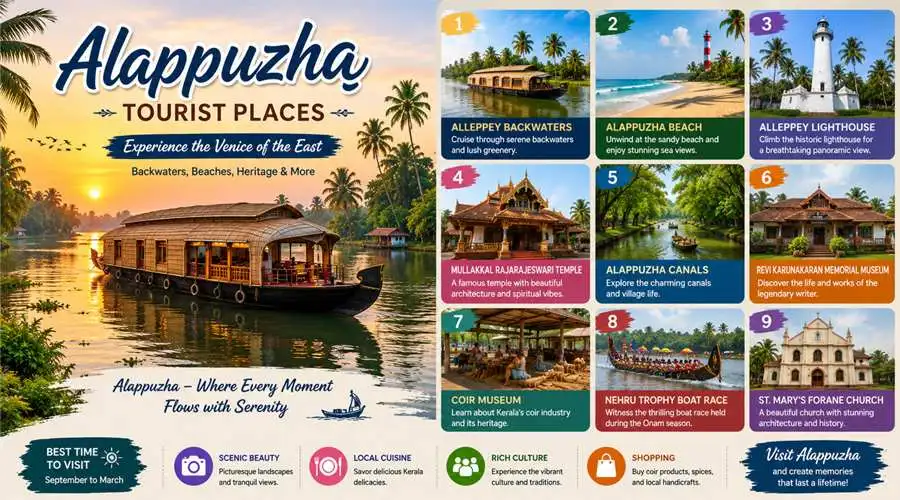
There is a reason Alappuzha — known across the world as Alleppey — has been called the Venice of the East. It is not just a poetic flourish. The city and its surroundings are genuinely threaded through with an extraordinary network of canals, lakes, rivers, and lagoons that have shaped the way its people live, work, travel, and celebrate for over a thousand years. Add to this a coastline of unhurried beaches, a clutch of colonial-era heritage buildings, ancient temples, and one of India’s most beloved boat races, and you begin to understand why Alappuzha is not merely a destination — it is an experience that stays with you long after you have left.
Located in the heart of Kerala’s coastal belt, about 65 kilometres north of Kollam and 60 kilometres south of Kochi, Alappuzha is one of the most accessible yet most rewarding places in the entire state. Whether you arrive by road, rail, or boat, the city welcomes you with an immediacy and warmth that is distinctly Keralite. Here is a comprehensive guide to the best tourist places in Alappuzha — its backwaters, beaches, and heritage sites — that deserve a place on every thoughtful traveller’s itinerary.
The Backwaters: Soul of Alappuzha
Alleppey Backwaters and Houseboat Cruises
The backwaters of Alappuzha are the defining experience of any visit, and a houseboat cruise is the ideal way to absorb them. These traditional kettuvallam houseboats — once used to transport rice and spices across the waterways — have been beautifully converted into floating accommodation with bedrooms, sit-out decks, dining areas, and sometimes even air-conditioning. Cruising through the narrow canals and open stretches of Vembanad Lake at a gentle pace, watching coconut palms reflected in still water, fishermen casting their nets at dawn, and village life unfolding on the narrow strips of land between canals, is an experience of rare tranquillity.
Most houseboat operators offer overnight stays that include meals prepared fresh on board — typically a Kerala sadya with fish curry, coconut chutneys, and appam. The stretch between Alappuzha town and Kumarakom is one of the most popular routes, but shorter day cruises along the village canals offer equally intimate glimpses of backwater life without the premium price of an overnight journey.
Vembanad Lake
Vembanad is the longest lake in India and the largest in Kerala, stretching across three districts and serving as the central artery of the entire backwater system. At Alappuzha, the lake opens into a vast shimmering expanse that is particularly beautiful at sunrise and sunset when the water turns gold and the silhouettes of Chinese fishing nets and distant boats create an almost painterly composition.
Vembanad is also the venue for the famous Nehru Trophy Boat Race — held on the second Saturday of August every year — where massive snake boats (chundan vallams) manned by over a hundred rowers each race in formation to the rhythmic beats of vanchipattu, the traditional boatman’s song. The race draws tens of thousands of spectators and is one of the most electrifying sporting and cultural spectacles in India.
Kuttanad — The Rice Bowl Below Sea Level
South of Alappuzha lies Kuttanad, the only place in India where farming is done below sea level. Known as the Rice Bowl of Kerala, this extraordinary agricultural landscape is a mosaic of paddy fields, canals, and embankments that have been maintained by generations of farmers using an intricate system of bunds and pumps. A country boat ride through Kuttanad’s narrow waterways — past flooded paddy fields, simple wooden churches, and stilted houses — offers an intimate look at a way of life that is both ancient and quietly resilient.
Punnamada Lake and the Finishing Point
Punnamada Lake, just outside Alappuzha town, is where the Nehru Trophy Boat Race reaches its climax. Even outside the racing season, the lake is a beautiful place for a quiet early morning boat ride, with mist rising off the water and birds — herons, kingfishers, and cormorants — working the shallows. The finishing point area has a pleasant walkway and is a popular local gathering spot in the evenings.
The Beaches: Quiet Coastline, Unhurried Pace
Alappuzha Beach
Alappuzha Beach is the most central and accessible beach in the district — a long, wide stretch of coastline with dark golden sand that sits just a short walk from the town’s main canal area. The beach is anchored by the old Alappuzha Pier, a Victorian-era structure that extends into the sea and has become one of the most photographed landmarks in Kerala. At 137 years old, the pier carries the grace of the colonial era alongside the salt and rust of decades of coastal weather.
The beach is busiest in the evenings when locals gather to walk, buy snacks from beachside vendors, and watch the sun sink into the Arabian Sea. A heritage park near the beachfront and the old lighthouse complex add to the area’s historical character.
Marari Beach
About 11 kilometres north of Alappuzha town, Marari Beach is everything the more commercialised Kerala beaches are not — quiet, clean, relatively uncrowded, and lined with the nets and boats of an active fishing community. The village of Mararikulam, which gives the beach its name, is a working fishing settlement where daily life continues largely independent of tourist footfall. Walking along the beach at low tide, past colourful fishing boats and drying nets, while local women sort the morning catch nearby, gives Marari a genuinely authentic character.
Marari has become increasingly popular with travellers seeking a slower, more restorative coastal experience, and several high-quality eco-resorts and Ayurvedic retreat centres have established themselves here without disrupting the essential quietude of the place.
Arthungal Beach
South of Alappuzha, Arthungal Beach is a lesser-known but deeply atmospheric stretch of coastline adjacent to the famous St. Andrew’s Basilica — one of the oldest and most venerated Catholic churches in Kerala, dating to 1581. The annual feast of St. Sebastian held here in January draws hundreds of thousands of pilgrims from across India, making it one of the largest Christian pilgrimages in the country. Outside the feast season, the beach is serene and the basilica is a beautiful, peaceful space worth visiting on its own merits.
Heritage Sites: Layers of History
Alappuzha Lighthouse
Standing near the beachfront in the heart of the town, the Alappuzha Lighthouse is one of the most recognisable landmarks in the district. Built during the colonial era and still operational, the lighthouse is open to visitors in the afternoons and the climb to the top rewards with panoramic views of the coastline, the town’s canal network, and the Arabian Sea stretching to the horizon. It is an ideal vantage point to appreciate the geography that has shaped Alappuzha’s identity.
Krishnapuram Palace
About 47 kilometres south of Alappuzha near Kayamkulam, Krishnapuram Palace is a beautifully preserved example of the Kerala style of palace architecture — a double-storied laterite structure with sloping tiled roofs, gabled windows, and a central courtyard. Built in the 18th century by the Travancore king Marthanda Varma, the palace today functions as a museum housing a notable collection of antiques, sculptures, and paintings. The star exhibit is a 14-feet long mural painting called the Gajendra Moksham — considered one of the largest mural paintings in Kerala — depicting the liberation of the elephant king as described in the Bhagavata Purana.
Revi Karunakaran Museum and Gardens
One of Alappuzha’s more unique heritage attractions, the Revi Karunakaran Museum is a private collection housed in a heritage mansion near the town centre. The museum displays an eclectic and fascinating assemblage — antique furniture, Belgian crystal glassware, ivory artefacts, bronze sculptures, and a remarkable collection of vintage toys and mechanical objects. The surrounding garden is lush and maintained with care. The combination of personal history, artistic taste, and architectural character makes this one of the more memorable museum visits in Kerala.
St. Mary’s Forane Church, Champakulam
Deep in the backwaters of Kuttanad, accessible by boat or a scenic backroad, Champakulam is home to one of the oldest churches in India. The St. Mary’s Forane Church is believed to have been established in 427 AD, making it a site of extraordinary antiquity. The current structure dates to a later reconstruction, but the church’s history, its setting among the canals, and the community that has worshipped here for sixteen centuries make it a profoundly moving heritage experience.
Champakulam is also famous for hosting the oldest boat race in Kerala — the Champakulam Moolam Boat Race — held annually in June or July, significantly predating even the Nehru Trophy and offering a more traditional and intimate racing experience.
Pathiramanal Island
Sitting in the middle of Vembanad Lake, accessible only by boat, Pathiramanal is a small, densely forested island whose name translates to “sands of the midnight.” The island is a recognised bird sanctuary and hosts over 50 species of rare migratory birds between November and February. Walking through its shaded interior while the lake sparkles on all sides gives Pathiramanal a quality of gentle enchantment that is difficult to replicate anywhere else in the backwaters.
Getting There and Travel Tips
Alappuzha is well connected by road and rail to Kochi (approximately 1.5 hours), Thiruvananthapuram (approximately 3 hours), and Kollam (approximately 1.5 hours). The most scenic approach, however, is by public ferry from Kochi via the backwaters — an eight-hour journey that is an attraction in its own right and one of the great bargain travel experiences in India.
The best time to visit is between October and March when temperatures are comfortable and the monsoon has cleared. August visitors are rewarded with the Nehru Trophy Boat Race, while June and July bring the Champakulam Boat Race. Wherever you go in Alappuzha, the pace is deliberately gentle — and surrendering to that pace is the surest way to understand what makes this city so universally beloved.