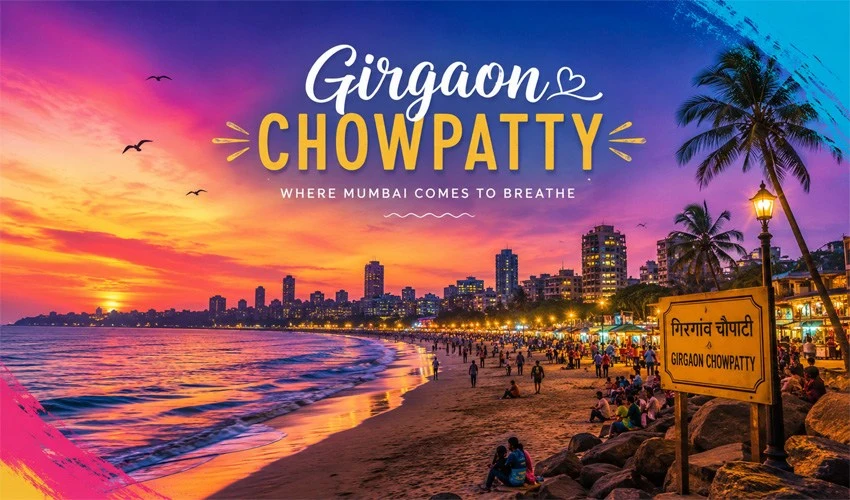
Mumbai’s Girgaon Chowpatty is one of those places that appears on every tourist itinerary, photographed a thousand times at sunset, and mentioned in nearly every travel blog about the city. Yet beneath its surface-level fame as a beach for evening strolls and bhel puri lies a far richer, more layered story. Most visitors arrive, take a few photographs, sample some street food, and leave without ever discovering the historical depth, cultural significance, and quieter rhythms that make this stretch of sand one of Mumbai’s most fascinating urban spaces. This article goes beyond the postcard image of Girgaon Chowpatty to uncover what most tourists simply never learn.
It’s Not Actually Mumbai’s Most Swimmable Beach (And Never Was)
Many first-time visitors assume that Chowpatty, like beaches elsewhere in the world, is a place for swimming. In reality, the waters here have long been considered unsafe for swimming due to pollution, strong undercurrents, and the general unsuitability of the Arabian Sea coastline at this particular stretch for recreational bathing. Locals have known this for generations, which is why Chowpatty has always functioned less as a swimming beach and more as a social and cultural gathering space. The sand is for walking, sitting, eating, and watching the city unwind, not for taking a dip. Tourists who arrive expecting a tropical beach experience are often surprised to find that the beach’s true purpose is communal rather than recreational.
The Name Itself Tells a Forgotten Story
“Chowpatty” is derived from the Marathi word “chowpati,” which loosely translates to a place where four paths or roads converge, or alternatively relates to the term for a flat, open ground near water. Girgaon, meanwhile, refers to the surrounding neighborhood, historically one of the oldest and most culturally significant residential areas of Mumbai, home to a strong Maharashtrian community and numerous heritage buildings, wadas (traditional courtyard housing), and old-world charm that predates much of Mumbai’s modern skyline. Most tourists never venture beyond the beach itself into Girgaon’s narrow lanes, missing an opportunity to see a side of Mumbai that feels worlds apart from the glass towers of South Mumbai or the bustle of Bandra.
A Beach With a Revolutionary Political History
Few visitors realize that Girgaon Chowpatty has served as a stage for some of India’s most significant political movements. During the freedom struggle, the beach was used as a venue for public gatherings, protests, and speeches by leaders of the Indian independence movement. Mahatma Gandhi himself addressed crowds here, and the beach became symbolically associated with civil disobedience and mass mobilization. The open sands provided ample space for the kind of large public assemblies that colonial authorities found difficult to control, making Chowpatty a natural choice for political organizing.
This history continued well into post-independence India, with the beach periodically hosting political rallies, public demonstrations, and civic gatherings. For a place now associated primarily with leisure and snacking, Chowpatty’s political past as a site of resistance and mass expression is largely invisible to the casual tourist, who has no way of knowing, simply by looking at the sand, that monumental moments in India’s history unfolded right there.
The Ganesh Visarjan Connection Most Visitors Miss the Significance Of
Many tourists who happen to visit Mumbai during the Ganesh Chaturthi festival witness the spectacle of idol immersions at Chowpatty, but few understand the full scale and emotional weight of what they’re witnessing. Girgaon Chowpatty is one of the most significant sites in Mumbai for the immersion (visarjan) of Ganesh idols at the conclusion of the ten-day festival. Hundreds of thousands of devotees converge on this beach, carrying elaborately decorated idols, some towering many feet tall, accompanied by music, dancing, and fervent devotion, to bid farewell to Lord Ganesha as the idols are ceremonially immersed in the sea.
What tourists often don’t realize is the sheer logistical and emotional magnitude of this event. The Mumbai police and municipal authorities deploy massive resources for crowd control, safety, and environmental management during this period, given that millions of people pass through the city’s various immersion points, with Chowpatty being among the busiest. For Mumbaikars, this is not simply a festival but an emotional culmination of community devotion built over ten days, and witnessing it without understanding this context means missing the true significance of what’s happening on the sand.
The Famous Bhel Puri Isn’t Just Street Food, It’s a Cultural Institution
Tourists flock to Chowpatty for its famous street food, particularly bhel puri, pani puri, and sev puri, often treating it as just another item to check off a food list. What they may not realize is that Chowpatty’s street food culture has its own distinct history and is considered by many food historians to be one of the originating hubs of Mumbai’s now globally recognized chaat culture. Vendors here have, in many cases, been serving the same recipes for generations, passed down through families who have operated stalls on this beach for decades.
The famous “Chowpatty bhel puri” carries a certain cultural cachet within Mumbai itself, distinct from bhel puri found elsewhere in the city. Locals often have strong opinions about which specific stalls serve the most authentic or best-tasting version, debates that tourists, unaware of this nuanced food culture, typically miss entirely. Additionally, hygiene standards have improved significantly over recent years due to municipal regulations, something that older visitors who experienced Chowpatty decades ago might be pleasantly surprised to discover.
The Beach Has Its Own Micro-Economy of Performers and Vendors
Beyond food stalls, Chowpatty hosts an entire ecosystem of small entrepreneurs, performers, and service providers that most tourists glance past without a second thought. Henna artists, balloon sellers, photographers offering instant prints, masseurs offering beachside head and shoulder massages, and even individuals who bring small ponies for children to ride all contribute to a unique informal economy that has existed on this beach for generations. Many of these vendors and service providers are multi-generational workers, having inherited their trade and their specific spot on the beach from parents or grandparents.
This informal economy reflects a broader story about urban livelihoods in Mumbai, where public spaces like Chowpatty serve as crucial sites for informal employment, particularly for migrants and working-class families who may not have access to formal employment opportunities elsewhere in the city.
It’s a Prime Spot for People-Watching Mumbai’s Social Fabric
What separates Chowpatty from many other tourist beaches worldwide is its function as a genuine cross-section of Mumbai society. Unlike beaches that might cater predominantly to a particular demographic, Chowpatty in the evenings draws an extraordinarily diverse crowd, families from nearby Girgaon, young couples seeking a rare moment of semi-privacy in a crowded city, college students, elderly residents on their evening walks, and visiting tourists, all sharing the same stretch of sand. Observing this convergence offers genuine insight into Mumbai’s social dynamics that few curated tourist experiences can replicate.
The beach essentially functions as Mumbai’s collective living room, a place where the city’s residents, regardless of background, come to unwind after the relentless pace of daily urban life. Tourists who simply pass through quickly, treating it as a brief photo stop, miss this deeper social function that makes Chowpatty genuinely significant to the people who call Mumbai home.
Sunset Timing and Crowd Patterns Most Visitors Get Wrong
Many tourists arrive at Chowpatty expecting a quiet sunset experience, only to find it more crowded than anticipated, simply because they’re unaware of the beach’s actual peak hours. The busiest period is typically early evening, particularly on weekends, when local families arrive en masse. Visitors seeking a quieter, more contemplative experience are often better served by visiting in the late afternoon before the evening rush, or alternatively during early morning hours, when the beach takes on an entirely different, more peaceful character, with joggers, walkers, and a handful of early vendors setting up for the day.
Environmental Efforts Tourists Rarely Notice
In recent years, significant environmental clean-up initiatives have targeted Chowpatty, addressing issues related to plastic pollution, particularly in the aftermath of festival seasons like Ganesh Chaturthi. Various civic groups, NGOs, and municipal bodies have undertaken beach clean-up drives, and there has been a growing push toward eco-friendly idol immersions to reduce the environmental impact on the coastline. Tourists visiting today are walking on a beach that has undergone considerable environmental rehabilitation compared to previous decades, an effort that goes largely unnoticed by those unfamiliar with the area’s recent history.
Conclusion
Girgaon Chowpatty is far more than a scenic backdrop for sunset photographs and a quick snack of bhel puri. It is a living archive of Mumbai’s political history, religious devotion, culinary tradition, and social fabric, layered over decades of urban life. For tourists willing to look beyond the surface, the beach offers a genuine window into the city’s soul, one that most visitors, rushing between checklist attractions, never get the chance to truly see. The next time you find yourself walking along Chowpatty’s sands, take a moment to consider everything that has unfolded there, the speeches, the celebrations, the generations of vendors, and the millions of quiet evenings shared by ordinary Mumbaikars, and you’ll understand why this beach remains so deeply woven into the identity of the city.