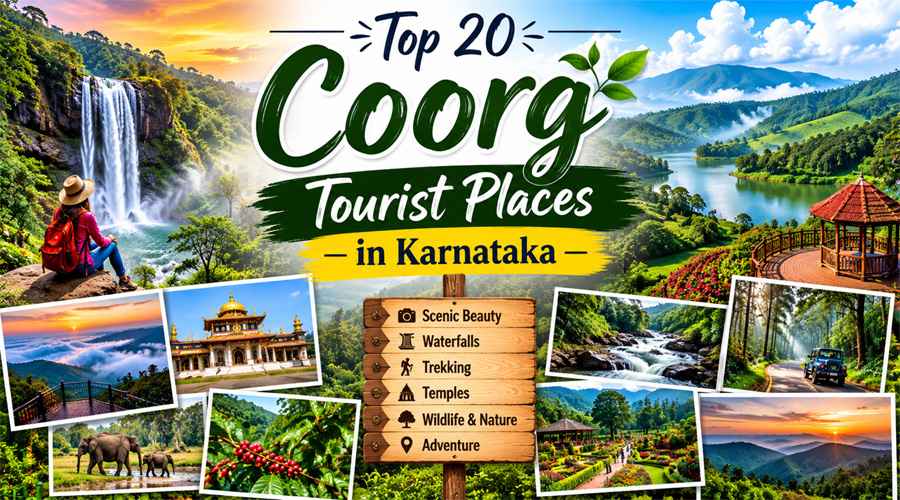
Tucked away in the Western Ghats of Karnataka, Coorg — officially known as Kodagu — is one of South India’s most enchanting hill destinations. Blanketed in coffee and spice plantations, threaded with silver rivers, and crowned with misty peaks, Coorg seduces every traveller who sets foot in it. The air smells of cardamom and rain-washed earth; the mornings unfold in layers of fog; the evenings shimmer with fireflies over paddy fields. Known fondly as the Scotland of India, Coorg is a destination that rewards slow exploration.
Whether you seek waterfalls, wildlife, heritage temples, or simply the meditative silence of a plantation bungalow, Coorg has something extraordinary waiting. Here is a carefully curated guide to the top 20 tourist places in Coorg that every visitor must explore.
1. Abbey Falls
One of Coorg’s most iconic landmarks, Abbey Falls plunges approximately 70 feet into a rocky gorge surrounded by coffee and spice estates. The walk to the falls winds through a lush, shaded trail, and the roar of the water grows louder with every step. The best time to visit is between June and September when the monsoon swells the falls to a dramatic torrent. A hanging bridge near the falls offers a thrilling vantage point.
2. Raja’s Seat
Perched in Madikeri town, Raja’s Seat — literally “the seat of kings” — is a garden terrace from which the Kodava kings once watched the sunset over the valleys below. Today it remains one of the most romantic sunset viewpoints in Karnataka, with manicured gardens, colourful flower beds, and a toy train that delights children. The panoramic view of rolling mist-covered hills at dusk is unforgettable.
3. Dubare Elephant Camp
Located on the banks of the Cauvery River near Kushalnagar, Dubare Elephant Camp is a forest department facility where elephants used for temple rituals are housed and trained. Visitors can bathe, feed, and interact with these gentle giants under the supervision of trained mahouts. The camp is most active in the morning hours and offers a rare, responsible wildlife experience that is deeply moving for families and nature lovers alike.
4. Nagarhole National Park
Also known as Rajiv Gandhi National Park, Nagarhole is one of India’s premier tiger reserves, stretching across Kodagu and Mysore districts. Dense deciduous forests shelter tigers, leopards, Indian elephants, gaur, wild dogs, and an extraordinary diversity of birds. Jeep safaris at dawn and dusk offer the best chance of wildlife sightings. The Kabini River flowing through the park creates a hauntingly beautiful landscape, particularly during the dry season when animals gather at the water’s edge.
5. Talacauvery
Talacauvery, the sacred birthplace of the River Cauvery, sits at an altitude of 1,276 metres in the Brahmagiri Hills. A holy tank marks the precise spot where the river is said to spring from the earth. The site is of immense religious significance, drawing pilgrims year-round. A short but steep trek leads to the Brahmagiri Peak, offering sweeping views over Karnataka and Kerala on clear days. The Talacauvery temple complex, dedicated to Goddess Cauvery, adds a deeply spiritual dimension to the visit.
6. Madikeri Fort
Situated in the heart of Madikeri town, this historic fort was originally built in mud by Mudduraja in the 17th century and later reconstructed in stone by Tipu Sultan. The fort houses a palace, a church, a prison, and a small museum that displays artefacts from the Kodava kingdom. Cannons still stand at the fort’s ramparts. The views from the fort walls across Madikeri town and the surrounding valleys make it a compelling stop for history enthusiasts.
7. Iruppu Falls
Cascading from the Brahmagiri Range, Iruppu Falls (also called Lakshmana Tirtha Falls) is both a natural wonder and a sacred pilgrimage site. The waters of the Lakshmana Tirtha River tumble down in two tiers through a forested gorge. The surrounding Brahmagiri Wildlife Sanctuary is home to rare orchids, dense shola forests, and diverse wildlife. A small Rama temple near the falls makes this a spiritually significant destination, especially during Shivaratri when thousands of devotees gather here.
8. Harangi Dam
The Harangi Dam, built across the Harangi River near Kushalnagar, is a major irrigation reservoir that also doubles as a scenic picnic destination. The vast backwaters of the reservoir reflect the surrounding hills, and the surrounding greenery makes it ideal for quiet evening visits. A garden maintained near the dam adds to the recreational appeal. Bird watchers find the reservoir edges productive, particularly for migratory waterfowl.
9. Omkareswara Temple, Madikeri
This unique temple in Madikeri town is a fascinating example of architectural fusion — the main structure blends Islamic and Gothic styles with traditional Kerala-style elements, a legacy of Lingarajendra Wodeyar II who built it in 1820. Dedicated to Lord Shiva, the temple sits beside a sacred tank and is surrounded by remarkably peaceful gardens. The architectural curiosity of the building makes it a must-visit even for those who don’t prioritise religious sites.
10. Bylakuppe
The largest Tibetan settlement in India outside Tibet, Bylakuppe near Kushalnagar is a remarkable cultural enclave that transports visitors across continents in an instant. The golden-roofed Namdroling Monastery — known as the Golden Temple — is the settlement’s crown jewel, its interiors adorned with massive gilded Buddha statues and vibrant murals. The settlement has its own monasteries, schools, hospitals, and markets, offering an immersive experience of Tibetan culture in the heart of Karnataka.
11. Nisargadhama
A small island formed by the Cauvery River near Kushalnagar, Nisargadhama is a forest department eco-tourism park dense with bamboo groves and towering trees. Bamboo cottages, elephant rides, a deer park, and rope bridges across the river make it a family favourite. The island’s atmosphere — birdsong, rustling bamboo, river breeze — has a restorative quality that lingers long after departure.
12. Mandalpatti Peak
For those who seek adventure beyond the well-worn tourist trail, Mandalpatti Peak is a revelation. Accessible by jeep from Madikeri and a short hike, this rugged peak sits amid the Pushpagiri Wildlife Sanctuary at around 1,400 metres above sea level. On clear mornings the summit offers a sea of clouds rolling between forested ridges — one of the most photogenic sights in all of Coorg. The drive itself, through jungle tracks and grasslands, is exhilarating.
13. Chelavara Falls
Located off the Kutta-Gonikoppal road, Chelavara Falls is a hidden gem that rewards those willing to venture off the beaten path. The waterfall drops from a considerable height into a deep pool, surrounded by pristine forest. Unlike the more commercialised falls in Coorg, Chelavara retains a sense of genuine wilderness and solitude, making it a favourite for photographers and trekkers.
14. Brahmagiri Wildlife Sanctuary
Straddling the border of Karnataka and Kerala, the Brahmagiri Wildlife Sanctuary is a biodiversity hotspot within the Nilgiri Biosphere Reserve. Elephants, gaur, sambar deer, lion-tailed macaques, Malabar giant squirrels, and rare birds including the Sri Lanka Frogmouth inhabit its dense forests. Trekking trails through the sanctuary pass through pristine shola grasslands and cloud forests, offering an immersive wilderness experience far from tourist crowds.
15. Pushpagiri Wildlife Sanctuary
One of Coorg’s lesser-explored protected areas, Pushpagiri Wildlife Sanctuary encompasses the Pushpagiri Peak and surrounding forests in the Somwarpet range. The sanctuary is a haven for endemic species of flora and fauna, particularly butterflies and birds. Trekkers and naturalists find it rewarding precisely because it lacks the infrastructure and crowds of more popular parks — here, nature exists entirely on its own terms.
16. Nalknad Palace
Hidden amidst coffee estates near Kakkabe village, the Nalknad Palace is a historic hunting lodge built by Kodava king Doddaviraraja in 1792. The modest palace served as a retreat during royal hunting expeditions and later housed the Kodava royal family. Today it is maintained by the Karnataka government and offers a glimpse into royal domestic life far removed from the pomp of the larger palaces of South India.
17. Tadiandamol Peak
The highest peak in Coorg at 1,748 metres, Tadiandamol is a trekker’s paradise near Kakkabe. The trail winds through forests, rolling grasslands, and past a small lake before opening onto the summit’s sweeping panorama. On exceptionally clear days, the view extends to the plains of Kerala. The trek is moderate in difficulty and takes approximately 4–5 hours return — making it accessible even to those without extensive trekking experience.
18. Cherangala Viewpoint
A quieter alternative to Raja’s Seat, the Cherangala Viewpoint near Virajpet offers unobstructed views of the Brahmagiri Range and the valleys stretching toward the Kerala border. The site is far less crowded than Madikeri’s popular viewpoints, making it ideal for those who prefer their sunsets without company.
19. Coffee Plantation Tours
No visit to Coorg is complete without a walk through one of its legendary coffee and spice estates. Dozens of homestays and plantation resorts offer guided tours where visitors learn about the coffee cultivation process from seedling to cup — the planting, the harvesting, the pulping, and the drying. These tours, which typically include cardamom, pepper, and vanilla gardens, culminate in a freshly brewed cup of estate coffee that no urban café can replicate.
20. Cauvery Nisargadhama and White Water Rafting on Barapole River
For the adventure-seeking traveller, the Barapole River near Kutta offers one of South India’s best white-water rafting experiences. The rapids through the forested gorge are graded at levels II to IV, making the experience thrilling yet manageable for beginners with a guide. The surrounding forests, waterfalls, and pristine river scenery make the rafting journey as visually memorable as it is adrenaline-charged.
Best Time to Visit Coorg
Coorg is a year-round destination, but each season brings a different character. October to March is the most popular period, with cool, clear days perfect for sightseeing and trekking. April and May see the coffee blossom season — when white jasmine-scented flowers carpet the estates in a brief, magical bloom. June to September is monsoon season: waterfalls are at their most spectacular, the landscape turns an impossibly vivid green, and the mist descends in thick, romantic curtains — ideal for those who love moody, atmospheric travel.
How to Reach Coorg
Coorg has no airport or railway station of its own. The nearest airport is Kannur International Airport (Kerala, ~100 km) or Mangalore International Airport (~135 km), while Mysore (~95 km) is the nearest major railway junction. From these points, well-connected road networks lead into Kodagu, with regular bus services and taxis available.
Coorg is not merely a destination — it is a state of mind. From the thunder of Abbey Falls to the golden silence of Bylakuppe’s monasteries, from the wild corridors of Nagarhole to the misty summit of Tadiandamol, every corner of Kodagu tells a story older and deeper than tourism. Come with curiosity, leave with wonder, and return — as almost everyone does — drawn back by something you cannot quite name.