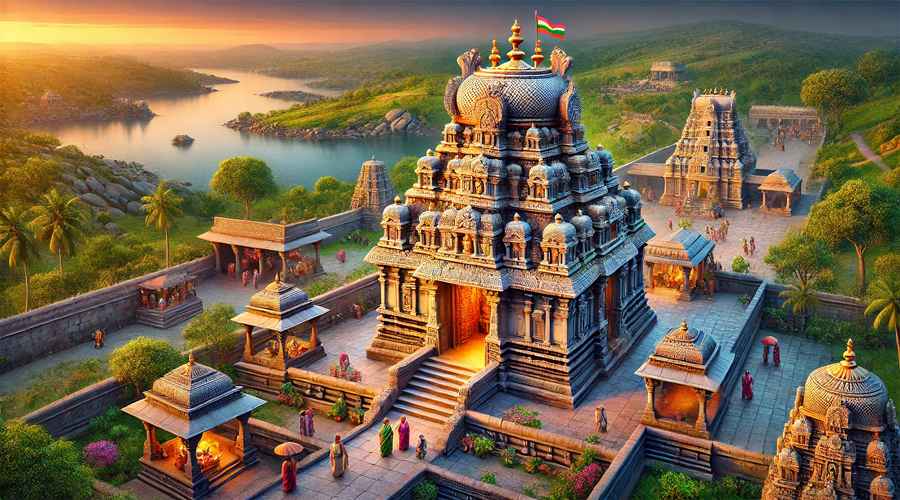
Among the many splendid monuments of the Chola dynasty, The Dhenupureeswarar Temple at Madambakkam stands out as a distinctive example of Dravidian temple architecture. Built in the mid-10th century during the reign of Parantaka Chola II, this temple reflects the artistic ingenuity of early Chola builders while also showcasing features rare or unusual among its contemporaries.
A Temple Rooted in Legend and Devotion
The temple is dedicated to Lord Shiva as Dhenupureeswarar and his consort Parvati as Dhenukambal. Local legend tells of a cow that offered milk to a buried Shiva linga until worshippers discovered the site, leading to the temple’s rediscovery and renovation in more recent centuries.
While such mythological associations are common in South Indian sacred geography, the architectural embodiment of this legend in sacred form adds depth to the temple’s spiritual and structural narrative.
The Apsidal Sanctum: A Rare Chola Feature
The most striking and architecturally unique feature of the Dhenupureeswarar Temple is its apsidal sanctum or gajaprishta vimana—a sanctum shaped like the back of a sleeping elephant. In Sanskrit this apsidal form is referred to as gajaprishta. Unlike the typical square or rectangular sancta that dominate Chola temples, this curved rear profile gives the shrine a semi-circular or horseshoe shape, imparting a distinctive silhouette to the shrine.
This architectural form likely has roots in earlier Dravidian traditions and reflects continuity with pre-Chola temple styles. While a few temples from the period around Chennai share this feature, it remains a relative rarity in the broader corpus of Chola temple architecture, where symmetrical, orthogonal planning was more common.
Minimalist Entrance and Monumental Focus
Unlike many Chola temples that are celebrated for their monumental gateways, the Dhenupureeswarar Temple’s entrance is simple and modest. It lacks a towering rajagopuram, which only became a defining element of later South Indian temple architecture. Instead, the temple presents a mottai gopuram (a low, incomplete tower) and an eastern entrance that leads directly into the sacred precinct.
This simplicity may reflect the temple’s early date within the Chola period, before the emergence of towering gopurams as focal points, or it could indicate regional stylistic preferences. The absence of a dominating gateway refocuses the visitor’s attention on the sanctum itself, emphasizing the sacred core over grand entrances—a philosophical nuance in spatial planning not always foregrounded in other Chola complexes.
Spatial Layout and Pillared Mandapas
Once inside, visitors encounter a sequence of mandapas (pillared halls) that guide movement and ritual practice. Immediately before the sanctum lies an ardha mandapa, followed by a larger maha mandapa that extends toward the outer precinct. These halls are supported by granite pillars carved with intricate motifs and figures.
A notable architectural highlight is the 18-pillared kalyana mandapa—a hall traditionally used for celestial weddings and community gatherings. Each pillar is an artistic canvas featuring delicate carvings of Shaiva and Vaishnava deities, reflecting both religious inclusivity and the high standard of stone craftsmanship that would later be perfected in larger Chola temples.
Rich Sculptural Program
Despite its relatively modest scale compared to imperial Chola temples such as the Brihadeeswarar Temple at Thanjavur, Dhenupureeswarar Temple is richly adorned with sculptures. The temple precinct houses over 140 finely executed stone sculptures, many depicting stories from the Shaivite and Vaishnavite traditions.
One particularly revered sculpture is that of Sarabeshwara, a fierce form of Shiva believed to subdue unruly cosmic forces. Sculptural panels in the mandapams and on the pillars narrate mythological episodes and showcase the talents of artisans spanning eras, especially contributions from the later Vijayanagara period, which added new layers to the temple’s visual narrative.
Material and Craftsmanship
Like its Chola contemporaries, the temple is constructed primarily of granite—an enduring choice that enabled fine detailing and longevity. The use of locally sourced stone and traditional dry-stacked masonry techniques demonstrates the robust construction practices of medieval South India.
The sacred linga itself—a self-manifested stone icon—bears a scar said to have been made by a cow’s hoof, weaving the temple’s founding legend into its very form.
Integration of Later Influences
While the temple’s core is unmistakably Chola in origin, later expansions by Kulothunga Chola I and the Vijayanagara rulers introduced additional mandapas and sculptural elements. These later additions enrich the temple’s architectural palimpsest, making the complex a chronicle of evolving South Indian temple styles.
A Unique Architectural Identity
In summary, the architectural uniqueness of the Dhenupureeswarar Temple among Chola temples lies in the combination of its apsidal sanctum, modest entryway, rich sculptural detailing, and harmonious spatial sequence. While many Chola temples are renowned for their towering vimanas and grand scale, this temple’s strengths are its elegant structural simplicity, regional stylistic distinctiveness, and layered aesthetic accumulated over centuries.
These features make the Dhenupureeswarar Temple a compelling study in early medieval South Indian architecture—a site where legend, artistry, and ritual converge in stone.