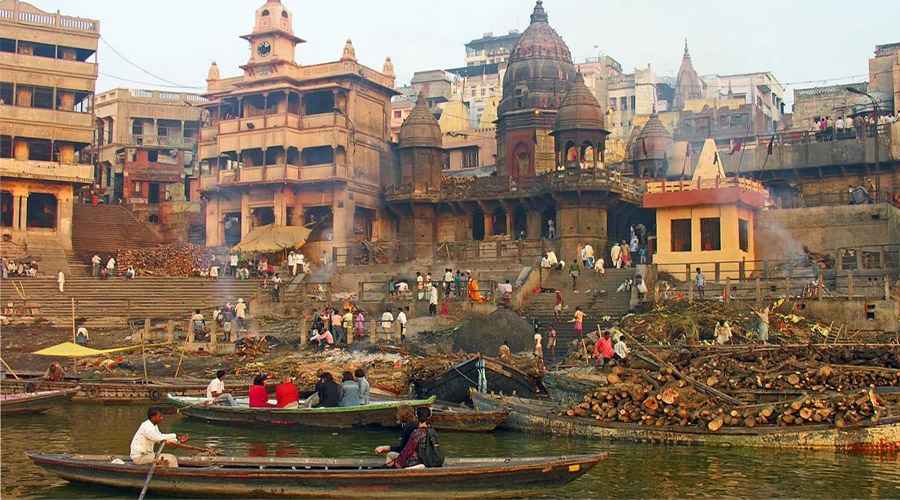
Manikarnika Ghat is the holiest cremation ground in Varanasi, India, revered deeply in Hindu belief as the gateway to moksha, liberation from the endless cycle of birth and death (samsara). According to ancient Hindu mythology and Puranic lore, Manikarnika Ghat is not merely a physical site for cremation but a sacred arena where the soul achieves ultimate freedom. It is believed that undergoing the last rites here ensures that the soul is delivered from the bondage of karma and rebirth, fulfilling a spiritual promise made by Lord Shiva himself. This article explores the mythological origins, spiritual significance, and ritual practices that make Manikarnika Ghat the paramount place for final rites in Hinduism.
Mythological Origins and Sacred Legends
Manikarnika Ghat’s sanctity is richly intertwined with mythological narratives. Legend has it that the ghat derives its name from an event involving Lord Shiva and Lord Vishnu. Vishnu, in an act of devotion, created a sacred pond (kund) with his discus weapon, Sudarshana Chakra, and offered his own sweat to Lord Shiva. Pleased with this devotion, Shiva’s earring (manikarna) fell into this kund, sanctifying the pool that came to be known as the Manikarnika Kund or Chakrapushkarini Tirtha. Shiva then promised that anyone who bathed here and died at Manikarnika Ghat would attain moksha, marking the ghat as an Avimukta Kshetra—a place where Shiva never departs. Furthermore, Shiva vowed to personally whisper the Taraka Mantra, the sacred mantra of liberation, into the ears of the deceased souls, ensuring their smooth passage from life to liberation.
These mythological promises have cemented Manikarnika Ghat’s role as a spiritual portal where death is not feared but embraced as a sacred transition. The ghat’s symbolic fire is considered the very fire of Shiva, transcending physical combustion to purify the soul and help it transcend the material world.
The Spiritual Promise of Moksha
Central to Hindu eschatology is the concept of moksha—liberation from samsara, the cycle of birth, death, and rebirth driven by karma. Manikarnika Ghat stands as a unique spiritual magnet because of Shiva’s divine assurance that dying here guarantees liberation. This belief offers profound solace to Hindus and creates a deep-seated cultural pilgrimage tradition where families bring their dying loved ones to Varanasi to pass away and be cremated at Manikarnika.
The continual burning of funeral pyres at the ghat symbolizes the eternal presence of Agni, the fire god, who acts as a divine messenger carrying purified souls. Hindus view cremation here as a sacred sacrifice that releases the soul from earthly ties. The ritualistic practice affirms life’s impermanence and reinforces faith in spiritual continuity beyond death.
Rituals and Practices at Manikarnika Ghat
Manikarnika Ghat is constantly active with the sacred rites of cremation and mourning. The process is marked by meticulous Hindu rituals overseen by priests, involving sacred chants, offerings, and the lighting of funeral pyres. The presence of the holy Ganges river adds further sanctity, as ashes and remains eventually merge with the sacred waters, believed to further purify the soul.
The ghat’s environment, though intense and somber, exudes a paradoxical peace. Pilgrims and locals alike believe that death at Manikarnika is painless and painless and a gift of Shiva’s grace. Families perform last rites with the conviction that this final journey is an auspicious transition, not an end.
Cultural and Historical Significance
Beyond religious beliefs, Manikarnika Ghat is steeped in Indian culture and history. It has been the site for cremations of countless spiritual figures, saints, and lay devotees. Its continuous activity for centuries testifies to its lasting importance in Hindu heritage.
Manikarnika Ghat’s spiritual aura is complemented by the nearby Kashi Vishwanath Temple, reinforcing Varanasi’s status as a major spiritual hub. It attracts pilgrims from across India and the world who seek both to witness and partake in the sacred rites, hoping to secure spiritual merit or moksha for their ancestors.
Broader Symbolism in Hindu Philosophy
In Hinduism, death is not viewed with despair but as a natural and sacred part of the cosmic cycle. Manikarnika Ghat embodies this philosophy by transforming the fear of death into hope for transcendence. It symbolizes the ultimate spiritual goal to which every soul aspires—the release from karmic cycles and union with the divine.
By witnessing the rituals and flames at Manikarnika, devotees are reminded of the impermanence of life and the importance of spiritual awakening. It is a compelling visual and experiential meditation on mortality, dharma (duty), and liberation.
In conclusion, Manikarnika Ghat is much more than a cremation site; it is the quintessential gateway to moksha in Hindu belief. Rooted in mythology and divine promises of Lord Shiva, the ghat offers devotees a pathway to spiritual liberation. Its sacred fire, eternal presence of the holy Ganges, and profound rituals create an environment where death is transformed into a divine passage. For millions of Hindus, Manikarnika Ghat represents hope, faith, and the ultimate spiritual attainment—freedom from the cycle of birth and rebirth.
This sacred space remains an enduring symbol of India’s spiritual depth, drawing devotees seeking liberation and reflecting the timeless Hindu vision of life, death, and beyond. Manikarnika Ghat stands as a profound testament to the belief that through surrender and divine grace, the soul can transcend this world and realize its eternal unity with the divine.